
From the Counsellor’s Chair
High-Functioning ADHD in Women: When Coping Well Doesn’t Mean You’re Doing Well
Centred Counselling & Mediation
There is a particular kind of woman with ADHD who can be incredibly difficult to recognise:
- She gets good grades.
- She holds down a demanding job.
- She remembers her children's appointments.
- She appears organised.
- People describe her as intelligent, capable and responsible.
And yet, privately, she may feel completely overwhelmed.
She may spend hours trying to organise herself, only to become paralysed by the number of things she needs to do. She may procrastinate on relatively simple tasks while being capable of working intensely for hours on something that has captured her attention. She may underestimate how long things will take, forget appointments, lose important items, struggle to prioritise and feel exhausted by the amount of effort required to maintain what appears to everyone else to be a perfectly functioning life.
And this is where one of the biggest misconceptions about ADHD begins:
“But you seem to be coping.”
Sometimes, the person who appears to be coping is actually the person working the hardest to hide how difficult everything feels.
Global research estimates that 2.58% of adults have persistent ADHD, while a broader estimate that includes symptomatic adult ADHD places the figure at 6.76%. In 2020, that equated to an estimated 140 million adults with persistent ADHD worldwide.
ADHD Doesn't Always Look Like Hyperactivity
One reason ADHD can be overlooked in women is that the stereotypical image of ADHD is often based on a highly visible, disruptive presentation:
- A child who cannot sit still.
- A student who constantly interrupts.
- Someone who appears unable to concentrate.
But ADHD is not limited to that presentation.
Inattentive difficulties can be particularly easy to overlook, and girls may develop strategies that compensate for their difficulties without drawing attention to them.
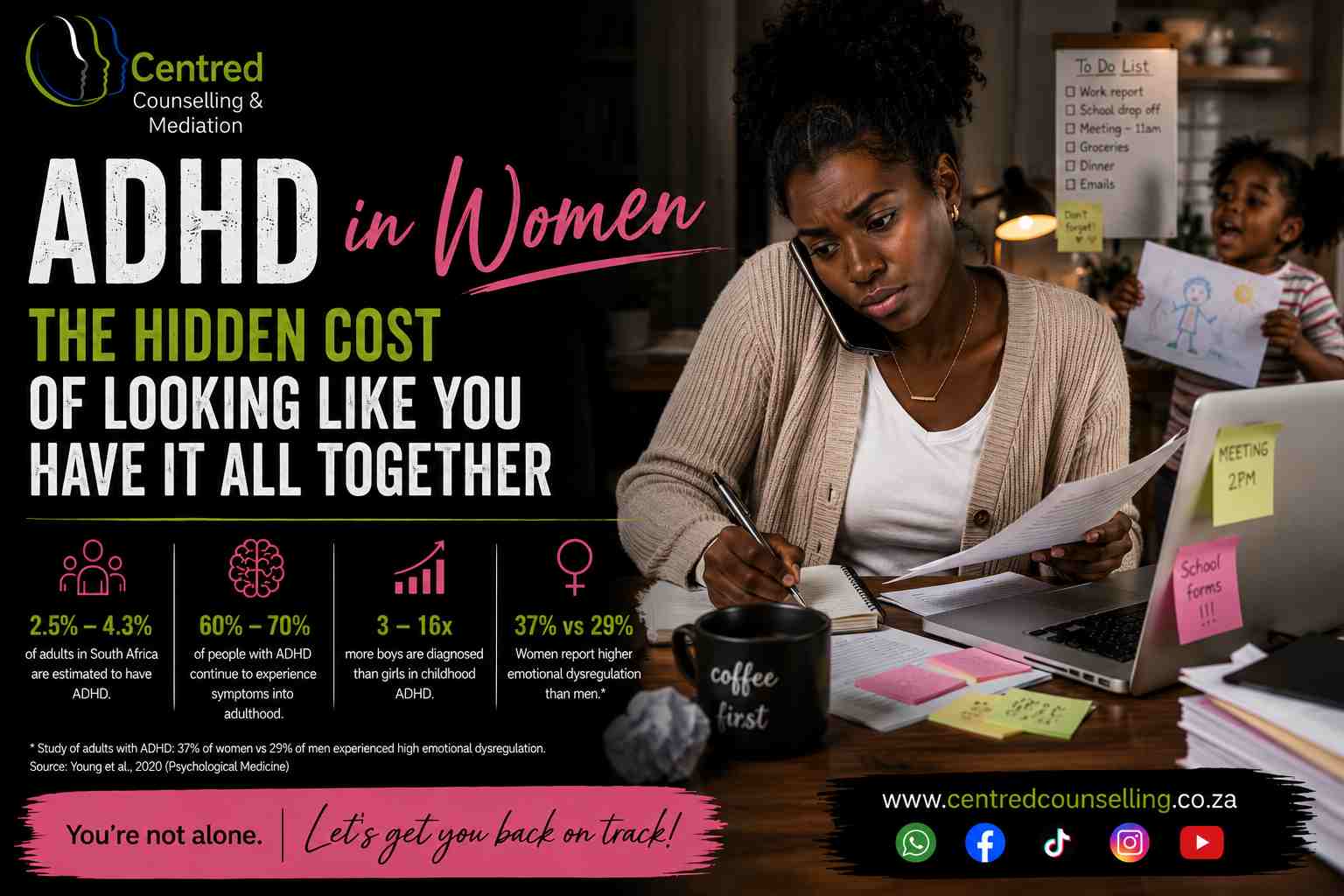
The statistics are revealing. A recent systematic review found that childhood ADHD was diagnosed 7–8 times more frequently in boys than girls, despite population estimates suggesting a male-to-female ratio closer to 3–4:1. That discrepancy is one reason researchers have raised concerns about under-identification and under-diagnosis in girls.
A girl who is quiet, academically capable and compliant may therefore receive a very different interpretation from a boy whose ADHD is more disruptive and visible. She may be described as:
- “Daydreamy.”
- “Forgetful.”
- “Disorganised.”
- “Not applying herself.”
- “Too emotional.”
- “Careless.”
- “Bright but inconsistent.”
The underlying ADHD may never be considered.
Intelligence Can Hide ADHD
One of the most damaging misconceptions is that a highly intelligent woman cannot have ADHD.
She can. In fact, intellectual ability can provide considerable compensation:
- A bright student may complete an assignment at the last minute and still achieve excellent marks.
- A capable university student may pull an all-nighter and perform exceptionally.
- A talented employee may compensate for poor time management by working late.
- A highly driven woman may develop elaborate systems to keep herself organised.
Eventually, however, life becomes more complicated. The workload increases. There are more responsibilities: children, a career, household administration, relationships, finances, appointments, emails, and deadlines.
And suddenly, the strategies that worked at 18 no longer work at 38. This is one reason ADHD can remain hidden for years and become more apparent during adulthood.
The problem was not necessarily that the woman suddenly developed ADHD. The demands of her life simply became greater than her ability to compensate.
The Difference Between Ability and Consistency
This is where I think we need to change the way we talk about ADHD.
A woman with ADHD may be incredibly capable. She may be able to complete an enormous amount of work in a few hours. She may have exceptional problem-solving abilities. She may be creative, perceptive and intellectually gifted. She may even be the person everyone turns to when there is a crisis.
But ADHD isn't necessarily about whether you can do something. It can be about whether you can reliably make yourself do it at the appropriate time, in the appropriate sequence, without an enormous amount of psychological effort.
That is where executive functioning becomes important. And it can be incredibly frustrating. Because the woman herself knows: “I can do this.” She has done it before.
- So why can't she do it today?
- Why can she spend four hours researching something that interests her but cannot answer three emails?
- Why can she reorganise an entire room at midnight but cannot complete a routine administrative task?
- Why can she perform brilliantly under pressure but struggle to begin something when the deadline is still two weeks away?
- Why does she sometimes feel incredibly productive and other times completely paralysed?
This inconsistency can be deeply confusing.
“I'm Lazy” Is Often the Wrong Conclusion
One of the psychological consequences of repeatedly struggling with executive functioning is self-criticism.
- A woman forgets something.
- She promises herself she won't forget it again.
- She forgets something else.
- She misses a deadline.
- She procrastinates.
- She becomes frustrated.
- She works excessively hard to compensate.
- Then she burns out.
And eventually she starts constructing an explanation for herself:
- “I'm lazy.”
- “I'm unreliable.”
- “I'm just terrible at adulting.”
- “I have no discipline.”
- “Why can everyone else manage this?”
But the problem may not be a lack of intelligence, motivation or character. It may be that ADHD is affecting the regulation of attention, task initiation, working memory, prioritisation and time management.
That distinction matters. Because when someone interprets a neurological difficulty as a character flaw, they don't simply experience the original difficulty: they experience shame on top of it.
The Hidden Cost of Masking
Many women with ADHD become extraordinarily good at compensating. They learn to hide their difficulties:
- They watch what other people do and imitate them.
- They create systems.
- They overprepare.
- They overwork.
- They become perfectionistic.
- They may repeatedly check their work because they are terrified of making a mistake.
- They may avoid situations where their difficulties could become visible.
From the outside, this can look like exceptional organisation. Internally, it can feel like constant crisis management.
The woman may look highly functional while operating at maximum psychological capacity. She isn't necessarily thriving: she may simply be coping exceptionally hard.
And this is where the phrase “high-functioning ADHD” can become misleading.
The High-Functioning Trap
“High-functioning ADHD” is commonly used to describe someone who has ADHD but appears to function successfully in everyday life. However, it isn't a formal clinical diagnosis.
The phrase can also obscure an important question: Functioning at what cost?
- A woman may have a successful career while experiencing significant difficulties with organisation.
- She may have a beautiful home while spending enormous amounts of energy maintaining it.
- She may be a wonderful mother while constantly feeling that she is failing.
- She may appear calm while internally experiencing chronic overwhelm.
- She may be praised for being exceptionally capable while privately wondering why everything seems to require so much effort.
So instead of asking: “How well is she functioning?” perhaps we should also ask: “How much does it cost her to function at that level?”
That question can reveal something very different.
This Is Particularly Relevant in South Africa
ADHD is not simply an overseas concern.
South African adult ADHD guidelines estimate adult ADHD prevalence at approximately 2.5%–4.3%, and report that around 60%–70% of people with ADHD continue to experience symptoms into adulthood. South African research has also highlighted challenges around recognition, funding and access to appropriate care.
That means the woman sitting in front of you may not look like someone with ADHD. She may simply look like someone who has spent years becoming exceptionally good at compensating for it.
When the System Finally Collapses
This is why some women seek help after years of apparently successful functioning. Something changes:
- They have a baby.
- They take on a promotion.
- They become responsible for managing a household.
- Their job becomes more demanding.
- They experience burnout.
- Or they enter a period of hormonal change.
Recent research is beginning to highlight the importance of female reproductive stages in understanding ADHD. A 2026 study involving 602 females, including 377 participants with self-reported ADHD, found that women with ADHD reported greater difficulties across several reproductive stages.
Another recent survey found that 70.4% of participants with ADHD or significant ADHD symptoms reported worsening symptoms during the postpartum period, while 97.5% reported worsening during menopause. Among premenopausal participants who were not using hormonal therapy, 88.6% reported changes in ADHD symptoms across the menstrual cycle. These findings were based on self-report, so they should be interpreted cautiously, but they highlight an important area for further research and clinical attention.
And suddenly, the woman who has spent her entire life thinking: “I just need to try harder” begins asking a different question:
“What if trying harder was never the real solution?”
The Woman Who Can Do Everything — But Cannot Do It Consistently
One of the most frustrating experiences for women with ADHD is knowing that they are capable of extraordinary things while struggling with ordinary ones:
- They can manage a crisis but cannot return a phone call.
- They can solve a complicated problem at work but cannot remember where they put their keys.
- They can work intensely for six hours on something fascinating but cannot start a 20-minute administrative task.
- They can produce exceptional results under pressure but struggle enormously with tasks that require sustained, self-directed effort.
This isn't necessarily irrational. ADHD involves difficulties with the regulation of attention and executive functioning, rather than simply an inability to pay attention.
The issue is often not: “Can I concentrate?” It can be: “Can I reliably direct my attention towards the thing I need to do, at the time I need to do it?”
That is a very different problem.
What Happens After Diagnosis?
For some women, recognising ADHD can be an enormous shift in self-understanding. It doesn't magically eliminate the difficulties, but it can change the interpretation of those difficulties.
Instead of: “What's wrong with me?” the question becomes: “What does my brain need in order to function effectively?”
That opens the door to appropriate professional assessment, practical strategies and, where clinically indicated, treatment. It also allows women to stop measuring themselves against an imaginary version of themselves who supposedly should be able to do everything effortlessly.
The goal isn't to become someone without ADHD. The goal is to understand how your ADHD operates and build a life that works with your cognitive profile rather than constantly fighting against it.
Maybe You Were Never Failing
One of the most powerful things I have seen in discussions around late-diagnosed ADHD is the way a person's history can suddenly make sense:
- The unfinished projects.
- The forgotten appointments.
- The periods of intense productivity.
- The procrastination.
- The chronic overwhelm.
- The perfectionism.
- The exhaustion.
- The feeling of being capable but inconsistent.
- The constant need for lists and reminders.
- The guilt.
- The shame.
- The question: “Why is everything so much harder for me than it seems to be for everyone else?”
A diagnosis doesn't rewrite the past. But it can provide a different interpretation of it.
Perhaps you weren't lazy. Perhaps you weren't careless. Perhaps you weren't lacking ambition. Perhaps you weren't failing to reach your potential.
Perhaps you were using enormous amounts of energy to compensate for difficulties nobody had properly identified.
And that is an important distinction. Because once you stop spending all your energy trying to prove that you can function like everyone else, you can begin asking a much more useful question:
“What would my life look like if I stopped fighting the way my brain works and started working with it?”
That's where meaningful change can begin.
Let's get you back on track!
Centred Counselling
Counselling & Family Mediation Services
- 📞 +27 84 485 3541
- 🌐 https://www.centredcounselling.co.za/
- ✉️ info@centredcounselling.co.za
Follow us:
- TikTok: www.tiktok.com/@centred.counselli
- YouTube: https://www.youtube.com/@CentredCounselling
- Instagram: https://www.instagram.com/centred_counselling
- Facebook: https://www.facebook.com/share/1AtmNzrAEo/?mibextid=wwXIfr
- Pinterest: https://pin.it/i0CksW39W
- Threads: https://www.threads.com/@centred_counselling