---
title: Why ADHD Leaves the Whole Family Exhausted | Centred
description: Feel trapped in cycles of reminders, arguments, and guilt? Discover why ADHD affects the entire family dynamic and how to break the cycle together.
image: https://www.centredcounselling.co.za/hubfs/adhd_family_exhausted_logo_under_100kb.webp
---
1332 Naivasha Road, Sunninghill
[info@centredcounselling.co.za](mailto:info@centredcounselling.co.za)
[084 485 3541](https://wa.me/27844853541)
[](https://www.centredcounselling.co.za/)
- [Home](https://www.centredcounselling.co.za)
- [About Me](https://www.centredcounselling.co.za/about-me)
- [Articles](https://www.centredcounselling.co.za/article)
- [Counselling](https://www.centredcounselling.co.za/counselling)
- [All Counselling Services](https://www.centredcounselling.co.za/counselling)
- [ADHD Counselling](https://www.centredcounselling.co.za/adhd-counselling-sunninghill)
- [Anger Management](https://www.centredcounselling.co.za/anger-management-sunninghill)
- [Chronic Pain Counselling](https://www.centredcounselling.co.za/chronic-pain-counselling-centred-counselling)
- [Grief Counselling](https://www.centredcounselling.co.za/grief-counselling-sunninghill)
- [LGBTQ+](https://www.centredcounselling.co.za/lgbtq-counselling-in-sandton-centred-counselling-mediation)
- [Marriage Counselling](https://www.centredcounselling.co.za/marriage-counselling-in-sunninghill-sandton-centred-counselling)
- [Porn Addiction](https://www.centredcounselling.co.za/porn-addiction-counselling-in-sandton-centred-counselling)
- [Premarital Counselling](https://www.centredcounselling.co.za/premarital-counselling-in-sunninghill-sandton-centred-counselling)
- [Relationship Counselling](https://www.centredcounselling.co.za/relationship-counselling-in-sunninghill-centred-counselling)
- [Mediation](https://www.centredcounselling.co.za/mediation)
- [Video Resources](https://www.centredcounselling.co.za/mental-health-vlogs-video-resources)
- [Contact](https://www.centredcounselling.co.za/contact-us)
- [Book NOW](https://www.centredcounselling.co.za/booking)
[BOOK NOW](https://www.centredcounselling.co.za/booking) [WHATSAPP US](https://wa.me/27844853541)
[Adult ADHD](https://www.centredcounselling.co.za/centred-counselling-blog/tag/adult-adhd) [Adhd signs](https://www.centredcounselling.co.za/centred-counselling-blog/tag/adhd-signs)
# Why ADHD Leaves the Whole Family Exhausted | Centred

Byron Werbeloff
Author
Sep 4, 2026, 2:08:18 AM
# From the Counsellor’s Chair
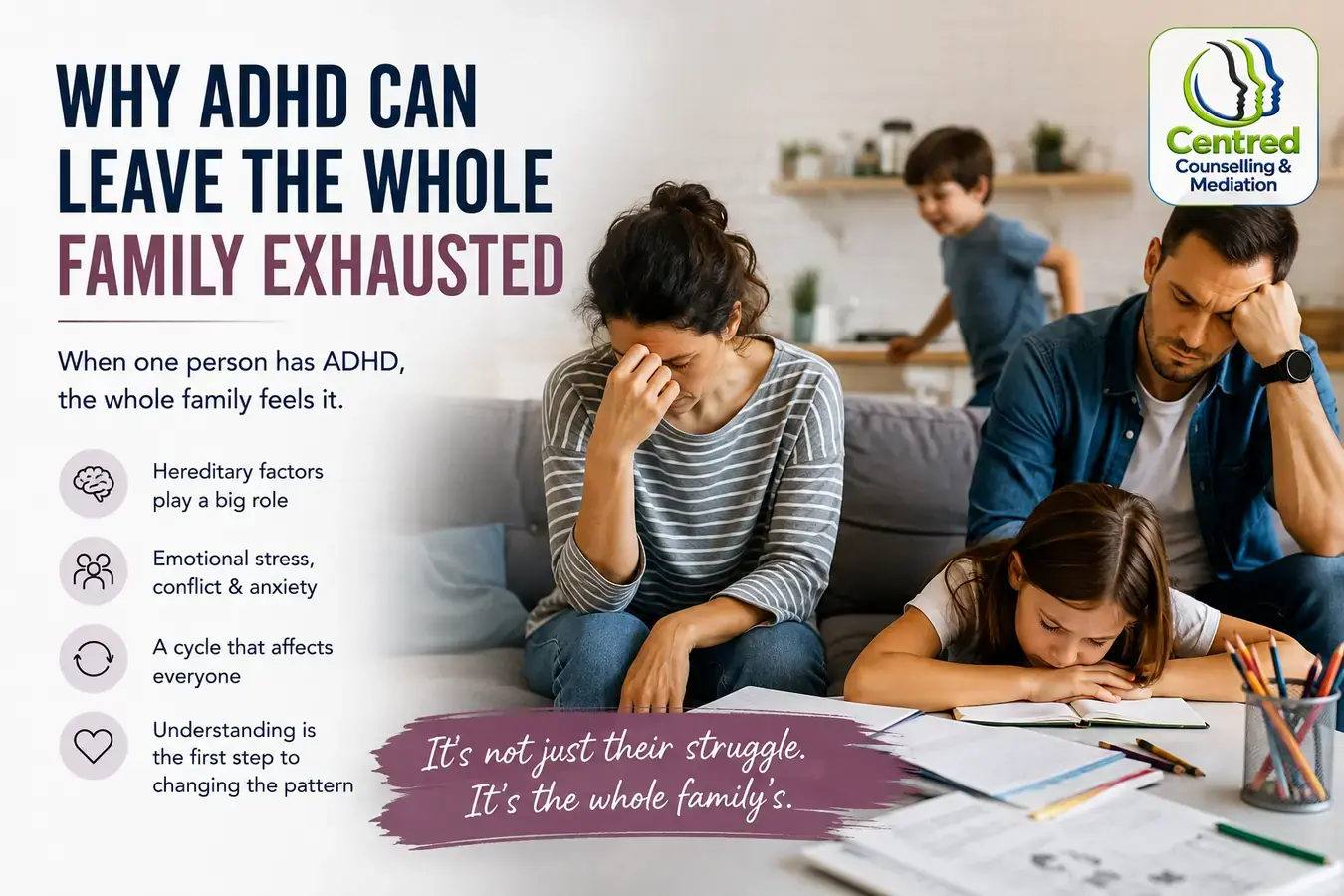
## Why ADHD Can Leave the Whole Family Exhausted
We often talk about ADHD as though it only affects the person who has it:
- The child has ADHD.
- The teenager has ADHD.
- The parent has ADHD.
But the reality is that ADHD rarely affects just one person.
When someone in a family has ADHD, the symptoms can start affecting everyone around them. And when more than one person in the family has ADHD, that impact can become even more complicated.
Research has consistently found higher levels of parenting stress in families raising children with ADHD.
But I think there is another part of this conversation that we don't talk about enough.
**Sometimes the entire family starts living around the ADHD.**
### It Can Start With Something Really Simple
Imagine a child who struggles to get ready for school:
- They can't find their shoes.
- They've forgotten where they put their homework.
- They get distracted while getting dressed.
The parent reminds them. Then reminds them again. Then again.
Eventually the parent gets frustrated. The child gets frustrated because they feel like they're constantly being told off. The parent feels guilty for losing their temper.
And then the next morning, it happens all over again.
None of this necessarily means that the child is deliberately misbehaving. And it doesn't necessarily mean the parent is a bad parent.
ADHD can turn ordinary everyday tasks into repeated sources of conflict.
### Now Imagine Both People Have ADHD
This is where things get particularly interesting.
ADHD has a strong genetic component, so it isn't unusual for more than one person in a family to have it:
- You might have a parent and child with ADHD.
- Two siblings.
- Or even multiple members of the same family.
And suddenly, some of the same difficulties can exist on both sides of the relationship:
- A parent who struggles with organisation is trying to organise a child who struggles with organisation.
- A parent who struggles with emotional regulation is trying to help a child regulate their emotions.
- A parent who struggles with time management is trying to get a teenager who struggles with time management out of the house on time.
Sometimes there isn't a naturally organised person in the room. And that can create an enormous amount of stress.
### How Likely Is a Child to Have ADHD If a Parent Has It?
This is where the genetics of ADHD become really important.
ADHD is one of the more strongly heritable neurodevelopmental conditions. Research generally estimates that around 70–80% of the variation in ADHD traits is influenced by genetic factors.
But that doesn't mean that if a parent has ADHD, their child has an 80% chance of developing it. **Heritability is not the same thing as individual risk.**
What we do know is that having a parent with ADHD substantially increases a child's likelihood of developing ADHD compared with the general population.
Some large population studies have found particularly high rates when both parents have ADHD. In one Norwegian registry study, ADHD was present in approximately 41.5% of sons and 25.1% of daughters when both parents had ADHD.
So when we see a family where a child has ADHD and one or both parents also have ADHD, it isn't necessarily a coincidence. There may be a significant genetic component connecting the two.
### The Parent May Be Dealing With Their Own ADHD Too
Imagine a parent who has spent their entire life struggling with organisation, forgetfulness, impulsivity, emotional regulation or time management.
They may never have been diagnosed.
Then they have a child who displays very similar difficulties:
> “Why can't my child just remember things?”
But they may not realise that they struggle with exactly the same thing.
This can create a particularly complicated family dynamic. The parent is trying to teach a child skills that they may have struggled to develop themselves.
And sometimes the frustration isn't just coming from the child's behaviour. It can come from the parent recognising, consciously or unconsciously, something of themselves in their child.
This is one reason why, when a child is diagnosed with ADHD, it can sometimes be worth asking:
> **“Could there be another family member with ADHD who has never been identified?”**
Not because ADHD is inevitable. It isn't. But because understanding the family pattern can make treatment and family relationships much easier.
And if you are a parent with ADHD and your child also has ADHD, this isn't about blaming yourself. You didn't cause your child's ADHD. You may simply have passed on some of the same genetic vulnerability that you inherited yourself.
### This Is Where the Arguments Start
One of the things I think we underestimate about ADHD is how quickly an executive-function problem can become a relationship problem.
Forgetting something might be an ADHD symptom. But after the tenth time, the other person may stop seeing it as forgetfulness:
- “You don't care.”
- “You don't listen to me.”
- “I can't rely on you.”
- “Why do I have to do everything?”
And that's when the emotional side of ADHD becomes much more complicated.
The original problem was forgetting. **Now the problem is trust, resentment and frustration.**
### And Then Anxiety Enters the Picture
When you've experienced enough difficult situations, you can start anticipating the next one.
The parent starts thinking:
- “Are they going to get into trouble at school?”
- “Did they remember their homework?”
- “Are they going to have another meltdown?”
- “Why haven't they answered their phone?”
- “How are they ever going to manage on their own?”
The child can experience anxiety too. Imagine constantly hearing:
- “Hurry up.”
- “Pay attention.”
- “You forgot again.”
- “Why didn't you listen?”
Eventually, the child can start developing a very negative view of themselves:
> “Why can't I just do what everyone else seems to be able to do?”
That can affect confidence, self-esteem and the way they see their own abilities.
### This Doesn't Mean ADHD Is an Excuse
I think this distinction is really important.
Understanding ADHD doesn't mean removing responsibility. A person with ADHD still needs to learn strategies, develop skills and take responsibility for their behaviour.
But there is a big difference between saying:
> “You need to take responsibility for this.”
and saying:
> “Why can't you just do it?”
The first recognises the difficulty while still expecting accountability. The second can create shame.
And shame rarely helps someone develop better executive functioning.
### ADHD Can Become a Family Cycle
1. The child struggles with executive functioning.
2. The parent provides more reminders.
3. The child becomes frustrated.
4. The parent becomes frustrated.
5. The child feels criticised.
6. The parent feels guilty.
7. Everyone becomes more anxious.
8. And then the next difficult situation starts the cycle again.
Over time, the family can begin anticipating problems before they even happen.
The family isn't necessarily dysfunctional. It may simply be caught in a cycle that nobody has properly understood.
### ADHD Doesn't Have to Become the Family's Identity
Having ADHD in a family doesn't mean that the family is destined to be chaotic, stressed or constantly fighting.
But it does mean that the family may need to understand what is actually happening.
Instead of:
> “Why can't you just do this?”
we can start asking:
> **“What is making this difficult, and what can we change to make it easier?”**
That is a very different conversation. And sometimes that change in perspective can make a significant difference.
Because ADHD isn't only about attention. It can affect communication, emotional regulation, routines, relationships, parenting and the overall functioning of a family.
And sometimes, helping the individual with ADHD isn't enough: **the family needs to understand the ADHD as well.**
### If ADHD Is Affecting Your Family
If you're a parent who feels like you're constantly reminding, correcting, organising and managing your child's behaviour, it's understandable that you may feel exhausted.
And if you have started wondering whether you or another family member may also have ADHD, that may be worth exploring too.
Counselling can help families understand the patterns developing within the family, improve communication, reduce conflict and develop practical strategies for dealing with the challenges ADHD can create.
You don't have to wait until the family is completely overwhelmed before asking for help.
If ADHD is creating stress, conflict or anxiety in your family, get in touch with Centred Counselling & Mediation to discuss how counselling and practical support could help your family.
### The Bottom Line
If your family seems to have an unusually high level of arguments, frustration, anxiety, forgotten responsibilities, lateness or emotional blow-ups, it doesn't automatically mean that your family is dysfunctional.
There may be an underlying pattern that nobody has identified yet.
And if ADHD is part of that pattern, understanding it can completely change the way you look at the problem.
The goal isn't to create a perfect family. It's to create a family that understands each other better.
Let's get you back on track!
**Tagged with:** [Adult ADHD](https://www.centredcounselling.co.za/centred-counselling-blog/tag/adult-adhd) [Adhd signs](https://www.centredcounselling.co.za/centred-counselling-blog/tag/adhd-signs)

#### Byron Werbeloff
KEEP READING
## Related Articles
May 1, 2026, 4:07:59 AM Byron Werbeloff
### [Why Rejection Hurts More with ADHD: Understanding RSD](https://www.centredcounselling.co.za/centred-counselling-blog/why-rejection-hurts-more-with-adhd-understanding-rsd)
# Why Rejection Hurts More If You Have ADHD
## Understanding Rejection Sensitivity Dysphoria (RSD)
Have you ever been criticised… and it didn’t...
[READ FULL ARTICLE](https://www.centredcounselling.co.za/centred-counselling-blog/why-rejection-hurts-more-with-adhd-understanding-rsd)
[](https://www.centredcounselling.co.za/centred-counselling-blog/do-we-dream-under-anaesthesia-sleep-consciousness)
May 12, 2026, 7:56:28 AM Byron Werbeloff
### [Do We Dream Under Anaesthesia? Sleep & Consciousness](https://www.centredcounselling.co.za/centred-counselling-blog/do-we-dream-under-anaesthesia-sleep-consciousness)
## Do We Dream Under Anaesthesia? The Science of Sleep, Dreams, and Consciousness
Most people assume sleep is simply the brain “switching...
[READ FULL ARTICLE](https://www.centredcounselling.co.za/centred-counselling-blog/do-we-dream-under-anaesthesia-sleep-consciousness)
[](https://www.centredcounselling.co.za/centred-counselling-blog/high-functioning-adhd-in-women-masking-coping-costs)
Sep 1, 2026, 6:00:58 PM Byron Werbeloff
### [High-Functioning ADHD in Women: Masking & Coping Costs](https://www.centredcounselling.co.za/centred-counselling-blog/high-functioning-adhd-in-women-masking-coping-costs)
# From the Counsellor’s Chair
## High-Functioning ADHD in Women: When Coping Well Doesn’t Mean You’re Doing Well
**Centred Counselling & Mediation**
[READ FULL ARTICLE](https://www.centredcounselling.co.za/centred-counselling-blog/high-functioning-adhd-in-women-masking-coping-costs)

Empowering individuals and couples through evidence-based counselling and mediation. Registered ASCHP professional (WC24/9024).
Quick Links
- [Home](https://www.centredcounselling.co.za)
- [About Me](https://www.centredcounselling.co.za/about-me)
- [Articles](https://www.centredcounselling.co.za/article)
- [Counselling](https://www.centredcounselling.co.za/counselling)
- [Mediation](https://www.centredcounselling.co.za/mediation)
- [Video Resources](https://www.centredcounselling.co.za/mental-health-vlogs-video-resources)
- [Contact](https://www.centredcounselling.co.za/contact-us)
- [Book NOW](https://www.centredcounselling.co.za/booking)
Resources
- [FAQ](https://www.centredcounselling.co.za/counselling#faq)
- [FAQ Mediation](https://www.centredcounselling.co.za/mediation#faq)
- [Downloads](https://www.centredcounselling.co.za/article#resources)
- [Cookie Policy](https://www.centredcounselling.co.za/terms-conditions-policies#cookies)
- [Privacy Policy](https://www.centredcounselling.co.za/terms-conditions-policies#privacy)
- [Terms and Conditions](https://www.centredcounselling.co.za/terms-conditions-policies#terms)
Get in Touch
Call Us [084 485 3541](tel:0844853541)
WhatsApp [Chat with us](https://wa.me/27844853541)
Email Us [info@centredcounselling.co.za](mailto:info@centredcounselling.co.za)
© 2026 Centred Counselling & Mediation. All rights reserved.
[Design by SEO Website Design](https://www.seowebsitedesign.co.za)
[Chat with us](https://wa.me/27844853541)
```json
{
"@context" : "https://schema.org",
"@type" : "BlogPosting",
"author" : {
"@type" : "Person",
"name" : "Byron Werbeloff",
"url" : "https://www.centredcounselling.co.za/centred-counselling-blog/author/byron-werbeloff"
},
"dateModified" : "2026-09-04T06:08:18.378Z",
"datePublished" : "2026-09-04T06:08:18.000Z",
"headline" : "Why ADHD Leaves the Whole Family Exhausted | Centred",
"image" : [ "https://www.centredcounselling.co.za/hubfs/adhd_family_exhausted_logo_under_100kb.webp" ],
"mainEntityOfPage" : {
"@id" : "https://www.centredcounselling.co.za/centred-counselling-blog/why-adhd-leaves-the-whole-family-exhausted-centred",
"@type" : "WebPage"
},
"publisher" : {
"@type" : "Organization",
"logo" : {
"@type" : "ImageObject",
"url" : "https://www.centredcounselling.co.za/hubfs/logo.jpeg"
},
"name" : "Centred Counselling"
}
}
```
```json
{
"@context": "https://schema.org",
"@type": "LocalBusiness",
"name": "Centred Counselling & Mediation",
"image": "https://www.centredcounselling.co.za/hubfs/logo1.png",
"@id": "https://www.centredcounselling.co.za",
"url": "https://www.centredcounselling.co.za",
"telephone": "0844853541",
"email": "info@centredcounselling.co.za",
"address": {
"@type": "PostalAddress",
"streetAddress": "153A 9th Avenue",
"addressLocality": "Highlands North",
"addressRegion": "Johannesburg",
"postalCode": "2192",
"addressCountry": "ZA"
},
"geo": {
"@type": "GeoCoordinates",
"latitude": -26.1368,
"longitude": 28.0841
},
"openingHoursSpecification": {
"@type": "OpeningHoursSpecification",
"dayOfWeek": [
"Monday",
"Tuesday",
"Wednesday",
"Thursday",
"Friday"
],
"opens": "08:00",
"closes": "18:00"
},
"sameAs": [
"https://www.facebook.com/profile.php?id=61573738539849",
"https://www.instagram.com/centred_counselling/",
"https://www.linkedin.com/in/byron-werbeloff-475bb251/",
"https://www.tiktok.com/@centred.counselli"
],
"founder": {
"@type": "Person",
"name": "Byron Werbeloff",
}
}
```