---
title: "ADHD in Women: The Cost of Holding It All Together"
description: Appearing organised while exhausted? Learn why ADHD in women is often missed, how masking hides impairment, and what it really costs to function
image: https://www.centredcounselling.co.za/hubfs/adhd_women_blog_image_under_100kb.jpg
---
1332 Naivasha Road, Sunninghill
[info@centredcounselling.co.za](mailto:info@centredcounselling.co.za)
[084 485 3541](https://wa.me/27844853541)
[](https://www.centredcounselling.co.za/)
- [Home](https://www.centredcounselling.co.za)
- [About Me](https://www.centredcounselling.co.za/about-me)
- [Articles](https://www.centredcounselling.co.za/article)
- [Counselling](https://www.centredcounselling.co.za/counselling)
- [All Counselling Services](https://www.centredcounselling.co.za/counselling)
- [ADHD Counselling](https://www.centredcounselling.co.za/adhd-counselling-sunninghill)
- [Anger Management](https://www.centredcounselling.co.za/anger-management-sunninghill)
- [Chronic Pain Counselling](https://www.centredcounselling.co.za/chronic-pain-counselling-centred-counselling)
- [Grief Counselling](https://www.centredcounselling.co.za/grief-counselling-sunninghill)
- [LGBTQ+](https://www.centredcounselling.co.za/lgbtq-counselling-in-sandton-centred-counselling-mediation)
- [Marriage Counselling](https://www.centredcounselling.co.za/marriage-counselling-in-sunninghill-sandton-centred-counselling)
- [Porn Addiction](https://www.centredcounselling.co.za/porn-addiction-counselling-in-sandton-centred-counselling)
- [Premarital Counselling](https://www.centredcounselling.co.za/premarital-counselling-in-sunninghill-sandton-centred-counselling)
- [Relationship Counselling](https://www.centredcounselling.co.za/relationship-counselling-in-sunninghill-centred-counselling)
- [Mediation](https://www.centredcounselling.co.za/mediation)
- [Video Resources](https://www.centredcounselling.co.za/mental-health-vlogs-video-resources)
- [Contact](https://www.centredcounselling.co.za/contact-us)
- [Book NOW](https://www.centredcounselling.co.za/booking)
[BOOK NOW](https://www.centredcounselling.co.za/booking) [WHATSAPP US](https://wa.me/27844853541)
[Adult ADHD](https://www.centredcounselling.co.za/centred-counselling-blog/tag/adult-adhd)
# ADHD in Women: The Cost of Holding It All Together

Byron Werbeloff
Author
Sep 1, 2026, 6:06:10 PM
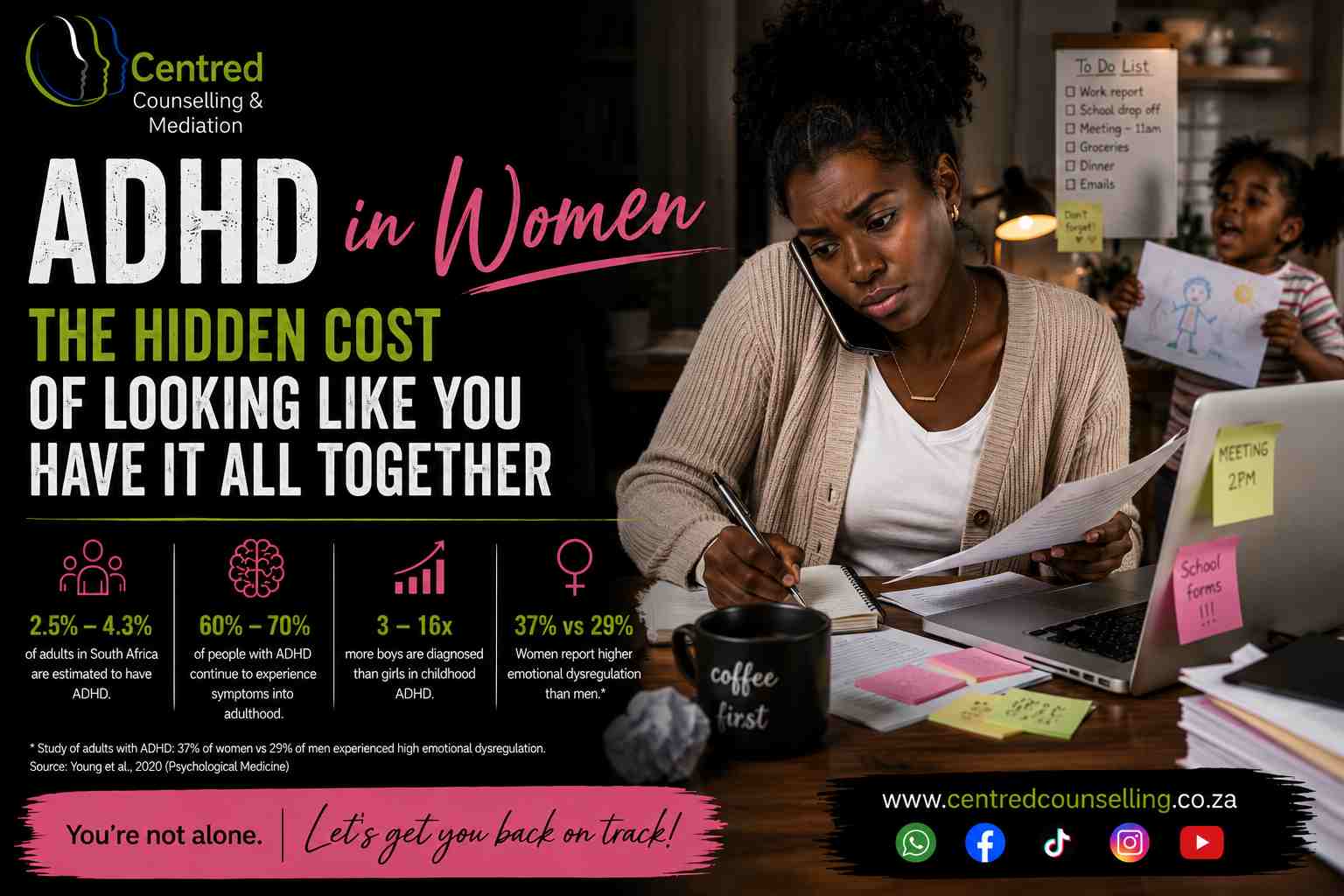
## ADHD in Women: The Hidden Cost of Looking Like You Have It All Together
**Centred Counselling & Mediation**
When most people think about ADHD, they tend to picture someone who is obviously distracted, restless, impulsive or disorganised. That picture isn't completely wrong. But it is incomplete.
For many women, ADHD can be considerably less visible. They may have developed strategies that allow them to compensate for their difficulties, sometimes for decades. The result can be a woman who looks highly capable to everyone around her while privately expending enormous amounts of energy simply trying to keep up.
And I think that distinction matters. Because perhaps the question shouldn't only be:
> **“Is she functioning?”**
Perhaps we should also ask:
> **“What is it costing her to function?”**
### ADHD in Women Is More Common Than Many People Realise
ADHD is not a rare childhood condition that disappears when someone becomes an adult.
- **Global Prevalence:** A global systematic review and meta-analysis estimated that 2.58% of adults have persistent ADHD, meaning ADHD that began in childhood and continued into adulthood. When adults with significant ADHD symptoms were included regardless of whether childhood onset was established, the estimate rose to 6.76%.
- **South African Context:** South African adult ADHD guidelines estimate prevalence at approximately 2.5%–4.3%, with around 60%–70% of people with ADHD continuing to experience symptoms into adulthood.
- **Clinical Presentation:** The guidelines also note that women are more likely than men to present primarily with inattentive features.
So when we talk about ADHD in women, we aren't talking about a small group of unusual cases. We are talking about a substantial number of women whose difficulties may not always be recognised.
### Why Are Women Still Being Missed?
This is where the statistics become particularly interesting.
A 2024 review noted that ADHD was diagnosed between 3 and 16 times more frequently in males than females during childhood, while by adulthood, the number of diagnosed men and women becomes much more similar. That doesn't necessarily mean that ADHD suddenly becomes more common in women.
It raises another possibility: **Some women simply aren't being identified when they're younger.**
There are several possible reasons:
- **Sustained Attention vs. Hyperactivity:** Research suggests that females with ADHD can present differently from males. A 2025 systematic review found that girls were more likely to show difficulties with sustaining attention and distractibility, while boys were more likely to display several of the more visibly hyperactive and impulsive behaviours.
- **Adult Manifestations:** In adulthood, women with ADHD were more likely to report difficulties with distractibility, organisation, mind wandering and adverse effects at home.
That matters because the behaviours that attract attention aren't always the same. A child who is disruptive in class is difficult to overlook. A child who is quiet, distracted and academically capable can be much easier to miss.
### Being Intelligent Doesn't Protect You from ADHD
Another misconception is that a successful or intelligent woman couldn't possibly have ADHD. But intelligence and executive functioning are not the same thing.
A person can have excellent reasoning ability and still struggle with planning, task initiation, prioritisation, working memory or regulating attention. A systematic review of adult ADHD found that women with ADHD may experience greater impairment than men in areas including social functioning, time perception, stress management and mood, although the researchers also noted that findings across studies are not completely consistent.
This is important because success can sometimes disguise impairment:
- Someone may achieve excellent academic results but require enormous amounts of last-minute pressure to do it.
- Someone may have a successful career but rely heavily on reminders, routines and over-preparation.
- Someone may manage a household but feel completely overwhelmed by the cognitive load involved in keeping everything organised.
From the outside, these women may look highly functional. That doesn't necessarily tell us how much effort their functioning requires.
### The Hidden Cost of Compensation
Women can become very good at compensating for ADHD:
- They create systems.
- They use calendars and reminders.
- They become extremely conscious of time.
- They overprepare.
- They develop rigid routines.
- They may become perfectionistic because mistakes feel particularly costly.
These strategies can be useful. But they can also conceal the underlying difficulties.
This is one reason I think the phrase “high-functioning ADHD” can be problematic. It isn't a formal clinical diagnosis, and the term can create the impression that someone who is successful isn't significantly affected by ADHD.
But functioning isn't necessarily the same as functioning comfortably. A woman can have a successful career, a family and a seemingly organised life while experiencing significant internal strain.
The better question may be: **“How sustainable is the way she is functioning?”**
### Women Can Experience ADHD Differently from Men
The research doesn't support the idea that ADHD is simply identical in every person.
A 2024 systematic review and meta-analysis examined 52 studies involving more than 18,000 people with ADHD—8,423 females and 9,985 males. The researchers found some differences in symptom severity, although the effects were generally small and depended on how symptoms were assessed. Across the lifespan, males showed greater hyperactivity/impulsivity on rating scales, while clinical interviews did not consistently show significant sex differences.
This is actually useful because it cautions us against another oversimplification: **There isn't one universal “female ADHD.”**
Women can have different presentations, different levels of impairment and different combinations of difficulties. What matters is recognising the individual pattern rather than expecting every woman with ADHD to look the same.
### Emotional Difficulties Can Become Part of the Picture
ADHD is formally defined around patterns of inattention and/or hyperactivity-impulsivity. But the wider experience can be considerably more complicated.
In one large analysis of adults with ADHD, women experienced higher levels of emotional dysregulation than men: 37% compared with 29% in that study. Women also showed higher levels of anxiety and depressive symptoms and more sleep difficulties.
This doesn't mean that emotional dysregulation is itself a diagnostic criterion for ADHD. It does, however, help explain why some women don't present saying: *“I can't concentrate.”*
Instead, they present saying:
- “I'm overwhelmed.”
- “I can't switch off.”
- “I feel like I'm constantly behind.”
- “I know I'm capable of more than this.”
The underlying ADHD may not be immediately obvious.
### And Then Hormones Enter the Picture
This is an area where research is developing rapidly.
A 2025 systematic review examined 11 studies investigating the relationship between ADHD symptoms and sex hormones in females. The researchers concluded that the evidence was suggestive of a relationship between hormonal changes and ADHD symptoms, particularly around puberty and the menstrual cycle, but also emphasised that the evidence base remains limited and that more research is needed.
This is particularly relevant because women's lives contain several major hormonal transitions that don't have an equivalent in men's lives:
- Puberty
- The menstrual cycle
- Pregnancy
- The postpartum period
- Perimenopause
- Menopause
For some women with ADHD, these periods may coincide with noticeable changes in symptoms or functioning. That doesn't mean hormones “cause” ADHD. It means hormonal changes may interact with an existing neurodevelopmental condition in ways that deserve greater clinical attention.
### Why Diagnosis Later in Life Can Make Sense
When you put these pieces together, late diagnosis becomes less surprising:
1. A girl may be intelligent enough to compensate at school.
2. She may develop systems that allow her to function.
3. She may enter university and discover that the increased independence makes things more difficult.
4. Then she starts working.
5. Then she has children.
6. Then her responsibilities increase again.
Eventually, the number of demands exceeds the capacity of the strategies she has been using. And she may suddenly think: *“Why can't I manage my life anymore?”*
But perhaps she hasn't suddenly become less capable. The environment has simply become more demanding. That is an important distinction.
### ADHD Isn't Laziness
One of the most damaging consequences of unidentified ADHD can be the interpretation a person develops about herself. If you repeatedly struggle to do things that you know you are capable of doing, it is very easy to conclude that you lack discipline, motivation, reliability, or self-control.
But those explanations don't necessarily fit the evidence.
A person who is genuinely incapable of doing something doesn't usually produce exceptional results under the right circumstances. Someone with ADHD may be able to perform extraordinarily well when a task is interesting, urgent or stimulating, while struggling significantly when the same person has to initiate something routine, repetitive or delayed.
That inconsistency can be incredibly frustrating. And it is one of the reasons ADHD is often misunderstood.
### The Goal Isn't to Lower the Bar
Understanding ADHD doesn't mean lowering expectations. It means understanding what is interfering with your ability to meet them.
You still have responsibilities. You still have to take accountability for how you behave. You still have to manage your relationships. But there is a difference between accountability and self-punishment.
If a particular strategy isn't working, repeatedly criticising yourself for failing to use it successfully isn't necessarily going to solve the problem. You may need:
- Different systems
- More external structure
- Different ways of organising tasks
- More deliberate recovery
- Professional assessment
- Treatment where appropriate
- Or simply a better understanding of how your attention and executive functioning actually operate
### Perhaps We Have Been Asking the Wrong Question
I think this is where the conversation about ADHD in women needs to change. For years, we have often looked for obvious dysfunction:
- Is she failing at school?
- Is she losing her job?
- Is her home completely chaotic?
- Is she obviously hyperactive?
If the answer is no, we can assume she's coping. But that isn't necessarily enough.
A woman can be successful and still be struggling. She can be productive and still be exhausted. She can be organised and still be compensating. She can be emotionally controlled in public and completely depleted in private. She can be capable and still need help.
So perhaps the more useful question isn't simply: *“How well is she functioning?”*
It is: **“How much effort, stress and exhaustion is required for her to function at that level?”**
Because there is a significant difference between a woman who has everything under control and a woman who has become exceptionally good at holding everything together. And sometimes, that distinction is where the real ADHD story begins.
Let's get you back on track
## Centred Counselling
### Counselling & Family Mediation Services
- 📞 +27 84 485 3541
- 🌐 [https://www.centredcounselling.co.za/](https://www.centredcounselling.co.za/)
- ✉️ info@centredcounselling.co.za
### Follow us:
- **TikTok:** [www.tiktok.com/@centred.counselli](https://www.google.com/search?q=http://www.tiktok.com/%40centred.counselli&authuser=1)
- **YouTube:** [https://www.youtube.com/@CentredCounselling](https://www.youtube.com/@CentredCounselling)
- **Instagram:** [https://www.instagram.com/centred\_counselling](https://www.instagram.com/centred_counselling)
- **Facebook:** [https://www.facebook.com/share/1AtmNzrAEo/?mibextid=wwXIfr](https://www.facebook.com/share/1AtmNzrAEo/?mibextid=wwXIfr)
- **Pinterest:** [https://pin.it/i0CksW39W](https://pin.it/i0CksW39W)
- **Threads:** [https://www.threads.com/@centred\_counselling](https://www.threads.com/@centred_counselling)
**Tagged with:** [Adult ADHD](https://www.centredcounselling.co.za/centred-counselling-blog/tag/adult-adhd)

#### Byron Werbeloff
KEEP READING
## Related Articles
[](https://www.centredcounselling.co.za/centred-counselling-blog/high-functioning-adhd-in-women-masking-coping-costs)
Sep 1, 2026, 6:00:58 PM Byron Werbeloff
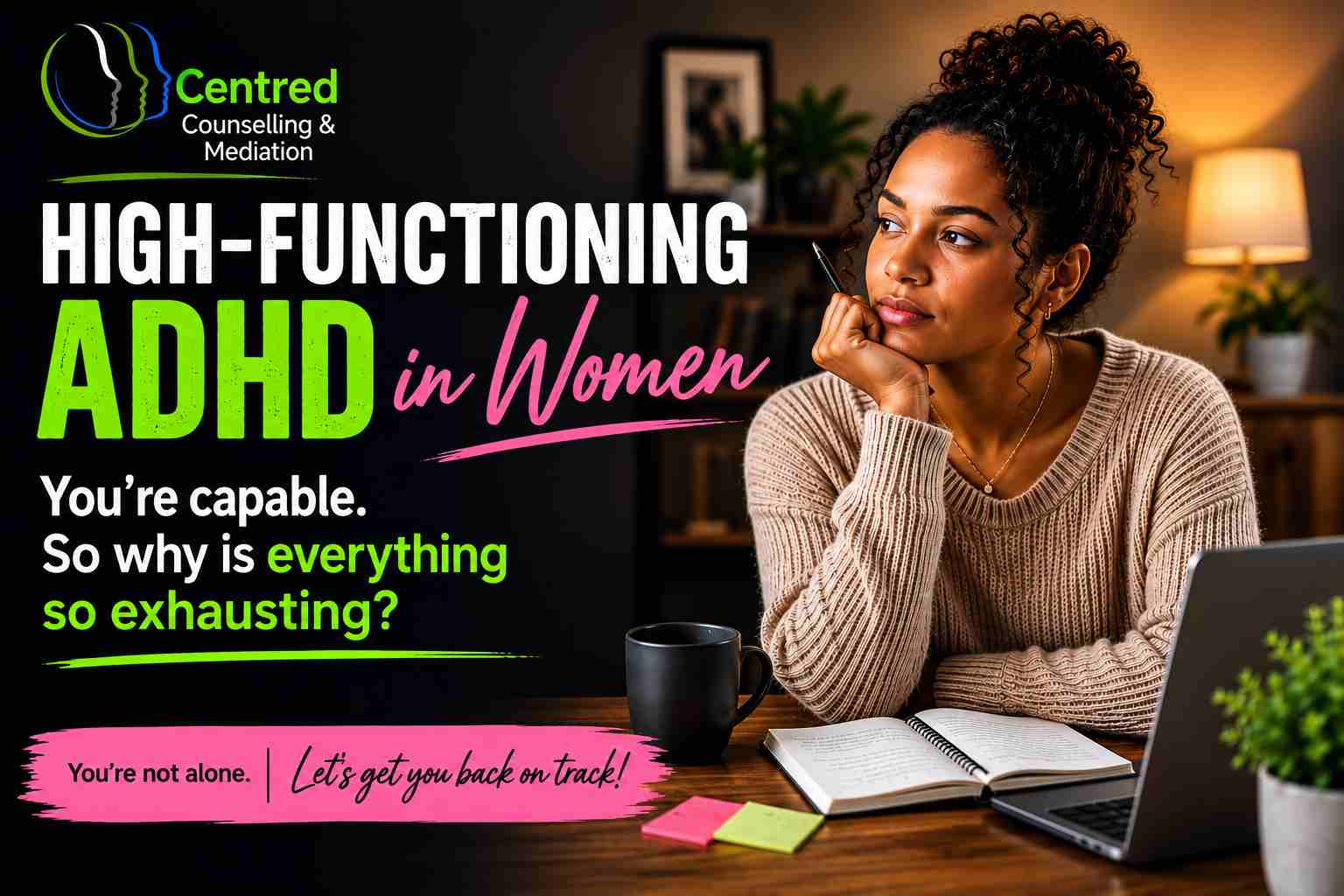
### [High-Functioning ADHD in Women: Masking & Coping Costs](https://www.centredcounselling.co.za/centred-counselling-blog/high-functioning-adhd-in-women-masking-coping-costs)
# From the Counsellor’s Chair
## High-Functioning ADHD in Women: When Coping Well Doesn’t Mean You’re Doing Well
**Centred Counselling & Mediation**
[READ FULL ARTICLE](https://www.centredcounselling.co.za/centred-counselling-blog/high-functioning-adhd-in-women-masking-coping-costs)
[](https://www.centredcounselling.co.za/centred-counselling-blog/why-a-child-with-adhd-needs-more-support-than-you-think)
Sep 2, 2026, 3:09:49 AM Byron Werbeloff
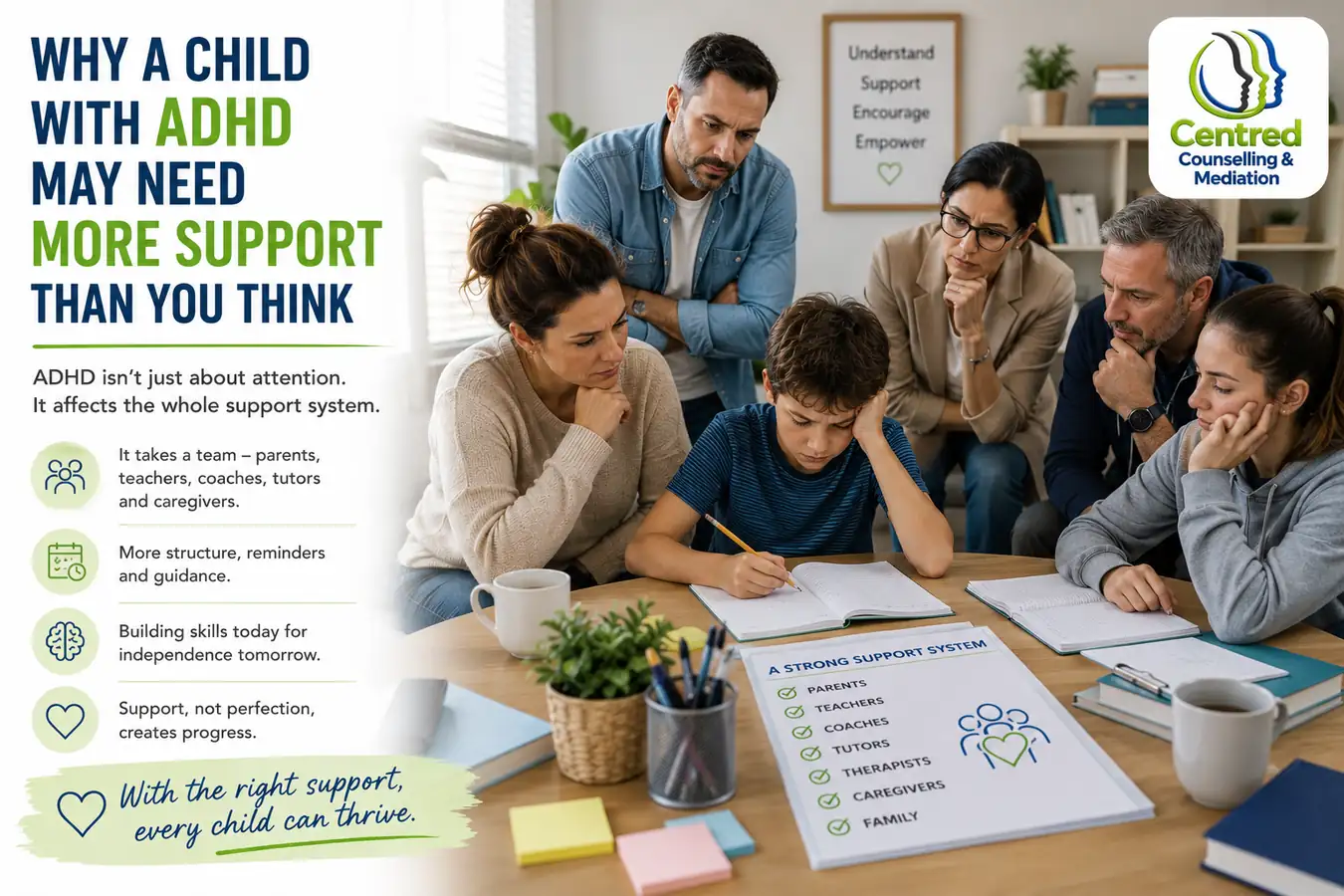
### [Why a Child With ADHD Needs More Support Than You Think](https://www.centredcounselling.co.za/centred-counselling-blog/why-a-child-with-adhd-needs-more-support-than-you-think)
# Why a Child With ADHD May Need More Support Than You Think
One of the things I think is often misunderstood about ADHD is how much support...
[READ FULL ARTICLE](https://www.centredcounselling.co.za/centred-counselling-blog/why-a-child-with-adhd-needs-more-support-than-you-think)
[](https://www.centredcounselling.co.za/centred-counselling-blog/why-adhd-leaves-the-whole-family-exhausted-centred)
Sep 4, 2026, 2:08:18 AM Byron Werbeloff
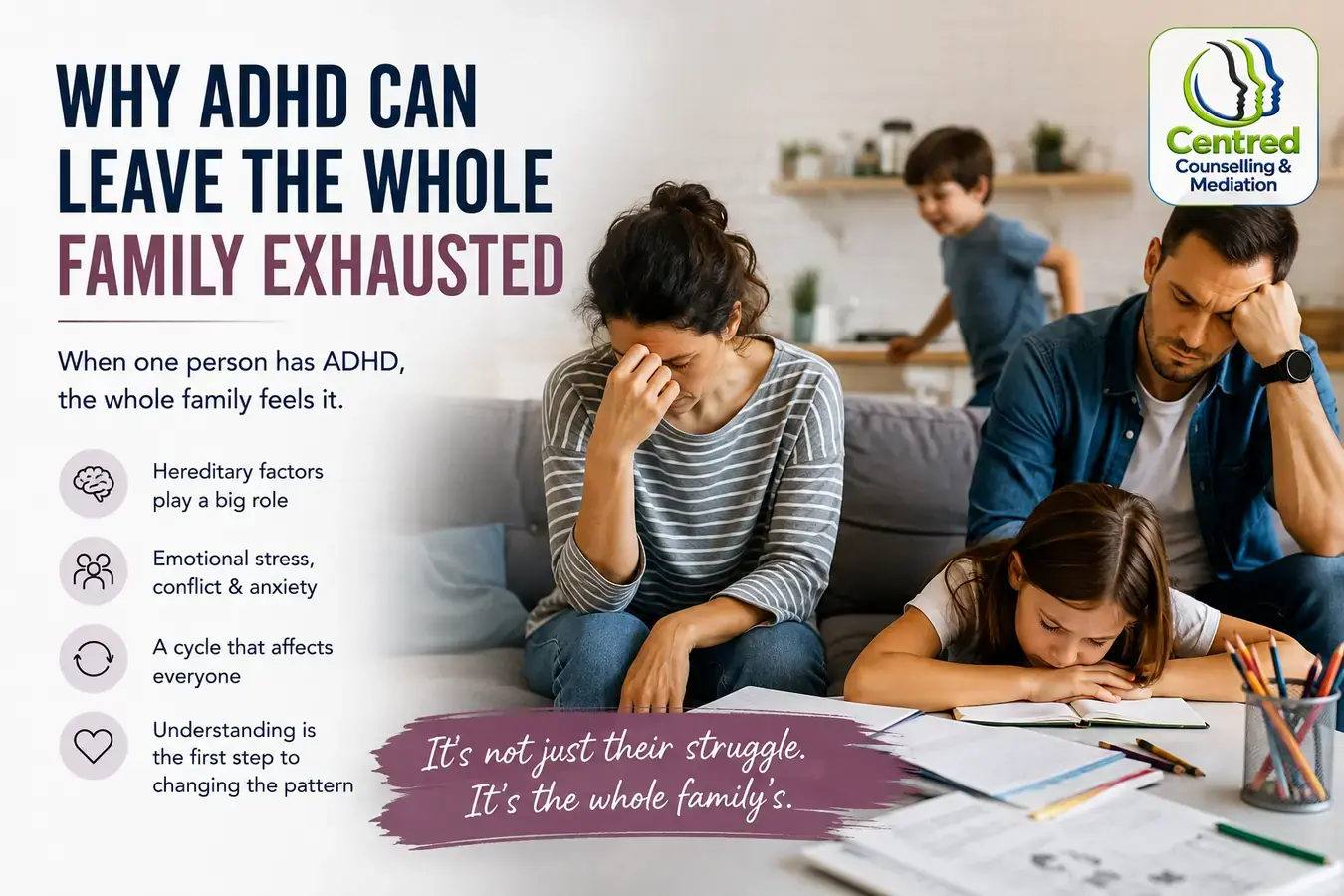
### [Why ADHD Leaves the Whole Family Exhausted | Centred](https://www.centredcounselling.co.za/centred-counselling-blog/why-adhd-leaves-the-whole-family-exhausted-centred)
# From the Counsellor’s Chair
## Why ADHD Can Leave the Whole Family Exhausted
We often talk about ADHD as though it only affects the person who...
[READ FULL ARTICLE](https://www.centredcounselling.co.za/centred-counselling-blog/why-adhd-leaves-the-whole-family-exhausted-centred)

Empowering individuals and couples through evidence-based counselling and mediation. Registered ASCHP professional (WC24/9024).
Quick Links
- [Home](https://www.centredcounselling.co.za)
- [About Me](https://www.centredcounselling.co.za/about-me)
- [Articles](https://www.centredcounselling.co.za/article)
- [Counselling](https://www.centredcounselling.co.za/counselling)
- [Mediation](https://www.centredcounselling.co.za/mediation)
- [Video Resources](https://www.centredcounselling.co.za/mental-health-vlogs-video-resources)
- [Contact](https://www.centredcounselling.co.za/contact-us)
- [Book NOW](https://www.centredcounselling.co.za/booking)
Resources
- [FAQ](https://www.centredcounselling.co.za/counselling#faq)
- [FAQ Mediation](https://www.centredcounselling.co.za/mediation#faq)
- [Downloads](https://www.centredcounselling.co.za/article#resources)
- [Cookie Policy](https://www.centredcounselling.co.za/terms-conditions-policies#cookies)
- [Privacy Policy](https://www.centredcounselling.co.za/terms-conditions-policies#privacy)
- [Terms and Conditions](https://www.centredcounselling.co.za/terms-conditions-policies#terms)
Get in Touch
Call Us [084 485 3541](tel:0844853541)
WhatsApp [Chat with us](https://wa.me/27844853541)
Email Us [info@centredcounselling.co.za](mailto:info@centredcounselling.co.za)
© 2026 Centred Counselling & Mediation. All rights reserved.
[Design by SEO Website Design](https://www.seowebsitedesign.co.za)
[Chat with us](https://wa.me/27844853541)
```json
{
"@context" : "https://schema.org",
"@type" : "BlogPosting",
"author" : {
"@type" : "Person",
"name" : "Byron Werbeloff",
"url" : "https://www.centredcounselling.co.za/centred-counselling-blog/author/byron-werbeloff"
},
"dateModified" : "2026-09-01T22:07:12.120Z",
"datePublished" : "2026-09-01T22:06:10.000Z",
"headline" : "ADHD in Women: The Cost of Holding It All Together",
"image" : [ "https://www.centredcounselling.co.za/hubfs/adhd_women_blog_image_under_100kb.jpg" ],
"mainEntityOfPage" : {
"@id" : "https://www.centredcounselling.co.za/centred-counselling-blog/adhd-in-women-the-cost-of-holding-it-all-together",
"@type" : "WebPage"
},
"publisher" : {
"@type" : "Organization",
"logo" : {
"@type" : "ImageObject",
"url" : "https://www.centredcounselling.co.za/hubfs/logo.jpeg"
},
"name" : "Centred Counselling"
}
}
```
```json
{
"@context": "https://schema.org",
"@type": "LocalBusiness",
"name": "Centred Counselling & Mediation",
"image": "https://www.centredcounselling.co.za/hubfs/logo1.png",
"@id": "https://www.centredcounselling.co.za",
"url": "https://www.centredcounselling.co.za",
"telephone": "0844853541",
"email": "info@centredcounselling.co.za",
"address": {
"@type": "PostalAddress",
"streetAddress": "153A 9th Avenue",
"addressLocality": "Highlands North",
"addressRegion": "Johannesburg",
"postalCode": "2192",
"addressCountry": "ZA"
},
"geo": {
"@type": "GeoCoordinates",
"latitude": -26.1368,
"longitude": 28.0841
},
"openingHoursSpecification": {
"@type": "OpeningHoursSpecification",
"dayOfWeek": [
"Monday",
"Tuesday",
"Wednesday",
"Thursday",
"Friday"
],
"opens": "08:00",
"closes": "18:00"
},
"sameAs": [
"https://www.facebook.com/profile.php?id=61573738539849",
"https://www.instagram.com/centred_counselling/",
"https://www.linkedin.com/in/byron-werbeloff-475bb251/",
"https://www.tiktok.com/@centred.counselli"
],
"founder": {
"@type": "Person",
"name": "Byron Werbeloff",
}
}
```