
Ways to Create a Good Marriage email moved to Checked off.
Next: Marriage Property Regimes in South Africa — 9 October 2026
Page title: Marriage Property Regimes in South Africa | Premarital Counselling
Meta description: Getting married in South Africa? Explore marriage in community of property, out of community with accrual, and without accrual before choosing your contract.
[Download the supplied image](C:/Users/cash/OneDrive/Desktop/webtemlates/centeredcounseling/blogs/Marriage_Property_Regimes_South_Africa_Under_100KB.webp)
From the Counsellor’s Chair
Marriage in Community of Property or Out of Community? Understanding Your Options in South Africa
Before You Get Married, Understand the Financial Partnership You Are Entering
Planning a wedding often involves decisions about the venue, guests, clothing and honeymoon. One decision with consequences that can last far beyond the wedding day is your matrimonial property regime: the legal framework that determines how assets and liabilities are treated during your marriage and what may happen if the marriage ends through divorce or death.
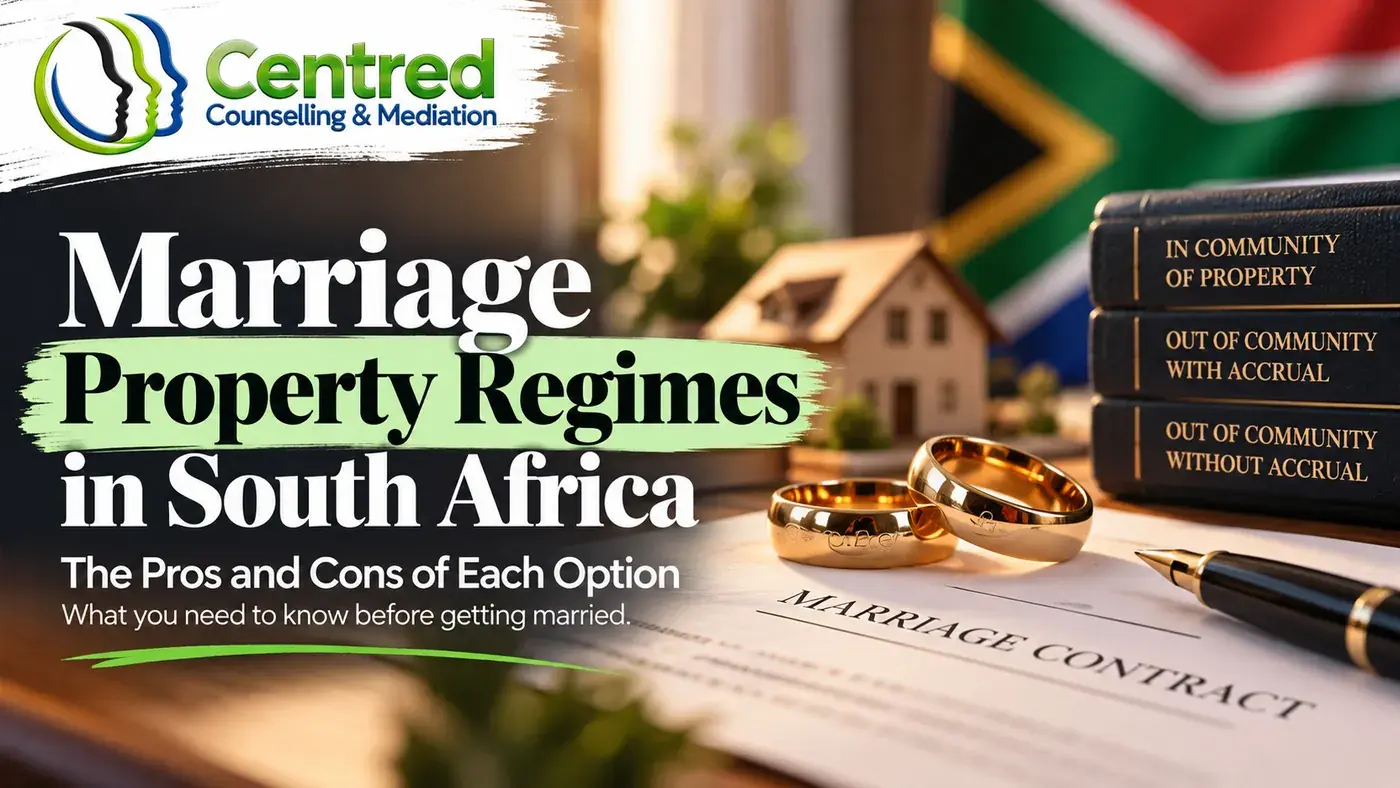
In South Africa, there are three main matrimonial property regimes commonly discussed for civil marriages: in community of property; out of community of property with the accrual system; and out of community of property without accrual.
For most civil marriages governed by South African law, marriage in community of property is the default if there is no valid antenuptial contract providing otherwise. An antenuptial contract, often called an ANC, should be addressed before the wedding, with a notary explaining the execution and registration requirements.
There is no single option that is right for every couple. The right choice depends on your circumstances, financial arrangements, responsibilities, business or debt risks, expectations about shared wealth, and plans for children or caregiving.
1. Marriage in Community of Property
What it generally means: A single joint estate is created. In broad terms, assets and liabilities from before and during the marriage may form part of that estate, subject to legal rules and exceptions. Each spouse has an interest in the joint estate, and certain transactions require the other spouse’s consent.
Potential Advantages
- A shared estate can reflect a couple’s intention to treat their finances as a common partnership.
- It may feel straightforward because a separate antenuptial contract is not required.
- It can recognise the contribution of a spouse who earns less or takes on unpaid household or caregiving work, because the estate is shared rather than kept entirely separate.
Potential Disadvantages
- Both spouses may be exposed to the financial consequences of the joint estate, including certain debts and insolvency risks.
- Financial decisions are not always independent; some transactions require spousal consent.
- Assets brought into the marriage may become part of the joint estate, depending on the applicable legal rules and any relevant exclusions.
- If one spouse runs a business, takes on substantial financial risk or has complex existing obligations, the shared estate may create risks that need careful advice.
This option may suit couples who deliberately want a shared estate and understand the associated risks. It should not be selected simply because no one explained the alternatives.
2. Marriage Out of Community of Property With Accrual
What it generally means: The spouses keep separate estates during the marriage, but the accrual system provides a way to share some of the growth in their estates if the marriage ends through divorce or death.
Broadly, each spouse’s estate growth is calculated, and the spouse with the smaller accrual may have a claim for half the difference, subject to the law and the terms of the ANC. Certain assets, such as inheritances, may be excluded from the calculation under the applicable rules. Matrimonial Property Act
Potential Advantages
- It separates the spouses’ estates during the marriage while allowing a degree of sharing in wealth built up during the marriage.
- It can recognise that one partner’s career or wealth may grow faster while the other contributes through caregiving, household work or supporting the family in other ways.
- It can offer more financial separation than a joint estate while still providing a mechanism to share growth when the marriage ends.
- It allows couples to record commencement values and agree on certain exclusions in the ANC, with appropriate legal advice.
Potential Disadvantages
- The accrual calculation can be technical and may require valuations, records and professional assistance.
- The wording of the ANC, commencement values and exclusions can have significant consequences; unclear drafting can lead to disputes.
- It does not mean every asset or every financial contribution is automatically split equally during the marriage.
- Couples may have different expectations about what counts as fair sharing, so they should discuss these expectations before signing.
This option is often worth discussing when partners want separate estates during marriage but also want a framework for sharing wealth accumulated over time. Whether it is suitable depends on the couple’s specific circumstances and legal advice.
3. Marriage Out of Community of Property Without Accrual
What it generally means: The spouses maintain separate estates and expressly exclude the accrual system in their ANC. There is generally no automatic sharing of the growth in their estates under the accrual calculation when the marriage ends. The precise legal consequences can be affected by the contract, applicable law and court decisions.
Excluding accrual does not mean that a court can never order redistribution. Constitutional Court decisions have extended access to redistribution remedies for qualifying marriages out of community of property without accrual. A further judgment on 9 October 2026 addressed pension interests in such claims. These remedies are distinct from automatic accrual sharing, and the outcome depends on the applicable requirements and circumstances. Ask your attorney to explain how current law affects your proposed contract. Constitutional Court: EB and KG, Constitutional Court: GD
Potential Advantages
- It provides a high degree of separation between each spouse’s estate and financial affairs.
- It may be considered by couples with significant premarital assets, particular business risks, family wealth or a deliberate preference for separate financial estates.
- Each spouse can maintain greater independence over assets held in their own estate, subject to applicable law and contractual obligations.
Potential Disadvantages
- There is no automatic accrual-based mechanism to share wealth built up by the other spouse during the marriage.
- A spouse who reduces paid work to raise children, relocate, support the other’s career or manage the household may face financial disadvantage if the relationship ends.
- It can create very different outcomes where one spouse’s wealth grows substantially while the other has fewer opportunities to earn or save.
- Couples may underestimate how their financial circumstances could change over decades, particularly after children, illness, career changes or caregiving responsibilities.
This regime should be chosen only after both partners understand its practical consequences and have had the opportunity to obtain independent legal advice where appropriate.
Quick Comparison
| Regime | Estate During Marriage | Main Issue to Consider |
|---|---|---|
| In community of property | One joint estate | Shared estate and potential exposure to liabilities |
| Out of community with accrual | Separate estates, with an accrual-sharing mechanism when the marriage ends | Commencement values, exclusions and the accrual calculation |
| Out of community without accrual | Separate estates, without automatic accrual sharing | Financial independence, unequal contributions and possible legal claims |
What About Debts, Inheritances, Businesses and Property?
The broad descriptions above are a starting point, not a substitute for advice about a specific couple’s circumstances. The effect of a regime can depend on the nature and timing of assets, the terms of an ANC, the type of debt, guarantees signed, insolvency law, inheritance terms, trusts, business ownership and other legal factors.
- Existing debt and business risk: discuss any business ownership, personal guarantees, suretyships or exposure to creditors before choosing a regime.
- Inheritance and family assets: do not assume every inheritance or family asset is treated the same way under every regime; obtain advice on the relevant will, contract and statutory rules.
- Property ownership: the regime may affect how property is held and what happens on divorce or death, but registration, financing and other agreements also matter.
- Children and caregiving: talk honestly about how paid work, unpaid work, parental leave and future career sacrifices may be shared and recognised.
- Estate planning: consider wills, beneficiary nominations, life cover and the interaction between the matrimonial property regime and estate planning.
Questions to Discuss Together Before Signing
- What assets, debts, business interests or financial obligations does each of us bring into the marriage?
- How would we feel if one person’s estate grew much more quickly than the other’s?
- What might happen if one of us reduces work or stops earning to care for children or a family member?
- Do we expect to pool income, keep separate accounts, or use a combination?
- How should we approach large purchases, borrowing, guarantees and financial decisions?
- Have we both had a chance to ask questions and obtain independent legal advice?
- Have we allowed enough time to have the ANC properly prepared and executed before the marriage, and registered as required?
How Premarital Counselling Can Help
Premarital counselling is not a substitute for legal or financial advice, and a counsellor should not choose a matrimonial property regime for a couple. It can, however, give partners a structured setting to discuss the values and expectations behind the decision.
For example, couples can explore what financial security means to each person, how they understand fairness, whether they expect to make joint or independent decisions, and how they would handle a period when one partner earns less or takes on more caregiving. These conversations can reduce the risk of entering marriage with unspoken assumptions.
This connects with the “One Plus One Equals Three” philosophy: a strong marriage is built when two people combine their strengths and make thoughtful decisions as a team. That does not mean every asset must be owned jointly or that partners must agree on everything. It means that they understand the implications of their choices, communicate honestly and build a partnership that respects both people.
Frequently Asked Questions
If we do not sign an antenuptial contract, what happens?
For most civil marriages governed by South African law, if there is no valid ANC providing otherwise, the marriage is in community of property. Confirm how the rules apply to your specific circumstances, especially where a foreign element or other legal factor is involved.
Can we sign an antenuptial contract after the wedding?
An ANC intended to place the marriage out of community of property must generally be executed before the marriage. Changing the matrimonial property system after marriage is a different, formal legal process and may require a court application. Get legal advice rather than assuming it can be corrected easily later.
Is one regime always the fairest?
No. Fairness depends on the couple’s circumstances, financial risks, contributions, future plans and shared expectations. The regime should be chosen after understanding the consequences, not because it is presented as universally best.
Does an ANC replace a will?
No. An ANC and a will serve different purposes and should be considered together as part of broader financial and estate planning.
Can premarital counselling tell us which regime to choose?
Counselling can help you discuss values, expectations and potential sources of conflict. A notary or suitably qualified legal professional should explain the legal consequences and prepare the appropriate contract.
Make the Decision Before the Wedding, Not After a Problem Arises
Choosing a matrimonial property regime is not a prediction that your marriage will fail. It is a practical conversation about how you will build a life together, manage risk and treat each other fairly through different stages of life.
Take time to understand the options, speak openly about money and future responsibilities, and consult a South African notary or family-law professional before signing anything. If you are preparing for marriage, premarital counselling at Centred Counselling & Mediation can help you have the important conversations that support a stronger partnership.
Let’s get you back on track!
Important Legal Note
This article provides general educational information about common matrimonial property regimes in South Africa. It is not legal, tax, financial or estate-planning advice, and it does not create a professional-client relationship. Laws, case law and individual circumstances can affect the outcome. Consult a South African attorney/notary with relevant expertise before making a decision or signing an antenuptial contract.