Lonely When Married email moved to Checked off.
The Family Counselling webpage request has the wrong attachment, so it remains pending.
Next: Blended Families — 8 October 2026
Page title: Blended Families: Why Becoming a Stepfamily Can Be So Difficult
Meta description: Blended families can face unique challenges involving parenting, stepchildren, loyalty conflicts, boundaries and family relationships. Learn how counselling can help.
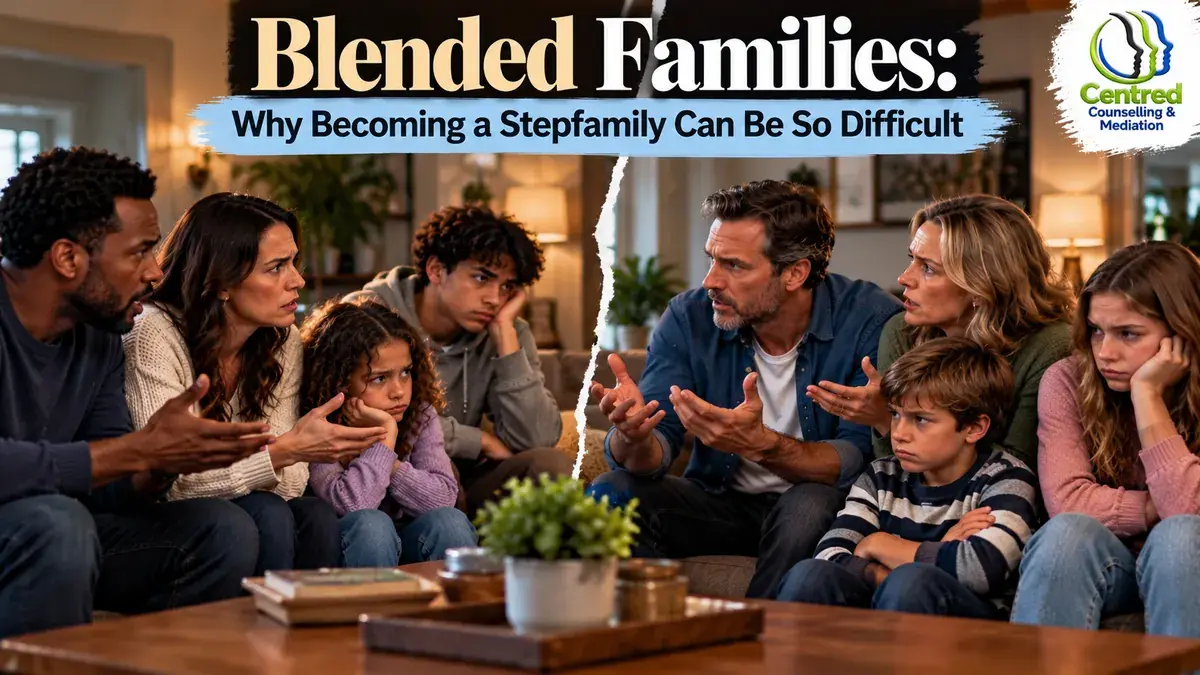
[Download the supplied image](C:/Users/cash/OneDrive/Desktop/webtemlates/centeredcounseling/blogs/Blended_Families_Blog_Image_Under_100KB.webp)
From the Counsellor’s Chair
Blended Families: Why Becoming a Stepfamily Can Be So Difficult
Bringing two families together doesn’t automatically create one family. Sometimes it creates two family systems trying to learn how to live under one roof.
Blended families can be rewarding, but they can also involve challenges that traditional family structures may not face in the same way. A new partner may enter an established parent-child relationship. Children may have to adjust to new household rules, new siblings and a new adult in a parental role.
At the same time, the adults may be trying to build a new relationship while managing parenting responsibilities, relationships with former partners and the emotional needs of their children.
This can create tension even when everyone genuinely wants the new family to work.
What Is a Blended Family?
A blended family generally refers to a family in which at least one adult has children from a previous relationship and those children become part of a new household or family structure.
There is no single model for a blended family. Children may live primarily with one parent, move between households, or share time between parents. A stepfamily may include stepchildren, half-siblings, step-siblings and children who remain closely connected to another household.
The complexity of these relationships means that there is rarely a simple set of rules that works for every blended family.
Why Love Doesn’t Automatically Make a Blended Family Work
A couple can have a strong and loving relationship and still struggle to integrate their families.
Adults may assume that because they love each other, the children will naturally develop the same connection. Children, however, may experience the new relationship very differently.
A child may feel that their parent’s new partner is taking attention away from them. They may worry that accepting a stepparent means betraying their other parent. They may also simply need time to become comfortable with a person who was previously a stranger.
Connection cannot be forced. It generally develops through repeated experiences of safety, consistency and respect.
The Loyalty Conflict
One of the most important concepts in blended-family relationships is the loyalty conflict.
A child may worry that liking or respecting a stepparent means they are being disloyal to their biological parent. Even when nobody explicitly says this, children can experience powerful internal pressure around loyalty.
For this reason, adults should be careful about putting children in situations where they feel they have to choose sides.
Children should generally be allowed to maintain their relationship with both biological parents without being expected to take responsibility for adult conflict.
The Stepparent’s Difficult Position
Stepparents can find themselves in an uncomfortable middle ground.
They may be expected to help with discipline, household responsibilities and emotional support, while simultaneously being told that they are not the child’s parent.
This can create frustration. A stepparent may think, “If I am expected to help raise this child, why can’t I have a say?”
At the same time, taking on too much parental authority too quickly can create resistance from the child.
Healthy blended families often require stepparents to build the relationship before expecting authority to come automatically.
Why Stepparents Shouldn’t Try to Replace a Parent
A stepparent does not need to become a replacement for a biological parent in order to have an important role in a child’s life.
Trying to erase the child’s existing relationship with their biological parent can create insecurity and resistance.
A more sustainable approach is often to become another trusted adult: someone who provides consistency, support, guidance and appropriate boundaries without demanding that the child immediately see them as a parent.
Different Parenting Styles
One of the biggest sources of conflict in blended families is disagreement over parenting.
- Discipline: One adult may believe in strict consequences while another prefers a more flexible approach.
- Household rules: Children who previously lived under different rules may struggle when those expectations suddenly change.
- Technology: Screen time, phones, gaming and social media can become major areas of disagreement.
- Independence: Adults may disagree about how much freedom children should have at different ages.
- Responsibilities: Chores and household contributions may be interpreted differently by each family member.
These differences become particularly difficult when adults disagree in front of the children or undermine each other’s decisions.
When the Biological Parent Feels Caught in the Middle
The biological parent can sometimes feel as though they are constantly being forced to choose between their partner and their children.
The partner may feel that the parent always sides with the child. The child may feel that the parent is choosing the new partner over them.
This triangle can create significant pressure within the household.
The solution is rarely for the parent to choose one relationship over another. Instead, the adults often need to clarify roles, expectations and boundaries so that the child does not become responsible for resolving adult disagreements.
Step-Siblings and Different Family Cultures
Step-siblings may have completely different expectations about what family life should look like.
One child may have grown up in a quiet home while another is used to a busy household. One may be accustomed to sharing everything while another has always had their own space.
Even apparently small differences can cause conflict when children suddenly have to share bedrooms, possessions, attention or parental time.
Adults should avoid expecting step-siblings to become close immediately. A respectful relationship is often a more realistic starting point than instant sibling-like affection.
The Role of the Other Biological Parent
Blended families can become especially complicated when children move between two households.
Parents may have different rules, routines and expectations. Children may hear different messages about the new family structure depending on which household they are in.
Where possible, adults should avoid placing children in the middle of parental disagreements.
Children should not be used as messengers, sources of information about the other household, or emotional intermediaries between adults.
When Ex-Partners Are Part of the Family System
A previous relationship does not disappear simply because a new relationship begins, particularly when children are involved.
This can be difficult for a new partner who may feel uncomfortable with the ongoing contact between their partner and an ex.
Co-parenting requires communication and boundaries. The goal is not necessarily for everyone to become friends. It is to establish a workable system that protects the children’s wellbeing and reduces unnecessary conflict.
Blended Families Take Time
One of the most important expectations for a blended family is patience.
A new household may look very different from the family structure that existed before. Children may need time to adjust to a new partner, new rules, new siblings and new routines.
Adults may also need time to discover what works and what does not.
There is no universal timetable for when a blended family should feel completely settled.
How to Build a Healthier Blended Family
- Prioritise the couple relationship: The adult relationship needs attention without making children responsible for maintaining it.
- Build relationships before demanding authority: Stepparents can focus on trust and connection before expecting immediate parental authority.
- Create clear household expectations: Rules should be discussed openly between adults and communicated consistently.
- Avoid forcing closeness: Children should not be pressured to call someone “Mom” or “Dad”, or to feel a particular level of affection.
- Keep adult conflict between adults: Children should not be placed in the middle of disagreements about former partners, money or parenting.
- Allow individual time: Children and adults may all benefit from maintaining one-on-one relationships within the larger family system.
- Respect existing relationships: A new family structure should not require children to abandon meaningful relationships with their other biological parent.
- Accept that different relationships develop differently: A stepparent may have a close relationship with one child and a more distant relationship with another. This does not automatically mean the family is failing.
When Blended Family Problems Become Serious
Some adjustment difficulties are normal. However, counselling may be worth considering when conflict becomes persistent or begins affecting the emotional wellbeing of family members.
- Constant arguments between parents and children
- A stepparent and child becoming increasingly hostile toward one another
- The biological parent feeling trapped between relationships
- Repeated conflict over discipline
- Children refusing contact or becoming highly distressed about household changes
- Ongoing conflict with an ex-partner affecting the children
- Communication between adults breaking down
- The couple relationship deteriorating because of family conflict
How Family Counselling Can Help
Family counselling can provide a structured environment where each person has an opportunity to explain how they are experiencing the family system.
Counselling may focus on communication, boundaries, parenting roles, step-parent relationships, sibling relationships and conflict between adults.
- Clarifying family roles
- Improving communication
- Reducing repeated arguments
- Developing healthier boundaries
- Working through resentment
- Supporting the couple relationship
- Managing parenting disagreements
- Helping family members understand different perspectives
Final Thoughts
A blended family does not have to look exactly like a traditional family in order to be healthy.
The goal is not to force everyone to feel the same way about one another. The goal is to create a family environment in which people can develop trust, communicate respectfully and understand their different roles.
Sometimes the strongest blended families are not the ones without conflict. They are the ones that learn how to manage conflict without allowing it to define the family.
About Centred Counselling & Mediation
Centred Counselling & Mediation provides counselling for adults and families experiencing communication difficulties, parenting challenges, relationship conflict, blended-family difficulties and major life transitions.
Family counselling is available in Sunninghill, Sandton, as well as online.
Let’s get you back on track!