---
title: "LGBTQ+ Relationships: Rejection, Family Pressure and Conflict | Centred Counselling"
description: Explore how LGBTQ+ couples can manage family rejection, privacy, relationship conflict and boundaries while protecting their connection and wellbeing.
image: https://www.centredcounselling.co.za/hubfs/LGBTQ_Relationships_Family_Pressure_Blog_Image_Under_100KB.webp
---
1332 Naivasha Road, Sunninghill
[info@centredcounselling.co.za](mailto:info@centredcounselling.co.za)
[084 485 3541](https://wa.me/27844853541)
[](https://www.centredcounselling.co.za/)
- [Home](https://www.centredcounselling.co.za)
- [About Me](https://www.centredcounselling.co.za/about-me)
- [Articles](https://www.centredcounselling.co.za/article)
- [Counselling](https://www.centredcounselling.co.za/counselling)
- [All Counselling Services](https://www.centredcounselling.co.za/counselling)
- [ADHD Counselling](https://www.centredcounselling.co.za/adhd-counselling-sunninghill)
- [Anger Management](https://www.centredcounselling.co.za/anger-management-sunninghill)
- [Chronic Pain Counselling](https://www.centredcounselling.co.za/chronic-pain-counselling-centred-counselling)
- [Grief Counselling](https://www.centredcounselling.co.za/grief-counselling-sunninghill)
- [LGBTQ+](https://www.centredcounselling.co.za/lgbtq-counselling-in-sandton-centred-counselling-mediation)
- [Marriage Counselling](https://www.centredcounselling.co.za/marriage-counselling-in-sunninghill-sandton-centred-counselling)
- [Porn Addiction](https://www.centredcounselling.co.za/porn-addiction-counselling-in-sandton-centred-counselling)
- [Premarital Counselling](https://www.centredcounselling.co.za/premarital-counselling-in-sunninghill-sandton-centred-counselling)
- [Relationship Counselling](https://www.centredcounselling.co.za/relationship-counselling-in-sunninghill-centred-counselling)
- [Mediation](https://www.centredcounselling.co.za/mediation)
- [Video Resources](https://www.centredcounselling.co.za/mental-health-vlogs-video-resources)
- [Contact](https://www.centredcounselling.co.za/contact-us)
- [Book NOW](https://www.centredcounselling.co.za/booking)
[BOOK NOW](https://www.centredcounselling.co.za/booking) [WHATSAPP US](https://wa.me/27844853541)
[LGBTQ+](https://www.centredcounselling.co.za/centred-counselling-blog/tag/lgbtq)
# LGBTQ+ Relationships: Rejection, Family Pressure and Conflict | Centred Counselling

Byron Werbeloff
Author
Oct 22, 2026, 4:45:15 AM
**Polyamory and Open Relationships email moved to Checked off.**
**Next: LGBTQ+ Relationships and Family Pressure — 9 October 2026**
**Page title:** LGBTQ+ Relationships: Rejection, Family Pressure and Conflict | Centred Counselling
**Meta description:** Explore how LGBTQ+ couples can manage family rejection, privacy, relationship conflict and boundaries while protecting their connection and wellbeing.
\[Download the supplied image\](C:/Users/cash/OneDrive/Desktop/webtemlates/centeredcounseling/blogs/LGBTQ\_Relationships\_Family\_Pressure\_Blog\_Image\_Under\_100KB.webp)
---
# From the Counsellor’s Chair
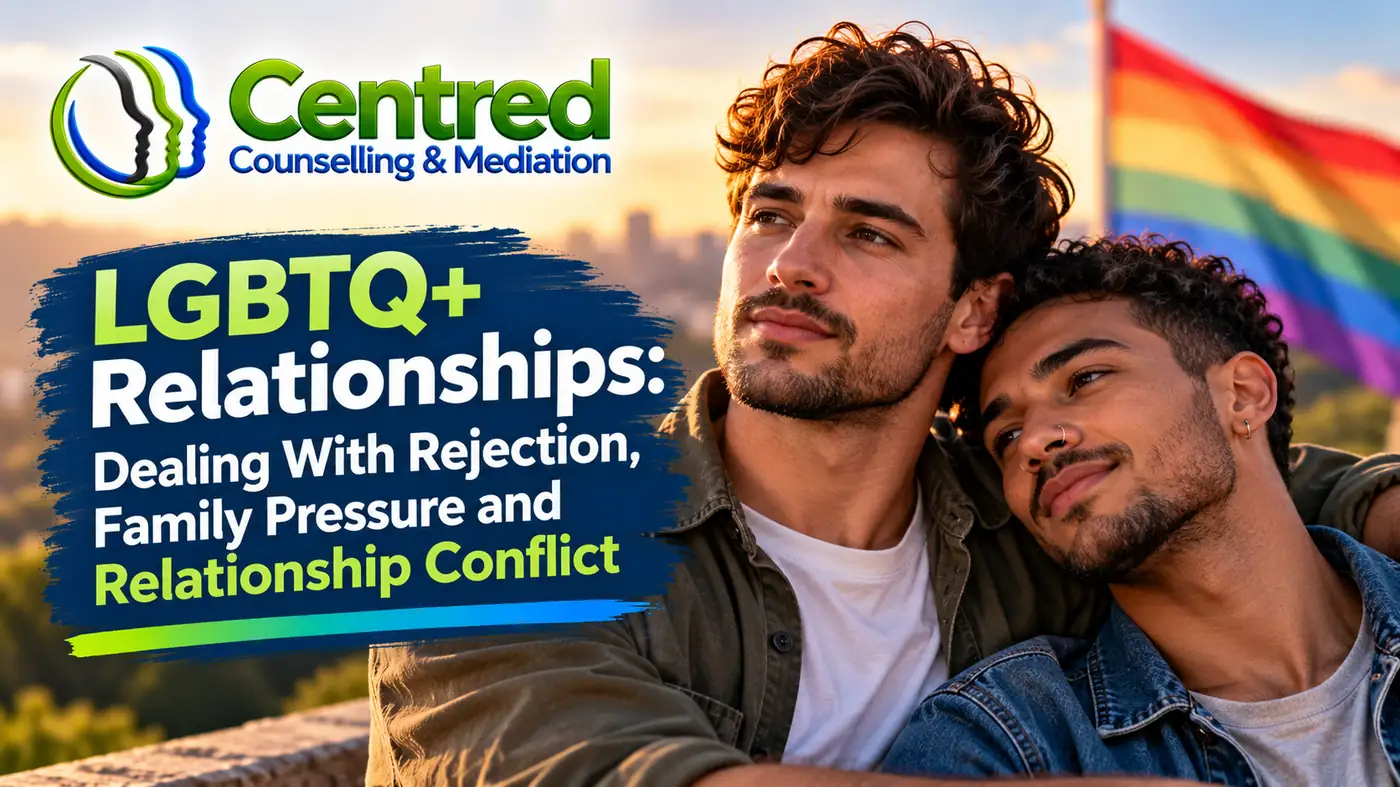
## LGBTQ+ Relationships: Dealing With Rejection, Family Pressure and Relationship Conflict
LGBTQ+ relationships can face many of the same challenges as other relationships: communication difficulties, disagreements, changes in intimacy, financial stress and uncertainty about the future. Some couples also face additional pressure when family members, friends, workplaces or communities respond negatively to their relationship or identity.
When outside pressure enters a relationship, partners may disagree about how open to be, whether to attend family events, how to respond to hurtful comments, or how much contact to maintain with people who are rejecting them. These disagreements can become painful because both partners may be trying to protect something important: their relationship, their safety, their family ties or their sense of belonging.
There is no single correct way for every couple to manage these pressures. The goal is to communicate honestly, respect each person’s boundaries and make decisions together without asking one partner to sacrifice their safety or identity to keep the peace.
### When Family Acceptance Becomes a Source of Stress
Family rejection can take many forms. It may involve direct criticism, refusal to acknowledge a partner, exclusion from family events, pressure to keep a relationship secret, or threats to withdraw emotional or financial support. Sometimes rejection is explicit; at other times it appears through repeated jokes, dismissive comments or the assumption that a relationship should not be taken seriously.
These experiences can be especially difficult when family relationships are close or when partners depend on relatives for housing, money, childcare or practical help. It is understandable to want acceptance while also wanting to avoid conflict. A person may need time to decide what contact feels possible and safe.
A partner who is struggling with family rejection may feel grief, anger, shame, anxiety or a sense of being caught between loved ones. Their partner may feel protective, frustrated or exhausted by repeatedly witnessing the hurt. Both experiences deserve attention, without treating either person as the problem.
### When Partners Disagree About Coming Out or Being Public
One partner may want to be open about the relationship, while the other may prefer privacy or may not feel safe disclosing it to family, colleagues or the wider community. These differences can be interpreted as a lack of commitment, but the reasons may be more complicated. Concerns about employment, housing, financial dependence, children, cultural expectations or personal safety can all influence a person’s choices.
Rather than assuming the worst, ask what being open or private means to each person. Does privacy feel protective, or does it leave one partner feeling hidden and unimportant? Does public disclosure feel affirming, or could it expose someone to genuine risk? Both partners can explain their needs, but neither should be pressured into disclosure or forced into secrecy without a meaningful conversation.
### Create a Shared Plan for Difficult Family Situations
Couples can reduce repeated conflict by discussing difficult situations before they happen. For example, before a family gathering, agree on what you will do if a relative makes a hurtful comment, refuses to acknowledge the relationship or asks intrusive questions. Decide whether you will respond together, leave early, take a break or contact a supportive person afterwards.
- **Agree on the boundary.** Be clear about which behaviour is unacceptable and what response you will take if it occurs.
- **Decide what to share.** You and your partner can protect your privacy without having to explain every personal detail to relatives.
- **Support each other in the moment.** Ask your partner whether they want you to respond, stand beside them quietly or help them leave.
- **Review afterwards.** Discuss what worked, what hurt and what you might do differently next time.
- **Avoid making promises under pressure.** Do not agree to ongoing secrecy, estrangement or contact arrangements simply to end an argument in the moment.
### Protect the Relationship Without Isolating Yourselves
When relatives are rejecting, couples may understandably turn toward each other for comfort. At the same time, ongoing conflict can place strain on the relationship if every conversation becomes about family disapproval or if one partner feels responsible for managing the other’s distress.
Where possible, build support beyond the relationship. Trusted friends, affirming community groups or individual counselling may provide space to process feelings without making one partner the only source of emotional support. This is not a reason to tolerate harmful family behaviour; it is a way to ensure that both partners have support and room to breathe.
### Communication When Outside Pressure Causes Conflict
A disagreement about family contact or disclosure can quickly become personal. One partner may say, “You’re ashamed of me,” while the other may feel accused of being careless about safety. Try to move from accusations toward the concern underneath the reaction.
- “When we avoid mentioning our relationship, I feel invisible. Can we talk about what privacy means to each of us?”
- “I want to stand up for us, but I’m worried about what might happen if we disclose this. Can we plan a safer approach together?”
- “When your family criticises me, I need to know we will discuss how to handle it rather than pretend it did not happen.”
- “I care about your family, but I cannot keep attending events where I am insulted. Let’s discuss another option.”
### Set Boundaries With Family Members
Boundaries clarify what behaviour you will accept and how you will respond if it continues. They are not a way to force relatives to agree with your relationship. A boundary might mean ending a conversation when insults begin, limiting visits, refusing to discuss private details, or choosing not to attend an event where you expect to be humiliated.
Boundaries work best when they are realistic and can be followed through. If you rely on relatives for housing, finances or care, consider the practical risks before making a change. You may need advice and support to plan safely. You do not have to confront someone immediately to begin thinking about what would protect your wellbeing.
### When Children or Extended Family Are Involved
If children are involved, parents may need to consider their emotional wellbeing, age-appropriate explanations, privacy and how to respond to questions from relatives or school communities. Children should not be used as messengers in adult conflict or pressured to take sides. The details will vary by family, and legal questions about parenting or contact should be discussed with an appropriately qualified professional.
Extended family members may also disagree about how the relationship should be acknowledged. Partners can discuss which events they want to attend, how introductions will be handled and what behaviour is necessary for contact to continue. The aim is not to control every relative’s opinion, but to agree on how the couple will protect respect and emotional safety.
### Recognise When Conflict Becomes Unsafe
Not all relationship or family conflict is simply a communication problem. Threats, stalking, physical violence, coercive control, forced disclosure or attempts to make someone financially dependent can create serious safety concerns. In these circumstances, avoid assuming that a joint conversation or couples session is automatically the right first step.
Prioritise safety and seek appropriate support if you or your partner are at risk. If disclosure could lead to violence, homelessness or loss of essential support, careful planning may be safer than immediate confrontation. The person experiencing the risk should have a say in decisions about what happens next.
### How LGBTQ+-Affirming Relationship Counselling Can Help
Affirming relationship counselling can help couples discuss family pressure, differences about privacy, repeated arguments, boundaries and the emotional impact of rejection. A counsellor may help partners hear each other’s concerns, identify shared values, practise difficult conversations and make realistic plans for family contact.
Counselling should not treat LGBTQ+ identity or the relationship itself as the problem. It should not pressure someone to come out, remain closeted, reconcile with rejecting relatives or cut off family contact. Instead, the work should support informed decisions, respect, safety and the needs of both partners.
Individual counselling may also be useful when one partner needs space to process grief, anxiety or family conflict separately. The appropriate format depends on the circumstances, including whether both people can participate freely and safely.
### You Do Not Have to Solve Everything at Once
Family acceptance may take time, and some relatives may never respond in the way you hoped. You and your partner can still work toward a relationship built on honesty, care, mutual respect and choices that reflect your circumstances. You can decide what to share, which boundaries to set and how much contact feels manageable.
If family pressure or conflict is affecting your relationship, Centred Counselling & Mediation offers counselling in Sunninghill, Sandton, and online. You can contact the practice to discuss whether counselling may be appropriate for your circumstances.
### Frequently Asked Questions
#### How can LGBTQ+ couples deal with family rejection?
Talk openly about the emotional impact, agree on boundaries and make plans for difficult family interactions. Build support beyond the relationship and consider safety and practical dependence before changing contact.
#### What if one partner wants to come out and the other does not?
Explore the reasons behind each person’s position, including privacy, safety and the need to feel acknowledged. Avoid pressuring someone to disclose or demanding secrecy without discussion.
#### Should I cut off family members who reject my relationship?
There is no single answer. Some people limit contact, some set firm boundaries, and some maintain contact under specific conditions. Consider your wellbeing, safety, practical circumstances and what behaviour you are willing to accept.
#### How can we stop family conflict from damaging our relationship?
Discuss concerns before difficult events, agree on how to respond to disrespect, check in afterwards and avoid making one partner solely responsible for managing family relationships.
#### Can couples counselling help with LGBTQ+ relationship conflict?
Affirming counselling can help partners communicate, explore different needs and set boundaries, provided the process respects each person’s autonomy and safety.
#### What if family pressure includes threats or violence?
Prioritise safety and seek appropriate support. Do not assume that confrontation or joint counselling is safe when coercion, threats or abuse are present.
**Tagged with:** [LGBTQ+](https://www.centredcounselling.co.za/centred-counselling-blog/tag/lgbtq)

#### Byron Werbeloff
KEEP READING
## Related Articles
[](https://www.centredcounselling.co.za/centred-counselling-blog/polyamory-and-open-relationships-building-healthy-relationships-centred-counselling)
Oct 22, 2026, 4:40:41 AM Byron Werbeloff
### [Polyamory and Open Relationships: Building Healthy Relationships | Centred Counselling](https://www.centredcounselling.co.za/centred-counselling-blog/polyamory-and-open-relationships-building-healthy-relationships-centred-counselling)
**Gender Transition email moved to Checked off.**
[READ FULL ARTICLE](https://www.centredcounselling.co.za/centred-counselling-blog/polyamory-and-open-relationships-building-healthy-relationships-centred-counselling)
[](https://www.centredcounselling.co.za/centred-counselling-blog/porn-addiction-and-relationships-centred-counselling)
Oct 22, 2026, 4:05:29 AM Byron Werbeloff
### [Porn Addiction and Relationships | Centred Counselling](https://www.centredcounselling.co.za/centred-counselling-blog/porn-addiction-and-relationships-centred-counselling)
Previous email moved to **Checked off**.
[READ FULL ARTICLE](https://www.centredcounselling.co.za/centred-counselling-blog/porn-addiction-and-relationships-centred-counselling)
[](https://www.centredcounselling.co.za/centred-counselling-blog/lgbtq-mental-health-anxiety-depression-and-support-centred-counselling)
Oct 22, 2026, 4:48:05 AM Byron Werbeloff
### [LGBTQ+ Mental Health: Anxiety, Depression and Support | Centred Counselling](https://www.centredcounselling.co.za/centred-counselling-blog/lgbtq-mental-health-anxiety-depression-and-support-centred-counselling)
**Relationships and Family Pressure email moved to Checked off.**
[READ FULL ARTICLE](https://www.centredcounselling.co.za/centred-counselling-blog/lgbtq-mental-health-anxiety-depression-and-support-centred-counselling)
Empowering individuals and couples through evidence-based counselling and mediation. Registered ASCHP professional (WC24/9024).
Quick Links
- [Home](https://www.centredcounselling.co.za)
- [About Me](https://www.centredcounselling.co.za/about-me)
- [Articles](https://www.centredcounselling.co.za/article)
- [Counselling](https://www.centredcounselling.co.za/counselling)
- [Mediation](https://www.centredcounselling.co.za/mediation)
- [Video Resources](https://www.centredcounselling.co.za/mental-health-vlogs-video-resources)
- [Contact](https://www.centredcounselling.co.za/contact-us)
- [Book NOW](https://www.centredcounselling.co.za/booking)
Resources
- [FAQ](https://www.centredcounselling.co.za/counselling#faq)
- [FAQ Mediation](https://www.centredcounselling.co.za/mediation#faq)
- [Downloads](https://www.centredcounselling.co.za/article#resources)
- [Cookie Policy](https://www.centredcounselling.co.za/terms-conditions-policies#cookies)
- [Privacy Policy](https://www.centredcounselling.co.za/terms-conditions-policies#privacy)
- [Terms and Conditions](https://www.centredcounselling.co.za/terms-conditions-policies#terms)
Get in Touch
Call Us [084 485 3541](tel:0844853541)
WhatsApp [Chat with us](https://wa.me/27844853541)
Email Us [info@centredcounselling.co.za](mailto:info@centredcounselling.co.za)
© 2026 Centred Counselling & Mediation. All rights reserved.
[Design by SEO Website Design](https://www.seowebsitedesign.co.za)
[Chat with us](https://wa.me/27844853541)
```json
{
"@context" : "https://schema.org",
"@type" : "BlogPosting",
"author" : {
"@type" : "Person",
"name" : "Byron Werbeloff",
"url" : "https://www.centredcounselling.co.za/centred-counselling-blog/author/byron-werbeloff"
},
"dateModified" : "2026-10-22T08:45:15.930Z",
"datePublished" : "2026-10-22T08:45:15.000Z",
"headline" : "LGBTQ+ Relationships: Rejection, Family Pressure and Conflict | Centred Counselling",
"image" : [ "https://www.centredcounselling.co.za/hubfs/LGBTQ_Relationships_Family_Pressure_Blog_Image_Under_100KB.webp" ],
"mainEntityOfPage" : {
"@id" : "https://www.centredcounselling.co.za/centred-counselling-blog/lgbtq-relationships-rejection-family-pressure-and-conflict-centred-counselling",
"@type" : "WebPage"
},
"publisher" : {
"@type" : "Organization",
"logo" : {
"@type" : "ImageObject",
"url" : "https://www.centredcounselling.co.za/hubfs/logo.jpeg"
},
"name" : "Centred Counselling"
}
}
```
```json
{
"@context": "https://schema.org",
"@type": "LocalBusiness",
"name": "Centred Counselling & Mediation",
"image": "https://www.centredcounselling.co.za/hubfs/logo1.png",
"@id": "https://www.centredcounselling.co.za",
"url": "https://www.centredcounselling.co.za",
"telephone": "0844853541",
"email": "info@centredcounselling.co.za",
"address": {
"@type": "PostalAddress",
"streetAddress": "153A 9th Avenue",
"addressLocality": "Highlands North",
"addressRegion": "Johannesburg",
"postalCode": "2192",
"addressCountry": "ZA"
},
"geo": {
"@type": "GeoCoordinates",
"latitude": -26.1368,
"longitude": 28.0841
},
"openingHoursSpecification": {
"@type": "OpeningHoursSpecification",
"dayOfWeek": [
"Monday",
"Tuesday",
"Wednesday",
"Thursday",
"Friday"
],
"opens": "08:00",
"closes": "18:00"
},
"sameAs": [
"https://www.facebook.com/profile.php?id=61573738539849",
"https://www.instagram.com/centred_counselling/",
"https://www.linkedin.com/in/byron-werbeloff-475bb251/",
"https://www.tiktok.com/@centred.counselli"
],
"founder": {
"@type": "Person",
"name": "Byron Werbeloff",
}
}
```