The Empty Side of the Bed: Coping With the Loss of a Partner
From the Counsellor’s Chair
There are many different forms of grief, but losing a life partner can be particularly difficult because you aren't simply losing a person.
You are losing a relationship, a daily routine, a source of companionship, a shared identity and, often, a future you had imagined together.
Your partner may have been the person you spoke to when you woke up, the person you told about your day, the person you made plans with, argued with, laughed with and relied upon.
And then suddenly, they aren't there.
The silence can be one of the hardest parts.
You can walk into a room and instinctively expect to see them. You can reach for your phone to tell them something before remembering that you can't. You can hear a song, smell a perfume or see something they loved and suddenly feel as though the loss has happened all over again.
Your mind understands that they have died, but parts of your everyday life can continue to expect them to be there.
You're Not Just Mourning the Person
When we think about grief, we often focus on missing the person.
But when a partner dies, there can be several different losses happening simultaneously.
You may be grieving:
- The person themselves
- Physical affection and intimacy
- Companionship
- Your shared routines
- Your role as a partner
- Your social identity as a couple
- Financial or practical security
- Shared friendships and family connections
- Plans for the future
- The home and lifestyle you built together
- The person you were when you were with them
Sometimes people feel guilty because they aren't only grieving the person. They are also grieving everything that their death has changed.
That doesn't make the grief less genuine.
It means the loss is bigger than the absence of one person.
The Future You Imagined Has Also Changed
One of the less discussed aspects of losing a partner is grieving a future that will now never happen.
Perhaps you planned to grow old together. Perhaps you were going to travel. Perhaps you had plans for retirement. Perhaps you were going to have children, move homes or simply spend the next twenty years together.
Those plans don't die gradually.
They can disappear almost instantly.
You aren't only mourning the life you had. You're mourning the life you expected to have.
This is why milestones can be surprisingly painful.
A birthday. An anniversary. A holiday. A child's graduation. Retirement. Moving into a new home.
Even something positive can trigger grief because the person you expected to share it with isn't there.
Grief Doesn't Mean You Have to Stop Living
One of the most difficult psychological conflicts after the death of a partner is the feeling that moving forward somehow means moving on from them.
Some people worry that laughing again means they are forgetting their partner. Others feel guilty when they enjoy themselves.
You may even find yourself thinking: “How can I be happy when they're not here?”
But happiness doesn't erase grief.
You can miss someone terribly and still have a good day.
You can laugh with friends and still love your deceased partner.
You can eventually fall in love again without replacing the person who died.
You can build a new life without deciding that the old one didn't matter.
Moving forward is not the same as moving on.
The Importance of Continuing Bonds
Modern approaches to grief increasingly recognise something called continuing bonds.
You don't necessarily have to sever your emotional connection with someone who has died in order to continue living.
Your relationship with them changes, but it doesn't necessarily disappear.
You might still talk about them. You might still keep their photographs. You might still cook their favourite meal. You might still ask yourself what they would have said about a particular situation. You might still celebrate their birthday.
These aren't necessarily signs that you are “stuck.” They can be ways of incorporating the person into the story of your life.
Ways to Mourn the Death of Your Partner
There is no single correct way to mourn. Different people need different rituals, and what feels meaningful to one person may feel completely wrong to another.
1. Create a memory space
Create a small area in your home dedicated to your partner. It might contain photographs, a favourite object, letters or something meaningful from your relationship. This can provide a physical place where memories can be acknowledged.
2. Talk about them
Don't be afraid to say their name. Tell stories about them. Talk about the things that made them laugh. Saying “She would have loved this” or “He used to do exactly that” can allow the relationship to remain part of everyday conversation.
3. Keep meaningful traditions
Continue a tradition that you shared. Watch the same movie, cook their favourite meal, visit somewhere important to both of you, or listen to a particular song. These rituals can provide continuity.
4. Write to them
Write a letter to your deceased partner. Tell them what you miss, what you're angry about, what you wish had happened differently, what has happened since they died, and what you wish you could tell them.
5. Create something in their memory
Plant a tree, create a photo album or memory book, donate to a cause they cared about, support an organisation connected to their life, or create a yearly remembrance ritual.
6. Allow yourself to experience the difficult days
There can be enormous pressure to “be strong.” Some days may be productive, some miserable, some social and others solitary. You don't have to perform recovery for other people.
7. Look after your physical needs
Grief is psychological, but it is also physical. Sleep, appetite, concentration and energy can all change. Eat something, drink enough water, get outside, walk when you can and maintain some structure.
8. Accept support — even when you don't feel like talking
You don't necessarily need someone to fix your grief. Sometimes you simply need someone to sit with you. Tell people what you actually need.
What About the Belongings?
What do you do with their clothes, phone, photographs, toiletries or side of the wardrobe? There is no requirement to make these decisions immediately.
Some people want to pack everything away. Others cannot bear to move anything. Neither response is automatically healthier.
If possible, give yourself permission to take your time. You don't have to decide what the rest of your life will look like while you're still trying to understand what happened.
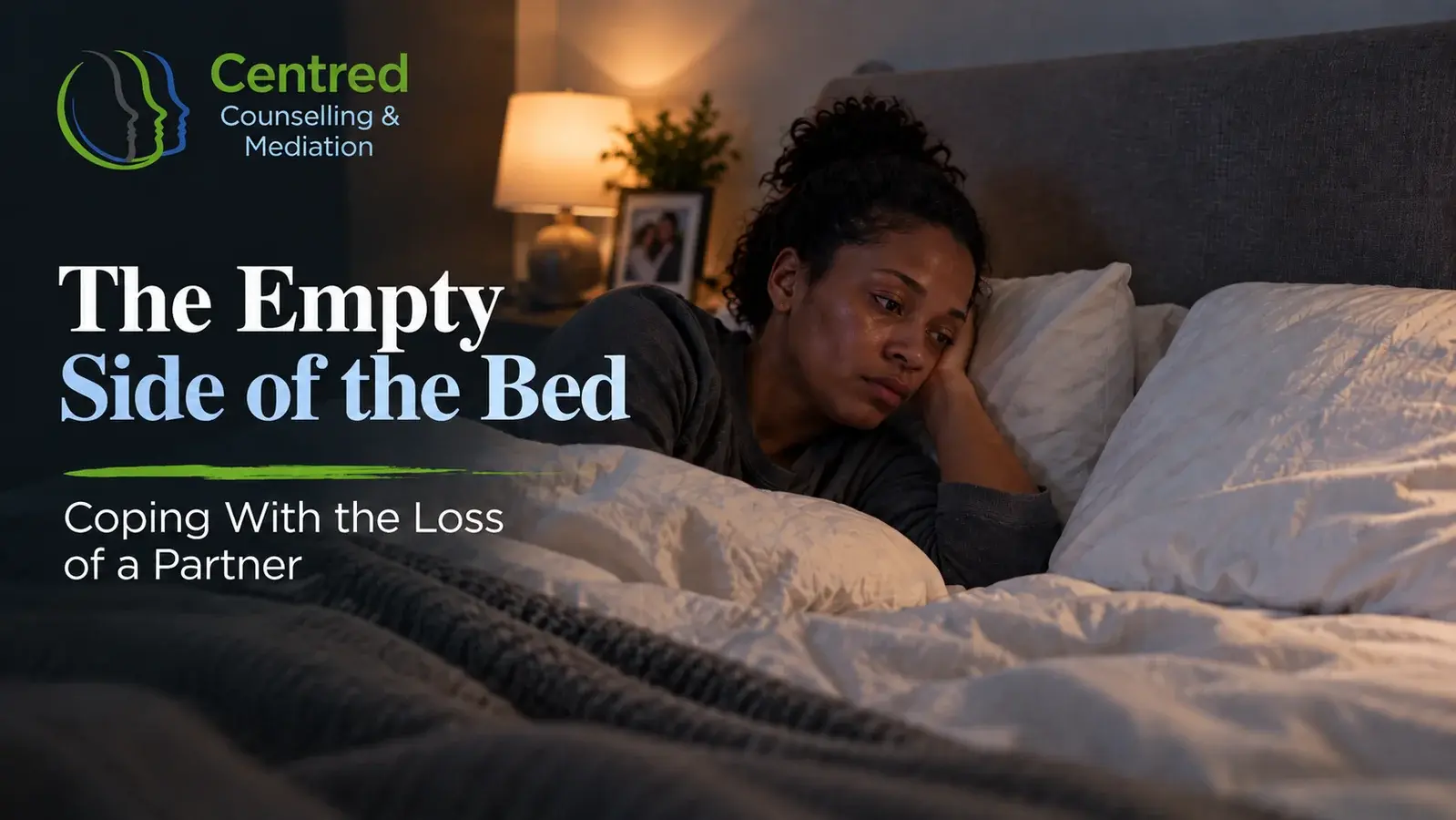
The Empty Side of the Bed
For many people who lose a partner, nighttime can be particularly difficult.
The bed becomes a physical reminder of the absence. There may be no one to say goodnight to. No familiar breathing. No warmth next to you. No conversation before falling asleep.
Creating a new evening routine can help. It doesn't replace the person. It gives your brain something predictable to hold onto while you adjust to a profoundly different environment.
Eventually, the Question Changes
In the early stages of grief, the question might be: “How am I going to survive without them?”
Later, the question may gradually become: “How do I build a life that includes what happened?”
The goal isn't necessarily to return to the person you were before the loss. You may never be exactly the same.
The goal can instead become learning how to construct a meaningful life around a loss that cannot be undone.
And that process takes time.
When Professional Support Can Help
Grief doesn't automatically require counselling. Many people gradually adapt through relationships, community, culture, spirituality and their own coping mechanisms.
But sometimes grief becomes overwhelming.
If someone remains unable to function, becomes increasingly isolated, experiences persistent hopelessness, or feels that life has become impossible to manage, professional support may be appropriate.
Counselling doesn't mean someone is trying to “fix” you. There is nothing to fix about loving someone and missing them after they die.
Counselling can provide a place to process the loss, make sense of the changes, work through difficult emotions and begin figuring out what life looks like now.
You Don't Have to Forget Them
Perhaps one of the most important things to understand about losing a partner is this: Healing doesn't require forgetting.
You don't have to stop loving them. You don't have to stop missing them. You don't have to remove every photograph. You don't have to stop talking about them.
Over time, the grief may become less dominant. The memories may become less painful. You may laugh when you remember something they did. You may eventually experience happiness without immediately feeling guilty about it.
And there may still be moments when the loss hits you unexpectedly.
That doesn't mean you've failed.
It means that someone important was part of your life.
The Takeaway
When a partner dies, you don't simply lose the person you love. You lose a shared life, a daily presence and a future you expected to experience together.
There is no correct timetable for recovering from that.
Mourning may involve crying, talking, remembering, creating rituals, keeping traditions, writing, visiting meaningful places or simply allowing yourself to feel whatever is present that day.
The relationship may have ended in its physical form, but the meaning of that relationship doesn't have to disappear.
You don't have to leave your partner behind in order to move forward.
Sometimes healing means learning how to carry their memory with you while slowly discovering what your life can become.
Centred Counselling & Mediation
Byron Werbeloff
Specialist Wellness Counsellor & Mediator
If you are struggling with the loss of a partner or someone close to you, counselling can provide a safe space to process the loss, understand your emotions and begin adjusting to life after bereavement.
Centred Counselling & Mediation
1332 Naivasha Road, Sunninghill, Sandton, 2191
084 485 3541
www.centredcounselling.co.za
In-person sessions in Sunninghill and online sessions available.
Centred Counselling & Mediation — helping you find your way forward through life's difficult transitions.
Let’s get you back on track!