---
title: Understanding Delayed Grief | Centred Counselling
description: Understand why grief can emerge weeks or months after a loss, what delayed grief can feel like and how counselling can help you process your emotions.
image: https://www.centredcounselling.co.za/hubfs/When_Grief_Comes_Later_Old_Man_under_100KB.webp
---
1332 Naivasha Road, Sunninghill
[info@centredcounselling.co.za](mailto:info@centredcounselling.co.za)
[084 485 3541](https://wa.me/27844853541)
[](https://www.centredcounselling.co.za/)
- [Home](https://www.centredcounselling.co.za)
- [About Me](https://www.centredcounselling.co.za/about-me)
- [Articles](https://www.centredcounselling.co.za/article)
- [Counselling](https://www.centredcounselling.co.za/counselling)
- [All Counselling Services](https://www.centredcounselling.co.za/counselling)
- [ADHD Counselling](https://www.centredcounselling.co.za/adhd-counselling-sunninghill)
- [Anger Management](https://www.centredcounselling.co.za/anger-management-sunninghill)
- [Chronic Pain Counselling](https://www.centredcounselling.co.za/chronic-pain-counselling-centred-counselling)
- [Grief Counselling](https://www.centredcounselling.co.za/grief-counselling-sunninghill)
- [LGBTQ+](https://www.centredcounselling.co.za/lgbtq-counselling-in-sandton-centred-counselling-mediation)
- [Marriage Counselling](https://www.centredcounselling.co.za/marriage-counselling-in-sunninghill-sandton-centred-counselling)
- [Porn Addiction](https://www.centredcounselling.co.za/porn-addiction-counselling-in-sandton-centred-counselling)
- [Premarital Counselling](https://www.centredcounselling.co.za/premarital-counselling-in-sunninghill-sandton-centred-counselling)
- [Relationship Counselling](https://www.centredcounselling.co.za/relationship-counselling-in-sunninghill-centred-counselling)
- [Mediation](https://www.centredcounselling.co.za/mediation)
- [Video Resources](https://www.centredcounselling.co.za/mental-health-vlogs-video-resources)
- [Contact](https://www.centredcounselling.co.za/contact-us)
- [Book NOW](https://www.centredcounselling.co.za/booking)
[BOOK NOW](https://www.centredcounselling.co.za/booking) [WHATSAPP US](https://wa.me/27844853541)
[Relationship](https://www.centredcounselling.co.za/centred-counselling-blog/tag/relationship) [Grief Counselling](https://www.centredcounselling.co.za/centred-counselling-blog/tag/grief-counselling)
# Understanding Delayed Grief | Centred Counselling

Byron Werbeloff
Author
Oct 2, 2026, 2:32:37 AM
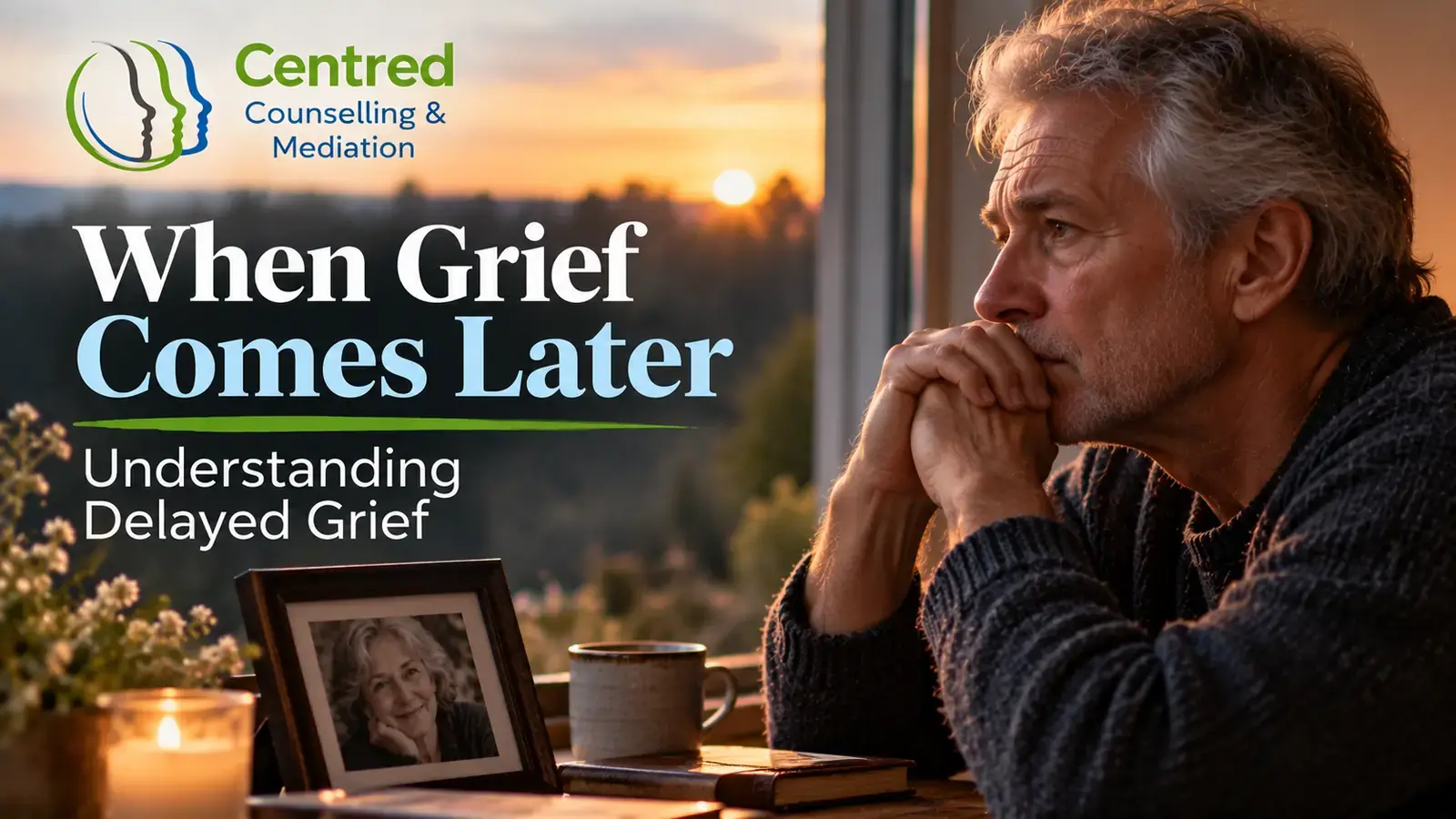
When Grief Comes Later: Understanding Delayed Grief
From the Counsellor’s Chair
Sometimes grief doesn't arrive when you expect it to.
Someone you love dies, and you expect to fall apart.
But you don't.
You organise the funeral. You deal with family. You handle paperwork. You go back to work. You look after the children. You help everyone else cope.
People may even tell you: “You're handling this really well.”
And perhaps, at the time, you genuinely feel that you are.
Then, weeks or months later, something changes.
You hear a song. You walk into a familiar place. You smell their perfume. You find an old photograph.
Or perhaps nothing obvious happens at all.
Suddenly, the grief arrives.
You start crying. You feel exhausted. You become irritable or withdrawn. You find yourself thinking about the person constantly.
And you may wonder:
“Why am I grieving now?”
The answer is that grief doesn't always follow the timetable we expect.
# What Is Delayed Grief?
“Delayed grief” is a term commonly used to describe a situation where a person's intense emotional response to a loss appears later rather than immediately.
It isn't a formal diagnosis in itself.
Grief can be delayed, muted, intermittent or initially difficult to access for many different reasons.
Sometimes the person is simply functioning on autopilot.
There may be practical responsibilities that need to be dealt with. There may be children who need looking after. There may be a funeral to organise, family members to support, work responsibilities to maintain or financial matters that cannot wait.
Your brain may effectively prioritise: “Get through today. We'll deal with the emotions later.”
And sometimes, later eventually arrives.
# Sometimes You Don't Have Time to Grieve
Imagine losing your partner while you have young children.
You still have to get them dressed. You still have to make breakfast. You still have to take them to school. You still have to answer questions. You still have to go to work.
You may not have the luxury of collapsing.
So you function.
You keep moving.
You tell yourself: “I'll deal with this when things settle down.”
But life doesn't necessarily settle down immediately.
Weeks become months.
And then one day, you finally have enough emotional space to experience what happened.
The grief wasn't necessarily absent. You may simply not have had the capacity to fully experience it yet.
# The Psychology Behind Delayed Grief
One useful way of understanding grief is through the Dual Process Model of Coping with Bereavement, developed by Margaret Stroebe and Henk Schut.
The model proposes that people naturally move between two broad modes of coping.
## Loss-oriented coping
This involves confronting the loss.
Thinking about the person. Missing them. Crying. Remembering. Talking about what happened. Experiencing sadness.
## Restoration-oriented coping
This involves dealing with life after the loss.
Going back to work. Managing finances. Looking after children. Learning new routines. Taking care of practical responsibilities. Trying to experience normality again.
Healthy grieving doesn't necessarily mean spending all your time confronting the loss.
We naturally move backwards and forwards between these two modes.
Sometimes we need to think about the person. Sometimes we need a break from thinking about them.
Sometimes we cry. Sometimes we watch television and laugh.
Sometimes we want to talk. Sometimes we don't want to talk at all.
This movement between confronting and temporarily stepping away from grief is part of how many people adapt to loss.
# Why Does Grief Sometimes Appear Months Later?
## 1. Shock and Emotional Numbness
Immediately following a death, some people experience shock or emotional numbness. This can feel strange. You may understand intellectually that the person has died, but emotionally it doesn't feel real. You may even feel guilty because you aren't crying. But numbness can occur during overwhelming experiences. It doesn't mean you didn't love the person.
## 2. Being the “Strong One”
Some people automatically become the person who holds everyone else together. They organise things. They support their family. They comfort their children. They deal with practical matters. They don't give themselves permission to fall apart. Eventually, however, the crisis passes. And once everyone else is okay, there may finally be space for their own grief.
## 3. Children Can Delay Their Own Grief
Parents sometimes put their grief aside because they are focused on protecting their children. “I need to be strong for them.” This can be necessary in the immediate aftermath. But children eventually return to school, routines resume and the family settles into a different reality. That's when the parent's own emotions may begin emerging.
## 4. The Reality of the Loss Takes Time to Become Real
Knowing that someone has died and feeling the reality of their absence aren't always the same thing. Initially, you may still expect them to phone. You might instinctively reach for your phone to tell them something. You may walk into a room expecting to see them. Over time, the permanence of the loss can become more psychologically real. That realisation can trigger intense grief.
# Sometimes the Trigger Seems Completely Unrelated
One of the most confusing aspects of delayed grief is that the trigger isn't always obvious.
You might suddenly cry while driving.
A particular smell may remind you of your mother.
You may hear an old song.
You might see someone who looks like your father.
You may find an old message on your phone.
Or you may simply wake up one morning feeling overwhelmingly sad.
The brain stores emotional associations in ways that aren't always conscious.
A seemingly insignificant reminder can connect you with memories and emotions associated with the person.
That's why grief can sometimes appear to come “out of nowhere.”
# Milestones Can Trigger Delayed Grief
Sometimes grief appears when you reach a point in your life that the person will never experience with you.
Your first birthday without them. Your wedding. The birth of your child. A graduation. A promotion. Moving into a new home. Retirement. A family holiday.
You may have been functioning relatively well until one of these moments arrives.
And suddenly you think:
“They're supposed to be here.”
This can be particularly painful because something that should be joyful becomes intertwined with the loss.
But this doesn't mean that you're going backwards.
Your relationship with the person is being experienced in the context of a new stage of your life.
# “Why Am I Only Crying Now?”
This question comes up frequently when people experience delayed grief.
They may feel embarrassed.
“Everyone else seemed to cope. Why am I falling apart now?”
But grief isn't a competition.
There is no award for grieving quickly.
There is no correct number of tears.
And there is no requirement to experience your strongest emotions immediately after someone dies.
Your emotional response may depend on your relationship with the person, the circumstances surrounding the death, your responsibilities, your previous experiences with loss, your support system and many other factors.
Your grief does not have to look like somebody else's.
# Delayed Grief Doesn't Mean You Didn't Care
This is perhaps one of the most important things to understand.
Some people feel guilty because they didn't experience intense grief immediately.
They think: “Maybe I didn't love them enough.”
That conclusion doesn't follow.
Grief isn't a measurement of love.
Someone can be devastated internally while appearing calm externally.
Someone can cry constantly.
Someone can experience numbness.
Someone can function normally for months and then suddenly break down.
There isn't a reliable emotional formula that tells us how much someone loved the person who died.
# What If You Feel Angry?
Delayed grief isn't necessarily sadness.
You might experience anger. You may become frustrated with your partner, children, colleagues or family.
You might feel angry about the circumstances of the death.
You may even feel angry with the person who died.
This can be uncomfortable.
But anger can be part of grief.
You can love someone and still be angry that they are gone.
You can miss someone and resent the circumstances surrounding their death.
You can wish they were still alive and simultaneously wish you had experienced more from the relationship.
Grief can contain contradictions.
# How Do You Work Through Delayed Grief?
The goal isn't to force yourself to grieve. If the emotions are beginning to emerge, however, it can be helpful to give them some space.
## Talk about what happened
Find someone you trust and allow yourself to talk about the person and the loss. You don't have to make the conversation positive. You don't have to find a lesson. You can simply talk.
## Allow yourself to remember
Look at photographs. Listen to their favourite music. Tell stories. Visit meaningful places. Remember who they were before they became someone you had to mourn.
## Write
Writing can help organise emotions that are difficult to express verbally. You could write about what you miss, what you're angry about, what you wish you could say, what you remember, what you wish had been different, and what you would tell them today.
## Don't judge the emotion
If you suddenly cry, don't immediately tell yourself: “I shouldn't still be feeling this.” Instead: “Something has reminded me of my loss. I can allow myself to feel this.”
## Maintain your routines
Grief can make ordinary life feel chaotic. Maintaining some structure around sleep, eating, work, exercise and social connection can provide stability while you process the emotional side of the loss.
# My Counselling Approach
When someone comes to counselling because they feel that their grief has arrived “late”, I don't begin by asking: “Why didn't you grieve earlier?”
I am more interested in understanding what was happening in their life when the loss occurred.
What responsibilities did they have? What did they have to manage? What emotions did they experience at the time? Did they have space to process what happened? What changed before the grief emerged?
And perhaps most importantly: What does the grief mean to them now?
Counselling provides a space where someone doesn't have to be the strong one.
They don't have to look after everyone else.
They don't have to minimise what happened.
They can be angry. They can cry. They can talk about the person. They can admit that they feel relieved. They can discuss complicated aspects of the relationship.
And they can explore the guilt that sometimes accompanies delayed grief.
The objective isn't to force grief out. It is to create enough safety for the person to experience what they are ready to experience.
# When Delayed Grief May Need Additional Support
Grief itself isn't a mental disorder.
However, sometimes someone may experience persistent and severe difficulties following a loss that interfere significantly with everyday functioning.
If you find that you are unable to function, increasingly isolated, experiencing persistent hopelessness, struggling with severe anxiety or trauma symptoms, or finding that the grief is becoming unmanageable, professional support may be appropriate.
Counselling doesn't mean that your grief is abnormal.
Sometimes it simply means that you don't want to carry it alone.
# The Takeaway
Delayed grief can be confusing.
You may wonder why you weren't devastated immediately.
You may wonder why you're struggling now.
You may even worry that something is wrong with you.
But grief doesn't operate according to a calendar.
Sometimes we have to function first.
Sometimes we have responsibilities that leave little room for emotional processing.
Sometimes the reality of the loss takes time to become psychologically real.
And sometimes a seemingly ordinary moment finally opens the door to emotions that have been waiting underneath the surface.
Grief arriving late doesn't mean you loved them late.
It doesn't mean you failed to grieve.
And it doesn't necessarily mean you're going backwards.
Sometimes it simply means that, finally, you have enough space to feel what happened.
And when that happens, you don't have to fight the grief.
You can sit with it, understand it and gradually learn how to carry the loss with you.
## Let’s get you back on track!
# Centred Counselling & Mediation
**Byron Werbeloff**
Specialist Wellness Counsellor & Mediator
If you are experiencing delayed grief or struggling to process the death of someone you love, counselling can provide a safe and non-judgemental space to understand your emotions, work through the loss and begin adjusting to life after bereavement.
**Centred Counselling & Mediation**
1332 Naivasha Road, Sunninghill, Sandton, 2191
084 485 3541
www.centredcounselling.co.za
In-person sessions in Sunninghill and online sessions available.
Centred Counselling & Mediation — helping you find your way forward through life's difficult transitions.
**Tagged with:** [Relationship](https://www.centredcounselling.co.za/centred-counselling-blog/tag/relationship) [Grief Counselling](https://www.centredcounselling.co.za/centred-counselling-blog/tag/grief-counselling)

#### Byron Werbeloff
KEEP READING
## Related Articles
[](https://www.centredcounselling.co.za/centred-counselling-blog/when-someone-you-love-dies-by-suicide)
Oct 2, 2026, 2:21:22 AM Byron Werbeloff
### [Grief After Suicide Loss | Centred Counselling](https://www.centredcounselling.co.za/centred-counselling-blog/when-someone-you-love-dies-by-suicide)
When Someone You Love Dies by Suicide: Understanding the Grief and Finding a Way Forward
[READ FULL ARTICLE](https://www.centredcounselling.co.za/centred-counselling-blog/when-someone-you-love-dies-by-suicide)
[](https://www.centredcounselling.co.za/centred-counselling-blog/grieving-the-death-of-a-parent)
Oct 4, 2026, 5:57:13 AM Byron Werbeloff
### [Grieving the Death of a Parent: Learning to Live With the Loss](https://www.centredcounselling.co.za/centred-counselling-blog/grieving-the-death-of-a-parent)
# Grieving the Death of a Parent: Learning to Live With the Loss
*From the Counsellor’s Chair*
[READ FULL ARTICLE](https://www.centredcounselling.co.za/centred-counselling-blog/grieving-the-death-of-a-parent)
[](https://www.centredcounselling.co.za/centred-counselling-blog/five-stages-of-grief)
Oct 4, 2026, 5:50:00 AM Byron Werbeloff
### [The Five Stages of Grief: Why Grief Doesn't Follow a Straight Line](https://www.centredcounselling.co.za/centred-counselling-blog/five-stages-of-grief)
# The Five Stages of Grief: Why Grief Doesn't Follow a Straight Line
*From the Counsellor’s Chair*
[READ FULL ARTICLE](https://www.centredcounselling.co.za/centred-counselling-blog/five-stages-of-grief)

Empowering individuals and couples through evidence-based counselling and mediation. Registered ASCHP professional (WC24/9024).
Quick Links
- [Home](https://www.centredcounselling.co.za)
- [About Me](https://www.centredcounselling.co.za/about-me)
- [Articles](https://www.centredcounselling.co.za/article)
- [Counselling](https://www.centredcounselling.co.za/counselling)
- [Mediation](https://www.centredcounselling.co.za/mediation)
- [Video Resources](https://www.centredcounselling.co.za/mental-health-vlogs-video-resources)
- [Contact](https://www.centredcounselling.co.za/contact-us)
- [Book NOW](https://www.centredcounselling.co.za/booking)
Resources
- [FAQ](https://www.centredcounselling.co.za/counselling#faq)
- [FAQ Mediation](https://www.centredcounselling.co.za/mediation#faq)
- [Downloads](https://www.centredcounselling.co.za/article#resources)
- [Cookie Policy](https://www.centredcounselling.co.za/terms-conditions-policies#cookies)
- [Privacy Policy](https://www.centredcounselling.co.za/terms-conditions-policies#privacy)
- [Terms and Conditions](https://www.centredcounselling.co.za/terms-conditions-policies#terms)
Get in Touch
Call Us [084 485 3541](tel:0844853541)
WhatsApp [Chat with us](https://wa.me/27844853541)
Email Us [info@centredcounselling.co.za](mailto:info@centredcounselling.co.za)
© 2026 Centred Counselling & Mediation. All rights reserved.
[Design by SEO Website Design](https://www.seowebsitedesign.co.za)
[Chat with us](https://wa.me/27844853541)
```json
{
"@context" : "https://schema.org",
"@type" : "BlogPosting",
"author" : {
"@type" : "Person",
"name" : "Byron Werbeloff",
"url" : "https://www.centredcounselling.co.za/centred-counselling-blog/author/byron-werbeloff"
},
"dateModified" : "2026-10-04T10:00:06.573Z",
"datePublished" : "2026-10-02T06:32:37.000Z",
"headline" : "Understanding Delayed Grief | Centred Counselling",
"image" : [ "https://www.centredcounselling.co.za/hubfs/When_Grief_Comes_Later_Old_Man_under_100KB.webp" ],
"mainEntityOfPage" : {
"@id" : "https://www.centredcounselling.co.za/centred-counselling-blog/when-grief-comes-later-understanding-delayed-grief",
"@type" : "WebPage"
},
"publisher" : {
"@type" : "Organization",
"logo" : {
"@type" : "ImageObject",
"url" : "https://www.centredcounselling.co.za/hubfs/logo.jpeg"
},
"name" : "Centred Counselling"
}
}
```
```json
{
"@context": "https://schema.org",
"@type": "LocalBusiness",
"name": "Centred Counselling & Mediation",
"image": "https://www.centredcounselling.co.za/hubfs/logo1.png",
"@id": "https://www.centredcounselling.co.za",
"url": "https://www.centredcounselling.co.za",
"telephone": "0844853541",
"email": "info@centredcounselling.co.za",
"address": {
"@type": "PostalAddress",
"streetAddress": "153A 9th Avenue",
"addressLocality": "Highlands North",
"addressRegion": "Johannesburg",
"postalCode": "2192",
"addressCountry": "ZA"
},
"geo": {
"@type": "GeoCoordinates",
"latitude": -26.1368,
"longitude": 28.0841
},
"openingHoursSpecification": {
"@type": "OpeningHoursSpecification",
"dayOfWeek": [
"Monday",
"Tuesday",
"Wednesday",
"Thursday",
"Friday"
],
"opens": "08:00",
"closes": "18:00"
},
"sameAs": [
"https://www.facebook.com/profile.php?id=61573738539849",
"https://www.instagram.com/centred_counselling/",
"https://www.linkedin.com/in/byron-werbeloff-475bb251/",
"https://www.tiktok.com/@centred.counselli"
],
"founder": {
"@type": "Person",
"name": "Byron Werbeloff",
}
}
```