From the Counsellor's Chair
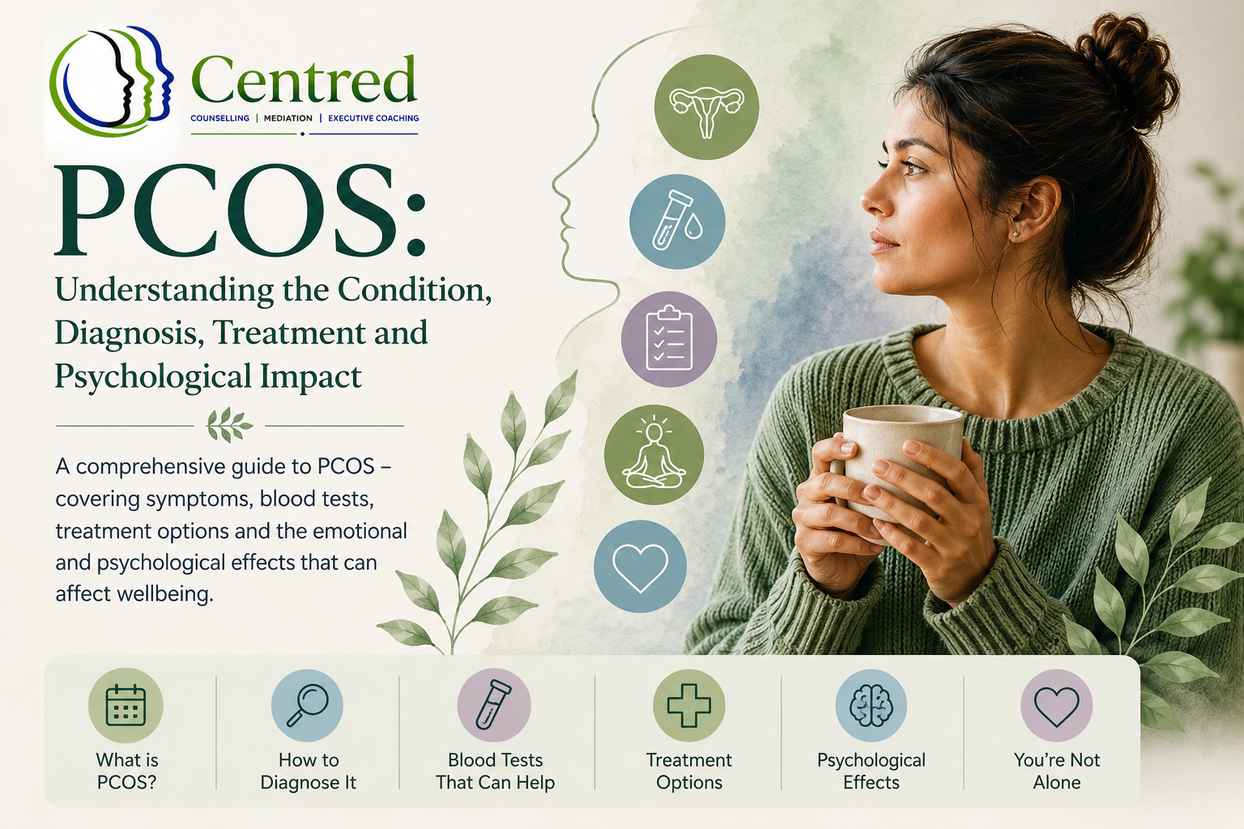
PCOS: Understanding the Condition, Diagnosis, Treatment and Psychological Impact
For Centred Counselling & Mediation
What Exactly Is PCOS?
Polycystic ovary syndrome (PCOS) is one of the most common hormonal conditions affecting women of reproductive age. Yet despite how common it is, PCOS is frequently misunderstood — both by the people experiencing it and sometimes by the people around them.
PCOS can affect menstruation, ovulation, fertility, hormones, skin, hair growth, weight and metabolic health. It can also affect something less visible: the way a person feels about themselves and their body.
For some women, the psychological impact of PCOS can be as distressing as the physical symptoms. Concerns about weight, acne, facial or body hair, fertility, sexuality and femininity can gradually affect self-esteem, relationships and quality of life.
Importantly, PCOS does not look the same in everyone. Someone can have PCOS without being overweight, without having obvious ovarian cysts and without experiencing every symptom commonly associated with the condition.
The current international evidence-based guidelines therefore approach PCOS as a complex, lifelong condition requiring individualised care, rather than simply a problem with the ovaries.
What Causes PCOS?
There is no single cause of PCOS.
The condition appears to involve a combination of genetic, hormonal, metabolic and environmental factors. Insulin resistance is an important feature for many people with PCOS, but it is not present in exactly the same way in everyone.
It is also important to understand that PCOS is not caused simply by being overweight.
Weight can influence the expression of PCOS and metabolic risk, but people in smaller bodies can also have PCOS, insulin resistance and significant symptoms.
This distinction matters psychologically because weight stigma can become an additional burden for someone already trying to understand a confusing condition.
The international guidelines specifically recommend reducing weight stigma and focusing on sustainable health behaviours rather than assuming that weight is the explanation for every PCOS symptom.
What Are the Symptoms of PCOS?
Menstrual and Reproductive Symptoms
A woman may experience:
- irregular periods
- very long menstrual cycles
- fewer than eight menstrual cycles per year
- periods that disappear for months
- unpredictable bleeding
- difficulty predicting ovulation
- difficulty becoming pregnant
Ovulatory dysfunction is one of the central features considered when diagnosing PCOS.
For adults more than three years after their first period, cycles shorter than 21 days, longer than 35 days, or fewer than eight cycles per year can indicate irregular menstrual cycles. A cycle lasting more than 90 days can also be significant.
Androgen-Related Symptoms
Higher androgen activity can result in:
- unwanted facial hair
- increased body hair
- acne
- oily skin
- thinning hair on the scalp
- male-pattern hair loss
Not everyone with biochemical evidence of increased androgen levels will have obvious physical symptoms, and not everyone experiencing these symptoms will necessarily have PCOS.
Metabolic Symptoms and Associated Conditions
PCOS is also associated with an increased risk of:
- insulin resistance
- impaired glucose tolerance
- type 2 diabetes
- abnormal cholesterol levels
- cardiovascular risk factors
- sleep apnoea
The condition therefore extends considerably beyond menstruation and fertility.
How Is PCOS Diagnosed?
There is no single blood test that says “you have PCOS.”
In adults, the current international diagnostic approach generally requires two of three features, after other possible causes have been excluded:
- Ovulatory dysfunction, usually reflected by irregular menstrual cycles.
- Clinical or biochemical hyperandrogenism — symptoms/signs of increased androgen activity or elevated androgen levels on testing.
- Polycystic ovarian morphology on ultrasound or an appropriately interpreted elevated anti-Müllerian hormone (AMH) level.
Importantly, if someone already has both irregular menstrual cycles and hyperandrogenism, an ultrasound or AMH test is not required to establish the diagnosis.
This is important because many people are told they cannot have PCOS because their ultrasound was “normal”. That is not necessarily correct.
What Blood Tests Can Be Done for PCOS?
Blood testing is often an important part of the assessment, but the exact tests will depend on the person's symptoms, age, medications, menstrual pattern and medical history.
A doctor may consider several categories of blood tests:
1. Testosterone and Androgen Testing
Tests may include:
- total testosterone
- free testosterone or calculated free testosterone
- sex hormone-binding globulin (SHBG)
- sometimes androstenedione
- sometimes DHEA-S
These tests help assess whether there is biochemical evidence of hyperandrogenism. Importantly, androgen results need to be interpreted in context. Hormonal contraception, for example, can influence androgen measurements.
2. Thyroid Testing
A TSH (thyroid-stimulating hormone) test may be performed because thyroid disorders can cause menstrual irregularity and symptoms that can overlap with PCOS. This is part of the reason PCOS should not be diagnosed simply because someone has irregular periods.
3. Prolactin
A prolactin test may be appropriate because elevated prolactin can interfere with menstrual cycles and ovulation. Again, the purpose is partly to identify conditions that can mimic or contribute to the symptoms being investigated.
4. 17-hydroxyprogesterone
A 17-hydroxyprogesterone (17-OHP) test may be used to screen for non-classic congenital adrenal hyperplasia, another condition that can resemble PCOS through androgen excess and menstrual abnormalities.
5. Blood Glucose Testing
Metabolic assessment is particularly important in PCOS. A doctor may assess glucose metabolism using:
- a 75 g oral glucose tolerance test (OGTT)
- fasting plasma glucose
- HbA1c
The international guideline considers the 75 g OGTT the most accurate test of glycaemic status in PCOS, including when BMI is within the normal range. If an OGTT cannot be performed, fasting glucose and/or HbA1c may be considered, although they are less accurate for this purpose.
What about an “insulin resistance blood test”?
This is an area where there is considerable confusion online. Although insulin resistance is an important part of PCOS physiology, routinely available insulin assays have limited clinical relevance and should not be used routinely to assess insulin resistance in PCOS.
So a normal or abnormal fasting insulin result by itself should not be treated as the definitive answer to whether someone has PCOS.
6. Cholesterol and Lipid Testing
A lipid profile may include:
- total cholesterol
- LDL cholesterol
- HDL cholesterol
- triglycerides
The international guideline recommends a lipid profile at the time of PCOS diagnosis regardless of age or BMI, with subsequent testing determined by individual risk.
7. Other Tests Depending on the Individual
Depending on the person's circumstances, a doctor may also consider:
- pregnancy testing
- FSH and other reproductive hormones
- progesterone testing when assessment of ovulation is required
- liver function tests
- blood pressure assessment
- additional endocrine investigations where symptoms suggest another condition
These tests are not all required for everyone with suspected PCOS. PCOS diagnosis should be based on a structured clinical assessment rather than ordering every possible hormone test.
What About an Ultrasound?
An ultrasound may be used to assess the ovaries for polycystic ovarian morphology.
However, the finding of multiple follicles does not automatically mean someone has PCOS. The opposite is also true: someone can have PCOS without having polycystic-appearing ovaries.
For adults, AMH can now be used as an alternative to ultrasound to define polycystic ovarian morphology, but AMH should not be used as a stand-alone diagnostic test.
What About Teenagers?
Diagnosis is more complicated in adolescents.
The adult criteria cannot simply be applied to teenagers because menstrual irregularity and ovarian changes can be normal during puberty.
For adolescents, the guideline requires both ovulatory dysfunction and hyperandrogenism, while ultrasound and AMH are not recommended for diagnosis because of concerns about poor specificity.
How Is PCOS Treated?
There is no single treatment that “cures” PCOS. Instead, treatment is usually directed at the person's specific symptoms, health risks and reproductive goals.
The most effective treatment plan is therefore individualised.
Lifestyle Management
Healthy lifestyle behaviours form an important part of PCOS management. This can include:
- regular physical activity
- nutritious, sustainable eating
- adequate sleep
- stress management
- behavioural strategies that support long-term habits
Importantly, there is no single PCOS diet that has been shown to be universally superior. Sustainable healthy eating tailored to the person's preferences and circumstances is preferred over unnecessarily restrictive approaches.
This is particularly important psychologically. When someone is repeatedly told that they simply need more discipline, eat less or lose weight, the conversation can quickly move from health management into shame and self-blame.
PCOS management should not require someone to hate their body in order to care for it.
Medication for PCOS
- Combined Oral Contraceptive Pills: Combined oral contraceptives may be prescribed to help manage irregular menstrual cycles, androgen-related symptoms, acne, and unwanted hair growth. They can also provide endometrial protection in people who have infrequent periods. The international guideline considers combined oral contraceptive pills a first-line pharmacological option for menstrual irregularity and hyperandrogenism when appropriate.
- Metformin: Metformin is commonly used in PCOS, particularly when metabolic abnormalities are present. It can improve insulin sensitivity and has a role in managing metabolic features of PCOS. It is not, however, a universal “PCOS medication” that everyone with the diagnosis needs. The treatment decision should be based on the individual's metabolic profile, symptoms and treatment goals.
- Treatment for Unwanted Hair: Depending on the circumstances, treatment can include cosmetic hair removal, laser hair reduction, electrolysis, hormonal treatment, and anti-androgen medication in selected patients. Anti-androgens require appropriate medical supervision because of potential side effects and, depending on the medication, pregnancy-related risks.
What If PCOS Is Affecting Fertility?
PCOS is one of the common causes of anovulatory infertility. But having PCOS does not mean someone cannot become pregnant.
For people who are trying to conceive and whose infertility is due to anovulation without other infertility factors, letrozole is recommended as the first-line pharmacological treatment for ovulation induction in the current international guideline.
Depending on the circumstances, fertility treatment may also involve:
- ovulation monitoring
- additional medication
- intrauterine insemination
- IVF
- treatment of other identified fertility factors
A PCOS diagnosis should therefore never automatically be translated into “you may never have children.”
The Psychological Side of PCOS
This is where the conversation around PCOS often becomes incomplete.
We can measure testosterone. We can measure glucose. We can look at ovaries on an ultrasound. We can count menstrual cycles.
But there is another question that is equally important:
“What is it like to live in this body?”
The international PCOS guideline recognises psychological wellbeing as a core component of PCOS care. Depression and anxiety occur at higher rates in people with PCOS, and screening for depression and anxiety is recommended for both adolescents and adults with the condition.
Body Image
PCOS can change someone's relationship with their appearance. For example:
- weight changes
- acne
- facial hair
- unwanted body hair
- hair thinning
- changes in body shape
These symptoms can be particularly difficult because they are often visible to other people. Someone may avoid photographs. They may avoid swimming or intimacy. They may become highly self-conscious about facial hair or acne. They may spend considerable time checking their appearance or trying to conceal symptoms.
Over time, a physical symptom can become a psychological narrative: “There is something wrong with me.” That narrative can be much more painful than the symptom itself.
PCOS and Self-Esteem
Self-esteem can be affected when someone feels that their body is behaving in ways they cannot control. This can produce thoughts such as:
- “Why can't my body just work normally?”
- “Why can't I lose weight like everyone else?”
- “I don't feel feminine.”
- “I'm embarrassed by my facial hair.”
- “My body is failing me.”
- “Other women don't have to deal with this.”
These thoughts are not necessarily evidence that the person has poor self-esteem to begin with. Sometimes repeated experiences of having a body that feels unpredictable, criticised or difficult to control gradually affect self-esteem.
PCOS, Femininity and Identity
There is another layer that deserves more attention. Menstruation, fertility, body hair, breasts, body shape and sexuality are often culturally connected with ideas about femininity.
When PCOS affects these areas, some women can begin questioning their sense of femininity or attractiveness. This can be particularly painful when fertility becomes part of the picture.
A woman may intellectually understand that PCOS does not determine her worth, while emotionally feeling that her body has somehow failed to meet expectations of what it means to be a woman. These experiences deserve to be taken seriously rather than dismissed as vanity.
The international guideline specifically recognises body-image distress, low self-esteem, difficulties relating to feminine identity and psychosexual dysfunction as psychological concerns that may warrant evidence-based psychological treatment.
PCOS and Anxiety
Living with a chronic condition can create uncertainty. Someone may worry about:
- when their next period will come
- whether they are ovulating
- whether they will be able to conceive
- whether their symptoms will get worse
- whether they will gain more weight
- whether their medication will work
- what other health problems might develop
For someone already prone to anxiety, PCOS can provide an almost constant stream of things to worry about. And uncertainty itself can become stressful.
PCOS and Depression
The relationship between PCOS and depression is complex. Hormonal and metabolic factors may contribute, while the lived experience of PCOS can also have a substantial psychological impact.
For some women, the combination of physical symptoms, fertility concerns, body-image difficulties and repeated frustration with healthcare can gradually contribute to low mood. This is why depression should not simply be viewed as an unrelated psychological problem.
PCOS and Disordered Eating
Another important area is eating behaviour. Someone who has repeatedly been told to lose weight may eventually develop an unhealthy relationship with food.
They may move between: restriction → hunger → overeating → guilt → renewed restriction. Alternatively, they may become preoccupied with calories, carbohydrates, weight or the number on the scale.
This is particularly concerning because a person can be simultaneously trying to manage the metabolic aspects of PCOS while developing significant distress around food. The PCOS guidelines therefore recommend awareness of disordered eating, alongside body image and psychological wellbeing.
PCOS and Relationships
PCOS can also affect intimate relationships. Someone who feels uncomfortable about their body may withdraw from physical intimacy.
Acne, unwanted hair, weight changes or concerns about attractiveness can affect sexual confidence. Fertility difficulties can create additional emotional pressure within a relationship.
And sometimes the partner simply does not understand why something that appears to be “just a hormonal condition” is affecting the person's mood, confidence or sexuality so profoundly. Communication becomes particularly important here.
Why Counselling Can Be Helpful
Counselling does not treat the hormonal or metabolic causes of PCOS. That belongs with appropriately qualified medical professionals such as a GP, gynaecologist, endocrinologist or fertility specialist.
But counselling can help someone deal with the psychological experience of living with PCOS. Therapeutic work may focus on:
- Body image: Developing a less critical and more compassionate relationship with the body.
- Self-esteem: Separating personal worth from appearance, fertility, weight or physical symptoms.
- Anxiety: Learning strategies for managing health-related uncertainty and catastrophic thinking.
- Depression: Addressing persistent low mood, hopelessness, withdrawal and loss of motivation.
- Eating difficulties: Exploring restrictive eating, emotional eating, guilt and unhealthy relationships with food.
- Fertility-related grief: Processing disappointment, uncertainty and grief associated with difficulties conceiving.
- Relationships and intimacy: Exploring communication, vulnerability, sexual confidence and the effect of PCOS on relationships.
- Identity: Working through feelings surrounding femininity, attractiveness, sexuality and changing body image.
The international guideline recommends psychological therapy for people with PCOS who experience depression, anxiety or eating disorders, and specifically identifies evidence-based approaches such as cognitive behavioural therapy for body-image distress, low self-esteem, difficulties with feminine identity and psychosexual concerns.
The Most Important Thing to Remember About PCOS
PCOS is a medical condition.
- It is not a character flaw.
- It is not a lack of discipline.
- It is not simply a weight problem.
- It is not caused by someone being “lazy”.
- And it does not define a woman's femininity, attractiveness, sexuality or worth.
Perhaps one of the most damaging things about PCOS is that some of its symptoms can become intertwined with the way a person evaluates themselves.
A woman may begin with: “I have PCOS.” And gradually, without realising it, move towards: “There is something wrong with me.”
Those two statements are profoundly different. The first describes a medical condition. The second describes an identity.
Part of psychological support is helping a person separate the two.
When Should You Speak to a Healthcare Professional?
Consider discussing PCOS with a doctor if you experience:
- persistently irregular or absent periods
- excessive facial or body hair
- persistent acne alongside menstrual irregularity
- unexplained scalp hair thinning
- difficulty becoming pregnant
- symptoms suggesting hormonal imbalance
- significant unexplained weight changes
- concerns about blood glucose or metabolic health
A diagnosis should be made through an appropriate clinical assessment rather than through an online symptom checklist or a single hormone result.
And if you have already been diagnosed with PCOS but feel that the condition is beginning to affect your mood, self-esteem, body image, relationship, eating patterns or quality of life, those concerns deserve attention too.
A Final Thought from the Counsellor's Chair
PCOS can be a condition of the body, but living with PCOS can become an experience of the mind.
The physical symptoms are real. The hormonal changes are real. The fertility concerns are real. But so is the emotional impact.
Sometimes the most important therapeutic work is not about convincing someone to love every part of their body. It is about helping them reach a different place:
“My body may be difficult for me sometimes, but it does not determine my value.”
That distinction can be the beginning of a much healthier relationship with both the body and the self.
Medical Disclaimer
This article is intended for general educational purposes and does not replace an individual medical assessment, diagnosis or treatment plan. PCOS can present differently from person to person, and blood tests and treatment should be selected according to individual circumstances. If you are concerned that you may have PCOS, speak to a qualified healthcare professional.