Checked off. Next email: “Article - why you keep watching porn - porn addiction webpage” — 10 October 2026.
Copy the article below:
From the Counsellor’s Chair
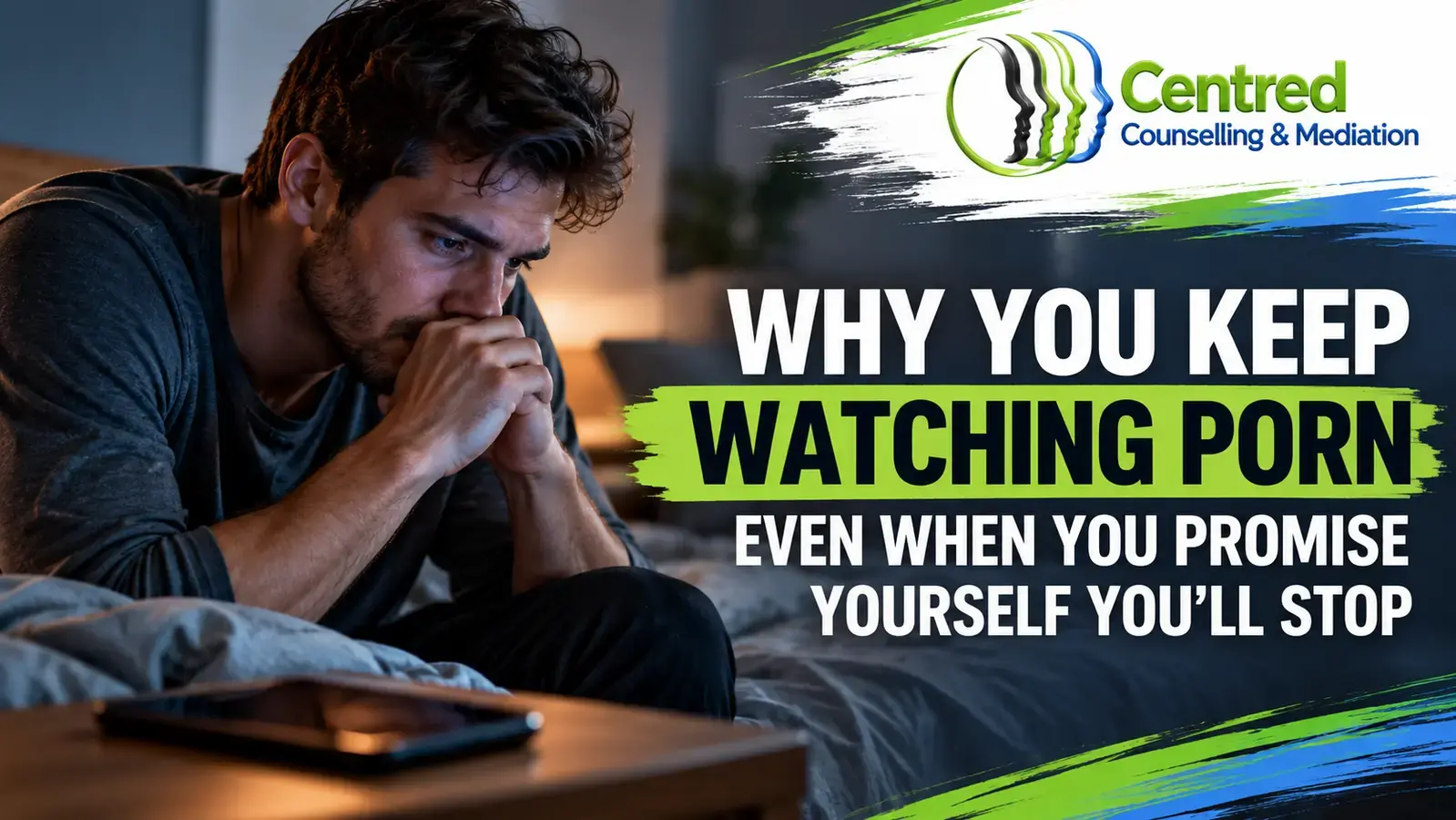
Why You Keep Watching Porn Even When You Promise Yourself You’ll Stop
If you repeatedly promise yourself that you will stop watching pornography and then return to it, you may conclude that you lack discipline. That explanation is often too simple. Habits can be reinforced by immediate reward, repeated cues, emotional relief and easy access. When a behaviour becomes a familiar response to a particular feeling or situation, the urge may appear before you have consciously considered what you want to do.
A 2021 systematic review examined 21 experimental studies on cognitive processes associated with problematic pornography use. It identified areas such as inhibitory control, decision-making and attentional processes as relevant research themes, while noting that the evidence base remained limited. These findings do not mean that everyone who watches pornography has impaired self-control. [1]
Understand the Cycle
A common pattern may begin with a trigger: stress after work, loneliness late at night, boredom, conflict or scrolling on a phone. An urge follows, and pornography offers immediate stimulation or distraction. Afterwards, the person may feel relief, then guilt or frustration. That distress can itself become another trigger.
The cycle differs between people. For some, the key factor is habit and access; for others, it may involve emotion regulation, relationship difficulties, sleep disruption or other concerns. Identifying your own sequence is more useful than assuming one explanation fits everyone.
Why Promises Alone May Not Work
A promise is an intention, not a plan. If the same device, time of day, emotion and environment remain in place, the familiar response can be easy to repeat. All-or-nothing thinking can also backfire: after one lapse, a person may decide that the entire effort has failed and stop trying.
Shame may add another layer. Hiding the behaviour can prevent honest reflection or support. Taking responsibility is important, but insulting yourself does not automatically build the skills needed to change.
A Practical Plan to Change the Pattern
- Map the triggers. For seven days, note the time, situation, feeling, urge intensity and what you did. Keep the record brief and non-judgmental.
- Change the environment. Set device-free times, keep a phone out of the bedroom if late-night use is a trigger, and consider content-blocking tools as one layer of support.
- Add a pause. When an urge appears, wait ten minutes before acting. Change rooms, take a walk, drink water or use a grounding exercise. The aim is to make room for a decision, not to guarantee that the urge disappears.
- Choose a replacement before the trigger occurs. If loneliness is a trigger, plan a call or social activity. If stress is the trigger, choose a realistic decompression routine.
- Make the goal specific. Decide whether your goal is abstinence, reducing a pattern that feels compulsive, or addressing a particular consequence. Track outcomes that matter to you.
- Learn from lapses. Ask what preceded the behaviour and what could be changed next time. A lapse is information, not proof that change is impossible.
- Seek appropriate support. If repeated attempts have not helped, counselling can provide structure and help identify factors that are harder to address alone.
ADHD and Problematic Pornography Use
In my counselling practice, I have noticed that a number of people who seek help for problematic pornography use also report ADHD. This is a clinical observation from a small number of clients, not a prevalence estimate.
A large 2019 non-clinical study of 14,043 adults examined ADHD symptoms, hypersexuality and problematic pornography use. ADHD symptoms were associated with problematic pornography use more strongly among men than women in that sample. The study used self-report measures and cannot establish that ADHD causes pornography problems. [2]
For some people, ADHD-related impulsivity, difficulty disengaging from rewarding activities or emotional regulation challenges may be relevant. These symptoms do not prove someone has ADHD, and not everyone with ADHD experiences problematic pornography use. If ADHD is a concern, seek an appropriate assessment rather than self-diagnosing from this behaviour alone.
When Counselling Can Help
Counselling can help you explore what the behaviour does for you, what situations maintain it and what alternatives are realistic. Work may include emotional awareness, planning for urges, relationship communication and strategies for managing setbacks. If sexual-functioning concerns or other health issues are present, a qualified healthcare professional may also be appropriate.
Centred Counselling & Mediation offers counselling in Sunninghill, Sandton. Confirm current in-person or online availability when booking.
Frequently Asked Questions
How long does it take to stop watching porn?
There is no reliable timeline that applies to everyone. It depends on your goals, circumstances, triggers and support.
Should I rely on a blocker?
Blocking tools can reduce access but are usually most useful as part of a broader plan.
Does an urge mean I have failed?
No. An urge is an experience, not an instruction. Practising a pause can help you choose how to respond.
Does ADHD cause porn addiction?
Research suggests an association between ADHD symptoms and problematic use in some groups, but association is not causation and the relationship is not universal.
Conclusion
You do not have to solve the pattern through willpower alone. Begin by identifying triggers, making a realistic plan and treating setbacks as information. For further support, visit our Porn Addiction Counselling webpage or read our article on the warning signs of problematic pornography use.
References
[1] Castro-Calvo, J., Cervigón-Carrasco, V., Ballester-Arnal, R., & Giménez-García, C. (2021). Cognitive processes related to problematic pornography use (PPU): A systematic review of experimental studies. Addictive Behaviors Reports, 13, 100345.
[2] Bőthe, B., Koós, M., Tóth-Király, I., Orosz, G., & Demetrovics, Z. (2019). Investigating the Associations of Adult ADHD Symptoms, Hypersexuality, and Problematic Pornography Use Among Men and Women on a Largescale, Non-Clinical Sample. The Journal of Sexual Medicine, 16(4), 489–499.