---
title: "Child ADHD vs Adult ADHD: Why It Looks Different Later in Life"
description: Think ADHD is just for hyperactive kids? Discover how adult ADHD hides behind chronic burnout, masking, and internal restlessness—and why so many get missed.
image: https://www.centredcounselling.co.za/hubfs/child_vs_adult_adhd_blog.webp
---
1332 Naivasha Road, Sunninghill
[info@centredcounselling.co.za](mailto:info@centredcounselling.co.za)
[084 485 3541](https://wa.me/27844853541)
[](https://www.centredcounselling.co.za/)
- [Home](https://www.centredcounselling.co.za)
- [About Me](https://www.centredcounselling.co.za/about-me)
- [Articles](https://www.centredcounselling.co.za/article)
- [Counselling](https://www.centredcounselling.co.za/counselling)
- [All Counselling Services](https://www.centredcounselling.co.za/counselling)
- [ADHD Counselling](https://www.centredcounselling.co.za/adhd-counselling-sunninghill)
- [Anger Management](https://www.centredcounselling.co.za/anger-management-sunninghill)
- [Chronic Pain Counselling](https://www.centredcounselling.co.za/chronic-pain-counselling-centred-counselling)
- [Grief Counselling](https://www.centredcounselling.co.za/grief-counselling-sunninghill)
- [LGBTQ+](https://www.centredcounselling.co.za/lgbtq-counselling-in-sandton-centred-counselling-mediation)
- [Marriage Counselling](https://www.centredcounselling.co.za/marriage-counselling-in-sunninghill-sandton-centred-counselling)
- [Porn Addiction](https://www.centredcounselling.co.za/porn-addiction-counselling-in-sandton-centred-counselling)
- [Premarital Counselling](https://www.centredcounselling.co.za/premarital-counselling-in-sunninghill-sandton-centred-counselling)
- [Relationship Counselling](https://www.centredcounselling.co.za/relationship-counselling-in-sunninghill-centred-counselling)
- [Mediation](https://www.centredcounselling.co.za/mediation)
- [Video Resources](https://www.centredcounselling.co.za/mental-health-vlogs-video-resources)
- [Contact](https://www.centredcounselling.co.za/contact-us)
- [Book NOW](https://www.centredcounselling.co.za/booking)
[BOOK NOW](https://www.centredcounselling.co.za/booking) [WHATSAPP US](https://wa.me/27844853541)
[adhd](https://www.centredcounselling.co.za/centred-counselling-blog/tag/adhd)
# Child ADHD vs Adult ADHD: Why It Looks Different Later in Life

Byron Werbeloff
Author
May 24, 2026, 8:18:33 PM
## Page Title & Meta Descriptions
### Option 1: Engaging & Empathic (Recommended)
- **Page Title:** Child ADHD vs Adult ADHD: Why It Looks Different Later in Life
- **Meta Description:** Think ADHD is just for hyperactive kids? Discover how adult ADHD hides behind chronic burnout, masking, and internal restlessness—and why so many get missed.
### Option 2: SEO-Focused
- **Page Title:** Adult ADHD Symptoms vs Childhood ADHD | Centred Counselling
- **Meta Description:** Explore why ADHD symptoms change from childhood to adulthood. Learn the signs of adult executive dysfunction, emotional dysregulation, and late diagnosis.
# Child ADHD vs Adult ADHD: Why ADHD Can Look Completely Different Later in Life
### In This Article, You’ll Learn:
- Why ADHD symptoms often change dramatically from childhood to adulthood
- How adult ADHD can look very different from the stereotypical “hyperactive child”
- Why many adults with ADHD were missed, misunderstood, or diagnosed late
- The emotional and psychological impact of untreated ADHD across different life stages
- How ADHD symptoms can evolve internally even when external hyperactivity decreases
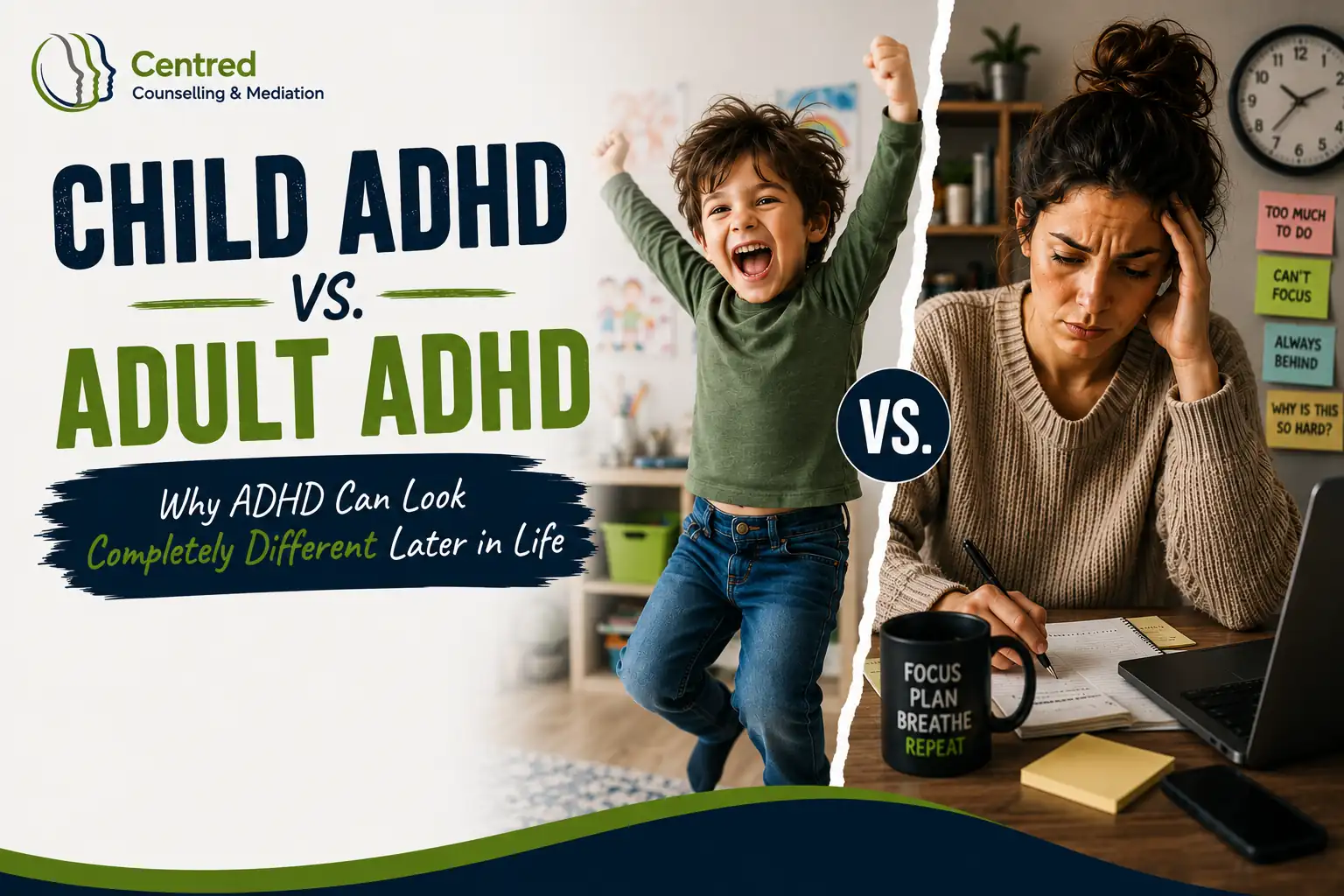
When most people think of ADHD, they picture a hyperactive young boy struggling to sit still in a classroom. They imagine constant movement, interrupting teachers, excessive talking, impulsive behaviour, and difficulty focusing during school lessons.
While this can absolutely be part of ADHD, it is only one version of the condition.
For many individuals, ADHD changes significantly over time. The symptoms that are obvious and externally visible during childhood often become more internal, psychological, and emotionally complex during adulthood.
This is one reason many adults reach their 20s, 30s, 40s, or even later before finally realising: **“This may have been ADHD all along.”**
Adult ADHD often looks very different from childhood ADHD — even though the underlying neurological condition is the same.
## Why ADHD Changes With Age
ADHD is a neurodevelopmental condition that affects executive functioning systems within the brain. These systems help regulate attention, planning, organisation, impulse control, emotional regulation, working memory, and motivation.
As children grow older, life expectations and responsibilities become dramatically more demanding.
- **A child’s environment** is often highly structured. Parents manage schedules, teachers provide routine, and school systems create external accountability. Daily life is relatively organised for them.
- **Adulthood** is completely different. Adults are suddenly expected to independently manage work responsibilities, finances, relationships, household tasks, time management, emotional regulation, long-term planning, and self-discipline — often without the same external support structures they had as children.
At the same time, the outward presentation of ADHD frequently changes. Many adults no longer appear physically hyperactive — but internally, their mind may still feel constantly restless, overstimulated, and mentally exhausted.
## What ADHD Often Looks Like in Children
In childhood, ADHD symptoms are often easier for other people to notice because they tend to be more externally visible.
### Hyperactivity & Impulsivity
Children with ADHD may struggle to sit still, interrupt frequently, forget instructions, lose belongings, become emotionally reactive quickly, or have difficulty following routines. Hyperactivity in children may appear through constant movement, climbing excessively, fidgeting, talking continuously, or struggling to remain seated in structured environments like classrooms.
### Inattention
Inattention may appear through careless mistakes, distractibility, forgetfulness, incomplete schoolwork, daydreaming, or difficulty staying mentally engaged.
> **The Hidden Presentation:** Not all children with ADHD are disruptive or outwardly hyperactive. Some children — particularly girls or those with inattentive presentations — may appear quiet, emotionally sensitive, anxious, withdrawn, overwhelmed, or chronically distracted internally rather than behaviourally disruptive externally.
This is one reason many children with ADHD go unnoticed for years. ADHD does not always look loud, disruptive, or hyperactive from the outside.
## What ADHD Often Looks Like in Adults
As people age, ADHD symptoms frequently become more internalised. The adult may no longer run around, climb furniture, or visibly disrupt classrooms — but their mind may still feel chaotic internally.
Adult ADHD often appears through chronic procrastination, time blindness, disorganisation, forgetfulness, emotional dysregulation, overwhelm, impulsivity, difficulty starting tasks, hyperfocus, racing thoughts, burnout, and difficulty managing life responsibilities consistently.
Instead of obvious physical hyperactivity, adult hyperactivity may appear as:
- Racing thoughts
- Internal restlessness
- Difficulty relaxing
- Constant stimulation-seeking
- Excessive talking
- Difficulty mentally “switching off”
Many adults with ADHD describe feeling mentally exhausted from constantly trying to keep up with daily responsibilities that seem easier for other people to manage. **For many adults, ADHD becomes less visible externally and far more exhausting internally.**
## Why So Many Adults Were Missed as Children
Many adults with ADHD were never diagnosed during childhood.
Some performed well academically and therefore did not fit the stereotype professionals expected to see. Others were intelligent enough to temporarily compensate through last-minute pressure, perfectionism, masking, or anxiety-driven overachievement.
Some children were simply labelled:
- “Lazy.”
- “Too emotional.”
- “Disorganised.”
- “Not trying hard enough.”
- “Unmotivated.”
- “Too sensitive.”
Others learned to hide their difficulties completely because they feared criticism, embarrassment, or rejection. Girls and inattentive ADHD presentations were especially under-recognised historically because they often did not fit the disruptive hyperactive stereotype associated with ADHD.
As responsibilities increase in adulthood, however, many people eventually reach a point where compensating becomes emotionally unsustainable. This is often when adults finally begin recognising that ADHD may have been affecting them for years.
## The Emotional Impact of Undiagnosed ADHD
Many adults with undiagnosed or unsupported ADHD grow up internalising years of criticism, shame, and self-doubt. Repeated experiences of forgetting things, struggling with organisation, falling behind, emotional overwhelm, missed deadlines, inconsistency, and burnout can slowly damage self-esteem over time.
Some adults eventually begin believing: **“I’m lazy.” “I’m broken.” “Why can everyone else handle life except me?”**
The problem is that many individuals are comparing themselves to neurotypical expectations without understanding that their brain may process attention, motivation, emotion, and executive functioning differently.
Many adults with ADHD are not failing because they do not care. Often, they are working far harder than other people realise simply to keep up.
## ADHD in Adults Is Often More Emotional Than People Realise
One major difference between child and adult ADHD is the emotional impact. Adults with ADHD frequently experience anxiety, chronic stress, burnout, emotional dysregulation, rejection sensitivity, relationship difficulties, shame, and low self-esteem.
Years of struggling with executive functioning difficulties can place enormous strain on the nervous system. Many adults become highly skilled at masking their difficulties externally while internally feeling overwhelmed almost constantly.
This is one reason adult ADHD is frequently misunderstood as:
- Laziness
- Anxiety alone
- Depression alone
- Lack of discipline
- Lack of motivation
In reality, ADHD often affects nearly every area of life when left unsupported. **ADHD is not simply an attention problem. For many adults, it becomes a chronic emotional regulation and overwhelm problem too.**
## ADHD Does Not Always “Disappear”
Some people believe children simply “grow out” of ADHD. In reality, symptoms often evolve rather than disappear completely.
| **Childhood Presentation** | **Adult Evolution** |
| --- | --- |
| **Physical Hyperactivity** | Internal restlessness & racing thoughts |
| **External/Classroom Chaos** | Mental overwhelm & executive dysfunction |
| **Obvious Impulsivity** | Emotional impulsivity, overspending, or burnout |
The condition may look different externally — but the underlying executive functioning difficulties often remain. ADHD in adulthood is often quieter externally but far more psychologically exhausting internally.
## Final Thoughts
Child ADHD and adult ADHD are deeply connected, but they often look very different on the surface. Children may show more visible hyperactivity, impulsivity, and classroom difficulties. Adults often experience more internal restlessness, executive dysfunction, emotional overwhelm, chronic stress, burnout, and difficulty managing the demands of daily life.
This difference is one reason so many adults go undiagnosed for years. Understanding how ADHD changes over time can help reduce shame and create a more accurate understanding of what many adults are actually struggling with beneath the surface.
The goal is not self-criticism. The goal is understanding how the ADHD brain functions so healthier support systems, coping strategies, and self-awareness can begin developing.
Many adults with ADHD are not lazy, irresponsible, or incapable. They are often navigating life with a nervous system that works very differently beneath the surface.
## Centred Counselling
### Counselling & Family Mediation Services
- 📞 +27 84 485 3541
- 🌐 [https://www.centredcounselling.co.za/](https://www.centredcounselling.co.za/)
- ✉️ info@centredcounselling.co.za
### Follow us:
- **TikTok:** [www.tiktok.com/@centred.counselli](https://www.google.com/search?q=http://www.tiktok.com/%40centred.counselli&authuser=1)
- **YouTube:** [https://www.youtube.com/@CentredCounselling](https://www.youtube.com/@CentredCounselling)
- **Instagram:** [https://www.instagram.com/centred\_counselling](https://www.instagram.com/centred_counselling)
- **Facebook:** [https://www.facebook.com/share/1AtmNzrAEo/?mibextid=wwXIfr](https://www.facebook.com/share/1AtmNzrAEo/?mibextid=wwXIfr)
- **Pinterest:** [https://pin.it/i0CksW39W](https://pin.it/i0CksW39W)
- **Threads:** [https://www.threads.com/@centred\_counselling](https://www.threads.com/@centred_counselling)
**Tagged with:** [adhd](https://www.centredcounselling.co.za/centred-counselling-blog/tag/adhd)

#### Byron Werbeloff
KEEP READING
## Related Articles
[](https://www.centredcounselling.co.za/centred-counselling-blog/time-blindness-in-adult-adhd-why-time-feels-different)
May 24, 2026, 8:22:16 PM Byron Werbeloff
### [Time Blindness in Adult ADHD: Why Time Feels Different](https://www.centredcounselling.co.za/centred-counselling-blog/time-blindness-in-adult-adhd-why-time-feels-different)
# Time Blindness in Adult ADHD: Why Time Feels So Different
### In This Article, You’ll Learn:
- What “time blindness” actually means in adult ADHD
[READ FULL ARTICLE](https://www.centredcounselling.co.za/centred-counselling-blog/time-blindness-in-adult-adhd-why-time-feels-different)
[](https://www.centredcounselling.co.za/centred-counselling-blog/do-i-have-adhd-understanding-adult-symptoms-signs)
May 1, 2026, 4:00:45 AM Byron Werbeloff
### [Do I Have ADHD? Understanding Adult Symptoms & Signs](https://www.centredcounselling.co.za/centred-counselling-blog/do-i-have-adhd-understanding-adult-symptoms-signs)
# **How Do You Know If You Have ADHD? Adult Symptoms, Signs, and When to Get Assessed**
Many adults live for years with undiagnosed ADHD without...
[READ FULL ARTICLE](https://www.centredcounselling.co.za/centred-counselling-blog/do-i-have-adhd-understanding-adult-symptoms-signs)
[](https://www.centredcounselling.co.za/centred-counselling-blog/adhd-and-high-intelligence-masking-iq-and-executive-function)
May 1, 2026, 4:05:33 AM Byron Werbeloff
### [ADHD and High Intelligence: Masking, IQ, and Executive Function](https://www.centredcounselling.co.za/centred-counselling-blog/adhd-and-high-intelligence-masking-iq-and-executive-function)
# Were You Called Smart… So Why Are You Still Struggling?
## ADHD & High IQ Explained
You were called *smart* your whole life… so why does...
[READ FULL ARTICLE](https://www.centredcounselling.co.za/centred-counselling-blog/adhd-and-high-intelligence-masking-iq-and-executive-function)

Empowering individuals and couples through evidence-based counselling and mediation. Registered ASCHP professional (WC24/9024).
Quick Links
- [Home](https://www.centredcounselling.co.za)
- [About Me](https://www.centredcounselling.co.za/about-me)
- [Articles](https://www.centredcounselling.co.za/article)
- [Counselling](https://www.centredcounselling.co.za/counselling)
- [Mediation](https://www.centredcounselling.co.za/mediation)
- [Video Resources](https://www.centredcounselling.co.za/mental-health-vlogs-video-resources)
- [Contact](https://www.centredcounselling.co.za/contact-us)
- [Book NOW](https://www.centredcounselling.co.za/booking)
Resources
- [FAQ](https://www.centredcounselling.co.za/counselling#faq)
- [FAQ Mediation](https://www.centredcounselling.co.za/mediation#faq)
- [Downloads](https://www.centredcounselling.co.za/article#resources)
- [Cookie Policy](https://www.centredcounselling.co.za/terms-conditions-policies#cookies)
- [Privacy Policy](https://www.centredcounselling.co.za/terms-conditions-policies#privacy)
- [Terms and Conditions](https://www.centredcounselling.co.za/terms-conditions-policies#terms)
Get in Touch
Call Us [084 485 3541](tel:0844853541)
WhatsApp [Chat with us](https://wa.me/27844853541)
Email Us [info@centredcounselling.co.za](mailto:info@centredcounselling.co.za)
© 2026 Centred Counselling & Mediation. All rights reserved.
[Design by SEO Website Design](https://www.seowebsitedesign.co.za)
[Chat with us](https://wa.me/27844853541)
```json
{
"@context" : "https://schema.org",
"@type" : "BlogPosting",
"author" : {
"@type" : "Person",
"name" : "Byron Werbeloff",
"url" : "https://www.centredcounselling.co.za/centred-counselling-blog/author/byron-werbeloff"
},
"dateModified" : "2026-06-15T05:59:21.864Z",
"datePublished" : "2026-05-25T00:18:33.000Z",
"headline" : "Child ADHD vs Adult ADHD: Why It Looks Different Later in Life",
"image" : [ "https://www.centredcounselling.co.za/hubfs/child_vs_adult_adhd_blog.webp" ],
"mainEntityOfPage" : {
"@id" : "https://www.centredcounselling.co.za/centred-counselling-blog/child-adhd-vs-adult-adhd-why-it-looks-different-later-in-life",
"@type" : "WebPage"
},
"publisher" : {
"@type" : "Organization",
"logo" : {
"@type" : "ImageObject",
"url" : "https://www.centredcounselling.co.za/hubfs/logo.jpeg"
},
"name" : "Centred Counselling"
}
}
```
```json
{
"@context": "https://schema.org",
"@type": "LocalBusiness",
"name": "Centred Counselling & Mediation",
"image": "https://www.centredcounselling.co.za/hubfs/logo1.png",
"@id": "https://www.centredcounselling.co.za",
"url": "https://www.centredcounselling.co.za",
"telephone": "0844853541",
"email": "info@centredcounselling.co.za",
"address": {
"@type": "PostalAddress",
"streetAddress": "153A 9th Avenue",
"addressLocality": "Highlands North",
"addressRegion": "Johannesburg",
"postalCode": "2192",
"addressCountry": "ZA"
},
"geo": {
"@type": "GeoCoordinates",
"latitude": -26.1368,
"longitude": 28.0841
},
"openingHoursSpecification": {
"@type": "OpeningHoursSpecification",
"dayOfWeek": [
"Monday",
"Tuesday",
"Wednesday",
"Thursday",
"Friday"
],
"opens": "08:00",
"closes": "18:00"
},
"sameAs": [
"https://www.facebook.com/profile.php?id=61573738539849",
"https://www.instagram.com/centred_counselling/",
"https://www.linkedin.com/in/byron-werbeloff-475bb251/",
"https://www.tiktok.com/@centred.counselli"
],
"founder": {
"@type": "Person",
"name": "Byron Werbeloff",
}
}
```