---
title: "Time Blindness in Adult ADHD: Why Time Feels Different"
description: Struggle with chronic lateness or procrastination? It's not laziness—it's ADHD time blindness. Learn how the ADHD brain processes time and how to work with it.
image: https://www.centredcounselling.co.za/hubfs/time_blindness_adhd_blog.webp
---
1332 Naivasha Road, Sunninghill
[info@centredcounselling.co.za](mailto:info@centredcounselling.co.za)
[084 485 3541](https://wa.me/27844853541)
[](https://www.centredcounselling.co.za/)
- [Home](https://www.centredcounselling.co.za)
- [About Me](https://www.centredcounselling.co.za/about-me)
- [Articles](https://www.centredcounselling.co.za/article)
- [Counselling](https://www.centredcounselling.co.za/counselling)
- [All Counselling Services](https://www.centredcounselling.co.za/counselling)
- [ADHD Counselling](https://www.centredcounselling.co.za/adhd-counselling-sunninghill)
- [Anger Management](https://www.centredcounselling.co.za/anger-management-sunninghill)
- [Chronic Pain Counselling](https://www.centredcounselling.co.za/chronic-pain-counselling-centred-counselling)
- [Grief Counselling](https://www.centredcounselling.co.za/grief-counselling-sunninghill)
- [LGBTQ+](https://www.centredcounselling.co.za/lgbtq-counselling-in-sandton-centred-counselling-mediation)
- [Marriage Counselling](https://www.centredcounselling.co.za/marriage-counselling-in-sunninghill-sandton-centred-counselling)
- [Porn Addiction](https://www.centredcounselling.co.za/porn-addiction-counselling-in-sandton-centred-counselling)
- [Premarital Counselling](https://www.centredcounselling.co.za/premarital-counselling-in-sunninghill-sandton-centred-counselling)
- [Relationship Counselling](https://www.centredcounselling.co.za/relationship-counselling-in-sunninghill-centred-counselling)
- [Mediation](https://www.centredcounselling.co.za/mediation)
- [Video Resources](https://www.centredcounselling.co.za/mental-health-vlogs-video-resources)
- [Contact](https://www.centredcounselling.co.za/contact-us)
- [Book NOW](https://www.centredcounselling.co.za/booking)
[BOOK NOW](https://www.centredcounselling.co.za/booking) [WHATSAPP US](https://wa.me/27844853541)
[adhd](https://www.centredcounselling.co.za/centred-counselling-blog/tag/adhd)
# Time Blindness in Adult ADHD: Why Time Feels Different

Byron Werbeloff
Author
May 24, 2026, 8:22:16 PM
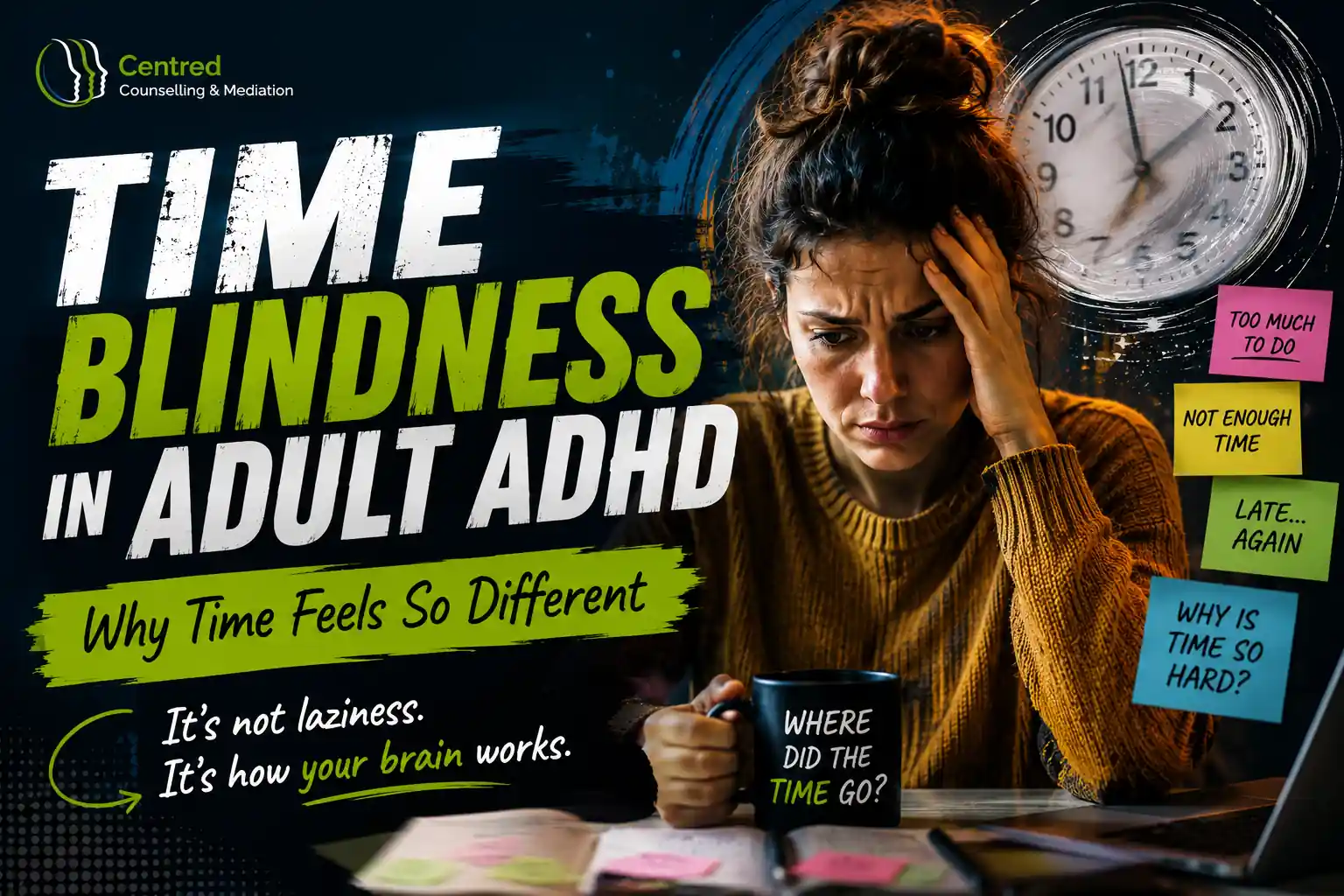
# Time Blindness in Adult ADHD: Why Time Feels So Different
### In This Article, You’ll Learn:
- What “time blindness” actually means in adult ADHD
- Why many adults with ADHD constantly underestimate or lose track of time
- How ADHD affects planning, lateness, procrastination, and daily functioning
- The psychological and emotional impact of chronic time-related struggles
- Practical ways to improve time awareness and reduce overwhelm
Many adults with ADHD describe feeling as though time works differently for them. Some constantly underestimate how long tasks will take, while others become so hyperfocused on one activity that they lose track of entire hours without realising it. For some individuals, days can disappear in what feels like minutes, while simple responsibilities suddenly become urgent crises at the last possible moment.
Over time, this can become deeply frustrating and emotionally exhausting. Many adults with ADHD grow up hearing criticism such as:
- “You’re lazy.”
- “You’re always late.”
- “You just need better discipline.”
- “Why can’t you manage your time properly?”
But for many people with ADHD, the issue is not laziness or lack of intelligence. The problem is often something called **time blindness**.
## What Is Time Blindness?
Time blindness refers to difficulty accurately sensing, tracking, estimating, or mentally processing the passage of time. Many adults with ADHD do not experience time in a consistent or intuitive way. Minutes can feel like seconds, while short tasks can unexpectedly consume entire afternoons.
Some people with ADHD describe time as psychologically existing in only two categories:
1. **“Now”**
2. **“Not now”**
This can make future tasks feel emotionally distant and difficult to act on until urgency becomes immediate.
> The ADHD brain often struggles to emotionally feel time until consequences become close enough to trigger stress or urgency. This is one reason many individuals with ADHD repeatedly delay important tasks despite fully understanding their importance intellectually.
## Why ADHD Affects Time Perception
ADHD affects executive functioning systems within the brain. Executive functions help regulate planning, organisation, prioritisation, working memory, impulse control, motivation, and time management.
Research suggests ADHD is linked to differences in dopamine regulation and brain networks involved in attention and self-regulation. As a result, many adults with ADHD struggle with internal time awareness. Instead of experiencing time as linear and consistent, attention and emotional stimulation often determine how time is perceived.
- **High-Stimulation Tasks:** Activities that are stimulating, urgent, emotionally engaging, or highly interesting may trigger hyperfocus, where someone becomes so absorbed that hours pass unnoticed.
- **Low-Stimulation Tasks:** At the same time, tasks perceived as repetitive, under-stimulating, or emotionally unrewarding may feel almost physically difficult to begin.
This is why many adults with ADHD can spend six hours intensely focused on one activity while struggling to start a simple five-minute task they find boring. The issue is not necessarily effort. The issue is often how the ADHD nervous system regulates attention, motivation, and stimulation.
## Why So Many Adults With ADHD Are Chronically Late
One of the most common consequences of time blindness is chronic lateness.
Many adults with ADHD genuinely believe they have plenty of time before suddenly realising they are already running late again. The brain may struggle to accurately estimate how long tasks, transitions, preparation, or travel actually take.
Someone may think: *“I’ll leave in five minutes.”* Then suddenly realise:
- They became distracted
- They started another task
- They lost track of time
- Thirty minutes disappeared unexpectedly
Over time, repeated lateness can become emotionally painful. Many adults with ADHD begin internalising harsh beliefs about themselves: *“I’m irresponsible.” “I can’t function properly.” “I’m unreliable.” “Something is wrong with me.”* **Repeated struggles with time can slowly damage self-esteem and create chronic shame.**
## Time Blindness and Procrastination
Time blindness is also closely connected to procrastination.
Many adults with ADHD do not procrastinate because they do not care. In reality, many care deeply and desperately want to perform well. The difficulty is that future consequences often do not feel emotionally real until urgency becomes immediate.
As a result, motivation may not fully activate until:
- Deadlines are close
- Pressure becomes intense
- Anxiety increases
- Consequences become unavoidable
The ADHD nervous system often responds more strongly to urgency, novelty, emotional stimulation, immediate rewards, or high-interest activities than to abstract future importance. This can create a painful cycle where tasks are repeatedly delayed until panic or stress finally forces action.
> Many adults with ADHD are not lazy. They are often struggling with a nervous system that regulates motivation differently.
## The Emotional Impact of Time Blindness
Many people underestimate how emotionally exhausting time blindness can become over years or decades. Adults with ADHD may constantly feel:
- Behind in life
- Disorganised
- Overwhelmed
- Anxious
- Mentally overloaded
- Ashamed of themselves
Some begin overcompensating by becoming hyper-vigilant about time, while others avoid planning altogether because planning itself becomes emotionally stressful.
Over time, repeated struggles with deadlines, lateness, forgotten responsibilities, unfinished tasks, and disorganisation can contribute to anxiety, burnout, depression, low self-esteem, workplace difficulties, and relationship conflict. **What looks like carelessness externally may actually be chronic executive functioning overwhelm internally.**
## Why Traditional Time Management Advice Often Fails
Many standard productivity strategies assume people naturally experience and track time consistently. But adults with ADHD often require external systems because internal time awareness may be unreliable.
This is why advice such as: *“Just be more disciplined.” “Use a diary.” “Plan better.” “Try harder.”* often feels ineffective or frustrating.
The issue is usually not lack of effort. Many adults with ADHD are already working incredibly hard just to keep up with basic daily functioning. Traditional productivity advice often fails because it does not address the underlying neurological differences involved in ADHD.
## Learning to Work With the ADHD Brain
Although time blindness can be frustrating, there are ways to reduce its impact.
Many adults with ADHD benefit from **externalising time** rather than relying purely on internal estimation. Visual timers, countdown clocks, phone alarms, calendar reminders, time-blocking, and visible schedules can help make time feel more concrete and measurable.
Breaking tasks into smaller visible steps can also reduce overwhelm and improve task initiation.
Transition time is another important factor. Many individuals underestimate how mentally difficult switching tasks can be, especially when hyperfocused. Building extra buffer time into routines often reduces stress significantly.
Most importantly, self-awareness matters. Understanding that time blindness is part of ADHD can reduce shame and replace self-criticism with more realistic support strategies.
## Final Thoughts
Time blindness is one of the most misunderstood aspects of adult ADHD.
To outsiders, it may appear like laziness, irresponsibility, carelessness, or lack of discipline. But for many adults with ADHD, the reality is far more complex. The ADHD brain often processes time differently. This can affect planning, punctuality, task initiation, motivation, emotional regulation, and daily functioning in ways that are deeply frustrating and emotionally exhausting.
The goal is not perfection. The goal is learning how your brain functions, developing supportive systems, and reducing shame while building healthier ways of managing time.
Many adults with ADHD are not bad at life. They are often trying to navigate a world built around a very different experience of time.
## Centred Counselling
### Counselling & Family Mediation Services
- 📞 +27 84 485 3541
- 🌐 [https://www.centredcounselling.co.za/](https://www.centredcounselling.co.za/)
- ✉️ info@centredcounselling.co.za
### Follow us:
- **TikTok:** [www.tiktok.com/@centred.counselli](https://www.google.com/search?q=http://www.tiktok.com/%40centred.counselli&authuser=1)
- **YouTube:** [https://www.youtube.com/@CentredCounselling](https://www.youtube.com/@CentredCounselling)
- **Instagram:** [https://www.instagram.com/centred\_counselling](https://www.instagram.com/centred_counselling)
- **Facebook:** [https://www.facebook.com/share/1AtmNzrAEo/?mibextid=wwXIfr](https://www.facebook.com/share/1AtmNzrAEo/?mibextid=wwXIfr)
- **Pinterest:** [https://pin.it/i0CksW39W](https://pin.it/i0CksW39W)
- **Threads:** [https://www.threads.com/@centred\_counselling](https://www.threads.com/@centred_counselling)
**Tagged with:** [adhd](https://www.centredcounselling.co.za/centred-counselling-blog/tag/adhd)

#### Byron Werbeloff
KEEP READING
## Related Articles
[](https://www.centredcounselling.co.za/centred-counselling-blog/do-i-have-adhd-understanding-adult-symptoms-signs)
May 1, 2026, 4:00:45 AM Byron Werbeloff
### [Do I Have ADHD? Understanding Adult Symptoms & Signs](https://www.centredcounselling.co.za/centred-counselling-blog/do-i-have-adhd-understanding-adult-symptoms-signs)
# **How Do You Know If You Have ADHD? Adult Symptoms, Signs, and When to Get Assessed**
Many adults live for years with undiagnosed ADHD without...
[READ FULL ARTICLE](https://www.centredcounselling.co.za/centred-counselling-blog/do-i-have-adhd-understanding-adult-symptoms-signs)
[](https://www.centredcounselling.co.za/centred-counselling-blog/child-adhd-vs-adult-adhd-why-it-looks-different-later-in-life)
May 24, 2026, 8:18:33 PM Byron Werbeloff
### [Child ADHD vs Adult ADHD: Why It Looks Different Later in Life](https://www.centredcounselling.co.za/centred-counselling-blog/child-adhd-vs-adult-adhd-why-it-looks-different-later-in-life)
## Page Title & Meta Descriptions
### Option 1: Engaging & Empathic (Recommended)
- **Page Title:** Child ADHD vs Adult ADHD: Why It Looks Different...
[READ FULL ARTICLE](https://www.centredcounselling.co.za/centred-counselling-blog/child-adhd-vs-adult-adhd-why-it-looks-different-later-in-life)
[](https://www.centredcounselling.co.za/centred-counselling-blog/do-you-have-adhd-real-signs-adults-often-miss-centred-counselling)
May 7, 2026, 2:02:11 AM Byron Werbeloff
### [Do You Have ADHD? Real Signs Adults Often Miss | Centred Counselling](https://www.centredcounselling.co.za/centred-counselling-blog/do-you-have-adhd-real-signs-adults-often-miss-centred-counselling)
## **How Do You Know If You Have ADHD? The Real Signs Adults Often Miss**
ADHD is one of the most misunderstood mental health conditions in the...
[READ FULL ARTICLE](https://www.centredcounselling.co.za/centred-counselling-blog/do-you-have-adhd-real-signs-adults-often-miss-centred-counselling)

Empowering individuals and couples through evidence-based counselling and mediation. Registered ASCHP professional (WC24/9024).
Quick Links
- [Home](https://www.centredcounselling.co.za)
- [About Me](https://www.centredcounselling.co.za/about-me)
- [Articles](https://www.centredcounselling.co.za/article)
- [Counselling](https://www.centredcounselling.co.za/counselling)
- [Mediation](https://www.centredcounselling.co.za/mediation)
- [Video Resources](https://www.centredcounselling.co.za/mental-health-vlogs-video-resources)
- [Contact](https://www.centredcounselling.co.za/contact-us)
- [Book NOW](https://www.centredcounselling.co.za/booking)
Resources
- [FAQ](https://www.centredcounselling.co.za/counselling#faq)
- [FAQ Mediation](https://www.centredcounselling.co.za/mediation#faq)
- [Downloads](https://www.centredcounselling.co.za/article#resources)
- [Cookie Policy](https://www.centredcounselling.co.za/terms-conditions-policies#cookies)
- [Privacy Policy](https://www.centredcounselling.co.za/terms-conditions-policies#privacy)
- [Terms and Conditions](https://www.centredcounselling.co.za/terms-conditions-policies#terms)
Get in Touch
Call Us [084 485 3541](tel:0844853541)
WhatsApp [Chat with us](https://wa.me/27844853541)
Email Us [info@centredcounselling.co.za](mailto:info@centredcounselling.co.za)
© 2026 Centred Counselling & Mediation. All rights reserved.
[Design by SEO Website Design](https://www.seowebsitedesign.co.za)
[Chat with us](https://wa.me/27844853541)
```json
{
"@context" : "https://schema.org",
"@type" : "BlogPosting",
"author" : {
"@type" : "Person",
"name" : "Byron Werbeloff",
"url" : "https://www.centredcounselling.co.za/centred-counselling-blog/author/byron-werbeloff"
},
"dateModified" : "2026-06-15T05:58:56.475Z",
"datePublished" : "2026-05-25T00:22:16.000Z",
"headline" : "Time Blindness in Adult ADHD: Why Time Feels Different",
"image" : [ "https://www.centredcounselling.co.za/hubfs/time_blindness_adhd_blog.webp" ],
"mainEntityOfPage" : {
"@id" : "https://www.centredcounselling.co.za/centred-counselling-blog/time-blindness-in-adult-adhd-why-time-feels-different",
"@type" : "WebPage"
},
"publisher" : {
"@type" : "Organization",
"logo" : {
"@type" : "ImageObject",
"url" : "https://www.centredcounselling.co.za/hubfs/logo.jpeg"
},
"name" : "Centred Counselling"
}
}
```
```json
{
"@context": "https://schema.org",
"@type": "LocalBusiness",
"name": "Centred Counselling & Mediation",
"image": "https://www.centredcounselling.co.za/hubfs/logo1.png",
"@id": "https://www.centredcounselling.co.za",
"url": "https://www.centredcounselling.co.za",
"telephone": "0844853541",
"email": "info@centredcounselling.co.za",
"address": {
"@type": "PostalAddress",
"streetAddress": "153A 9th Avenue",
"addressLocality": "Highlands North",
"addressRegion": "Johannesburg",
"postalCode": "2192",
"addressCountry": "ZA"
},
"geo": {
"@type": "GeoCoordinates",
"latitude": -26.1368,
"longitude": 28.0841
},
"openingHoursSpecification": {
"@type": "OpeningHoursSpecification",
"dayOfWeek": [
"Monday",
"Tuesday",
"Wednesday",
"Thursday",
"Friday"
],
"opens": "08:00",
"closes": "18:00"
},
"sameAs": [
"https://www.facebook.com/profile.php?id=61573738539849",
"https://www.instagram.com/centred_counselling/",
"https://www.linkedin.com/in/byron-werbeloff-475bb251/",
"https://www.tiktok.com/@centred.counselli"
],
"founder": {
"@type": "Person",
"name": "Byron Werbeloff",
}
}
```