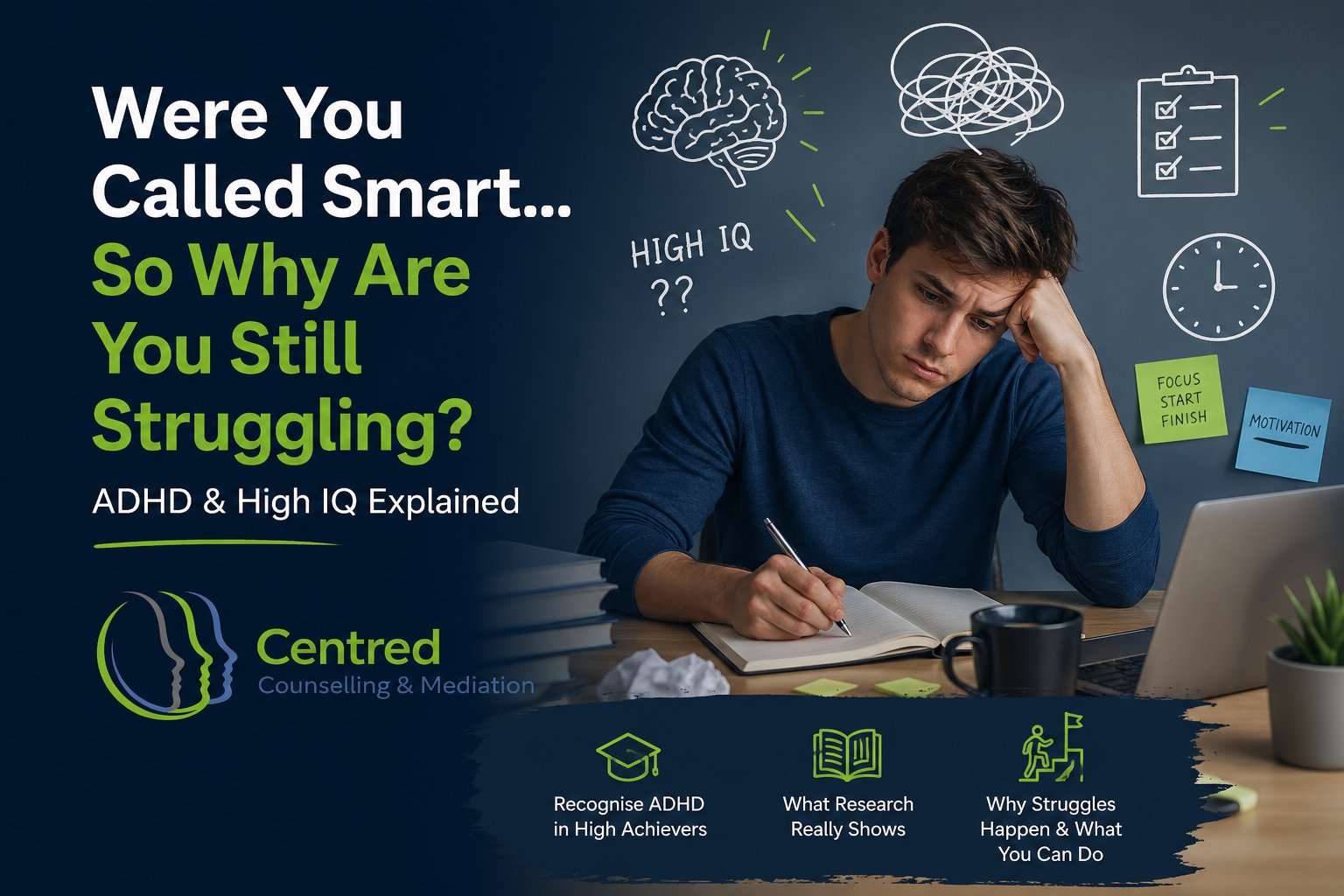
Were You Called Smart… So Why Are You Still Struggling?
ADHD & High IQ Explained
You were called smart your whole life… so why does everything still feel harder than it should?
This is a question many high-functioning adults quietly carry. There’s a persistent myth that ADHD only affects people who struggled at school or performed poorly academically. In reality, that assumption is not only inaccurate — it often delays diagnosis for years.
ADHD can and does exist in individuals with strong intelligence, good grades, and clear potential. In fact, those very strengths can mask the condition.
This article breaks down:
- How to recognise ADHD if you performed well academically
- What research actually shows about ADHD, IQ, and giftedness
- Why intelligent people with ADHD often struggle in the working world — and what to do about it
1. How to Recognise ADHD If You Did Well at School
One of the most damaging misconceptions is this:
“If I got good grades, I can’t have ADHD.”
That is false.
Academic success does not rule out ADHD. Many individuals perform well because they compensate — often at a significant internal cost.
Common compensatory factors include:
- High intelligence
- Strong memory
- Last-minute pressure (“panic productivity”)
- Supportive or structured environments
- Fear of failure
- Perfectionism
School environments often provide built-in scaffolding:
- Fixed timetables
- Clear expectations
- Immediate deadlines
- External accountability
For someone with ADHD, this structure can temporarily mask difficulties with executive functioning — the mental processes responsible for planning, organisation, impulse control, and sustained attention.
What ADHD may look like in a high-performing student:
- Chronic procrastination
- Leaving tasks until the last minute
- Hyperfocusing only on interesting topics
- Forgetting small but important tasks
- Frequently losing items
- Mental restlessness
- Inconsistent performance
- Needing pressure to function
- Appearing successful externally but feeling chaotic internally
Many people are coping, not thriving.
They achieve results — but expend disproportionate mental energy to do so. Over time, this becomes unsustainable.
This often spills into other areas:
- Strained relationships
- Difficulty collaborating in business or work environments
- Increased impulsivity (including higher accident risk)
These patterns tend to catch up later in life.
2. What Research Shows About ADHD, IQ, and Giftedness
Let’s clarify a key point:
ADHD and IQ are separate constructs.
- IQ measures certain cognitive abilities
- ADHD is a neurodevelopmental condition involving attention regulation, impulsivity, and executive functioning
Research shows ADHD exists across the entire IQ spectrum.
At a group level, studies suggest individuals with ADHD may score slightly lower on IQ tests (on average, around 9–10 points). However, this does not define individuals.
A significant proportion of people with ADHD score in the average to above-average range. Estimates suggest roughly 30–45% of individuals with ADHD have IQ scores above 100 (which is considered average).
What this means in practice:
- You can have ADHD and be highly intelligent
- You can be gifted and still struggle with attention and regulation
- Intelligence does not “protect” you from ADHD
There is also a concept often discussed in educational psychology called twice-exceptional — where an individual is both highly capable and has a developmental or learning difficulty such as ADHD.
Why this matters
High intelligence can mask ADHD symptoms:
- A student may grasp concepts quickly and disengage, yet still pass
- They may complete work last-minute and still achieve high marks
- They may rely on raw ability instead of structured habits
But this compensation has limits.
As life becomes more complex, demands increase:
- Greater independence
- Longer-term projects
- Multiple responsibilities
- Less external structure
This is often when people say:
“I was fine before… then everything fell apart.”
3. Why Intelligent People with ADHD Struggle in the Working World
This is where many high-ability individuals hit a wall — particularly in adulthood.
School rewards:
- Short-term performance
- Clear instructions
- External structure
- Defined deadlines
The working world rewards:
- Consistency
- Prioritisation
- Self-management
- Follow-through
- Time estimation
- Emotional regulation
- Administrative reliability
These are precisely the areas where ADHD tends to create difficulty.
Research in adults with ADHD links symptoms to:
- Occupational impairment
- Lower job stability
- Higher absenteeism
- Reduced productivity
The real-world impact
You can be highly intelligent — and still struggle to:
- Reply to emails
- Arrive on time
- Complete repetitive tasks
- Manage admin
- Maintain routines
- Start important projects
- Regulate frustration
This creates a damaging internal narrative:
“If I’m smart, why can’t I just do it?”
The issue is not intelligence.
It’s executive functioning.
A useful analogy:
A powerful engine is meaningless if the steering, brakes, and transmission don’t work properly.
Ability is not the same as self-management.
4. What You Can Do About It
If this resonates, there are practical and evidence-based steps you can take:
1. Seek a Proper Assessment
ADHD is a clinical diagnosis. It requires a comprehensive evaluation by a qualified psychologist, psychiatrist, or trained clinician.
2. Stop Using Grades as Evidence You’re “Fine”
Past academic success does not invalidate present difficulties. Many high achievers were compensating — not coping sustainably.
3. Build External Systems
ADHD brains perform better with external structure:
- Calendars and reminders
- Time blocking
- Task chunking
- Accountability systems
- Body doubling
4. Address Shame
Many intelligent adults with ADHD carry years of self-criticism.
This is not a motivation problem. It is a regulation difference.
5. Consider Treatment Options
Evidence-based approaches may include:
- Psychoeducation
- Therapy
- ADHD coaching
- Skills training
- Medication (where appropriate and prescribed)
Final Thoughts
Being smart does not cancel ADHD.
And ADHD does not cancel intelligence.
Some of the most frustrated individuals are not those with low ability — but those with high potential and no explanation for why life feels harder than it should.
If you were called smart your whole life… but you’re still struggling, it may be time to stop blaming yourself — and start understanding how your brain actually works.
Ready to Take the Next Step?
If this resonates with you, professional guidance can make a meaningful difference.
Centred Counselling offers support for ADHD, emotional regulation, and personal development.
📞 +27 84 485 3541
🌐 https://www.centredcounselling.co.za/
You don’t need to keep pushing through confusion and frustration alone.