Scientists Are Teaching The Brain To “See” Again: Inside Australia’s Bionic Vision Breakthrough
- What Australia’s “bionic eye” technology actually is
- How artificial vision systems work
- What researchers have successfully achieved so far
- What blind patients may realistically experience using this technology
- Why this research is considered a major medical breakthrough
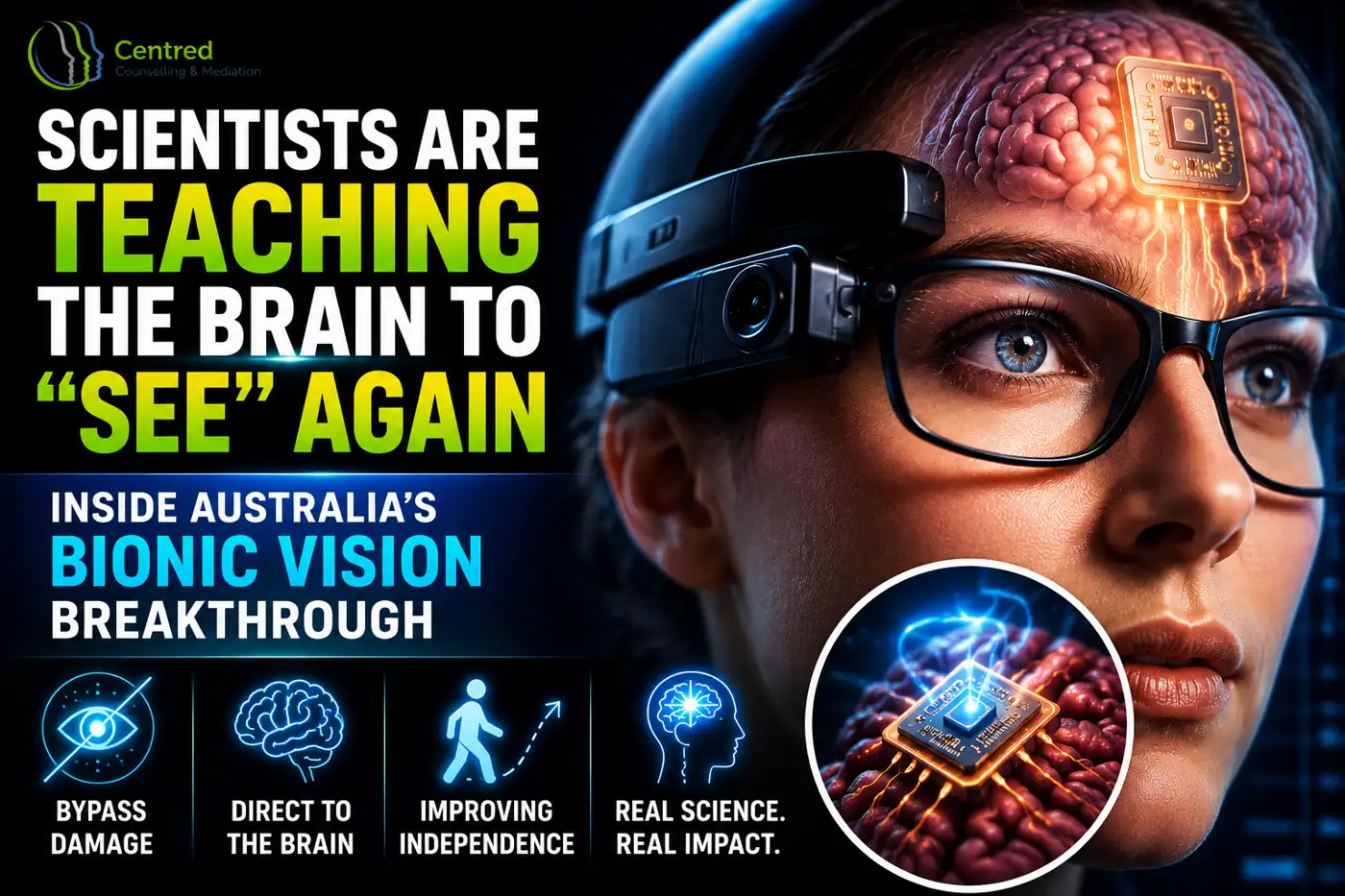
Australian researchers are making major advances in artificial vision technology through the development of highly sophisticated “bionic vision” systems designed to help people living with severe blindness. One of the most well-known projects is the Gennaris Bionic Vision System, developed by researchers at Monash University in Australia.
Unlike what many people imagine, this is not a robotic replacement eyeball. Instead, it is a highly advanced brain-computer interface designed to deliver visual information directly to the brain itself.
How the Technology Works
The system works using a combination of wearable cameras, wireless transmitters, image-processing software, and implants positioned on the visual cortex — the region of the brain responsible for processing visual information.
- A camera mounted on specialised headgear captures visual information from the environment.
- That information is then simplified into electrical signals which are wirelessly transmitted to implants in the brain.
This allows the technology to bypass damaged eyes, retinas, or optic nerves and communicate directly with the brain’s visual processing centres.
What Patients Realistically Experience
Current bionic vision systems do not recreate natural human eyesight. Instead, researchers are aiming to provide functional artificial vision that may improve a person’s ability to navigate and interact with their environment.
Some patients involved in artificial vision research have demonstrated the ability to:
- Detect movement
- Recognise large shapes
- Identify obstacles
- Improve their spatial awareness
Researchers often describe the experience as seeing flashes or patterns of light known as “phosphenes,” which the brain gradually learns to interpret over time.
Even partial visual perception may significantly improve independence and quality of life for individuals living with profound blindness. For many people, being able to detect doorways, movement, or nearby objects could dramatically improve navigation, confidence, and daily functioning. While the technology remains under active development, the progress already achieved represents an extraordinary milestone in neuroscience and biomedical engineering.
Why It Is a Major Medical Breakthrough
Artificial vision is considered one of the most difficult challenges in modern medicine because the human visual system is incredibly complex. Researchers must solve problems involving:
- Neural stimulation
- Wireless communication
- Implant safety
- Long-term compatibility with brain tissue
- The interpretation of visual signals by the brain
The fact that scientists can successfully generate meaningful visual perception through direct brain stimulation is a remarkable scientific achievement.
This field of research sits at the intersection of neuroscience, medicine, artificial intelligence, and neuroprosthetic engineering. Researchers hope future versions of these systems may improve visual resolution, object recognition, environmental navigation, and AI-assisted interpretation systems that could help users better understand their surroundings. Although the technology is still evolving, it demonstrates how rapidly neuroscience and brain-computer interface technology are advancing.
The Human Impact
Blindness and severe visual impairment can profoundly affect emotional wellbeing, independence, employment, confidence, and daily life. Technologies designed to restore even limited visual perception may therefore have important psychological and practical benefits for many individuals. For people living with vision loss, advances like these represent far more than technology — they represent greater independence, mobility, and connection to the world around them.
Centred Counselling
At Centred Counselling, we believe understanding advances in neuroscience, mental health, and human wellbeing helps people navigate a rapidly changing world with greater clarity and balance.
If you are navigating stress, adjustment to illness, neurodivergence, anxiety, or emotional challenges, support is available.
- 📞 +27 84 485 3541
- 🌐 https://www.centredcounselling.co.za/
Follow Centred Counselling:
- TikTok: www.tiktok.com/@centred.counselli
- YouTube: https://www.youtube.com/@CentredCounselling
- Instagram: https://www.instagram.com/centred_counselling
- Facebook: https://www.facebook.com/share/1AtmNzrAEo/?mibextid=wwXIfr
- Pinterest: https://pin.it/i0CksW39W
- Threads: https://www.threads.com/@centred_counselling