---
title: "Polyamory and Open Relationships: Building Healthy Relationships | Centred Counselling"
description: Learn how polyamory and open relationships work, including consent, communication, boundaries, jealousy, safer sex and when relationship counselling may help.
image: https://www.centredcounselling.co.za/hubfs/Polyamory_Open_Relationships_Blog_Image_Under_100KB.webp
---
1332 Naivasha Road, Sunninghill
[info@centredcounselling.co.za](mailto:info@centredcounselling.co.za)
[084 485 3541](https://wa.me/27844853541)
[](https://www.centredcounselling.co.za/)
- [Home](https://www.centredcounselling.co.za)
- [About Me](https://www.centredcounselling.co.za/about-me)
- [Articles](https://www.centredcounselling.co.za/article)
- [Counselling](https://www.centredcounselling.co.za/counselling)
- [All Counselling Services](https://www.centredcounselling.co.za/counselling)
- [ADHD Counselling](https://www.centredcounselling.co.za/adhd-counselling-sunninghill)
- [Anger Management](https://www.centredcounselling.co.za/anger-management-sunninghill)
- [Chronic Pain Counselling](https://www.centredcounselling.co.za/chronic-pain-counselling-centred-counselling)
- [Grief Counselling](https://www.centredcounselling.co.za/grief-counselling-sunninghill)
- [LGBTQ+](https://www.centredcounselling.co.za/lgbtq-counselling-in-sandton-centred-counselling-mediation)
- [Marriage Counselling](https://www.centredcounselling.co.za/marriage-counselling-in-sunninghill-sandton-centred-counselling)
- [Porn Addiction](https://www.centredcounselling.co.za/porn-addiction-counselling-in-sandton-centred-counselling)
- [Premarital Counselling](https://www.centredcounselling.co.za/premarital-counselling-in-sunninghill-sandton-centred-counselling)
- [Relationship Counselling](https://www.centredcounselling.co.za/relationship-counselling-in-sunninghill-centred-counselling)
- [Mediation](https://www.centredcounselling.co.za/mediation)
- [Video Resources](https://www.centredcounselling.co.za/mental-health-vlogs-video-resources)
- [Contact](https://www.centredcounselling.co.za/contact-us)
- [Book NOW](https://www.centredcounselling.co.za/booking)
[BOOK NOW](https://www.centredcounselling.co.za/booking) [WHATSAPP US](https://wa.me/27844853541)
[LGBTQ+](https://www.centredcounselling.co.za/centred-counselling-blog/tag/lgbtq)
# Polyamory and Open Relationships: Building Healthy Relationships | Centred Counselling

Byron Werbeloff
Author
Oct 22, 2026, 4:40:41 AM
**Gender Transition email moved to Checked off.**
**Next: Polyamory and Open Relationships — 9 October 2026**
**Page title:** Polyamory and Open Relationships: Building Healthy Relationships | Centred Counselling
**Meta description:** Learn how polyamory and open relationships work, including consent, communication, boundaries, jealousy, safer sex and when relationship counselling may help.
\[Download the supplied image\](C:/Users/cash/OneDrive/Desktop/webtemlates/centeredcounseling/blogs/Polyamory\_Open\_Relationships\_Blog\_Image\_Under\_100KB.webp)
---
# From the Counsellor’s Chair
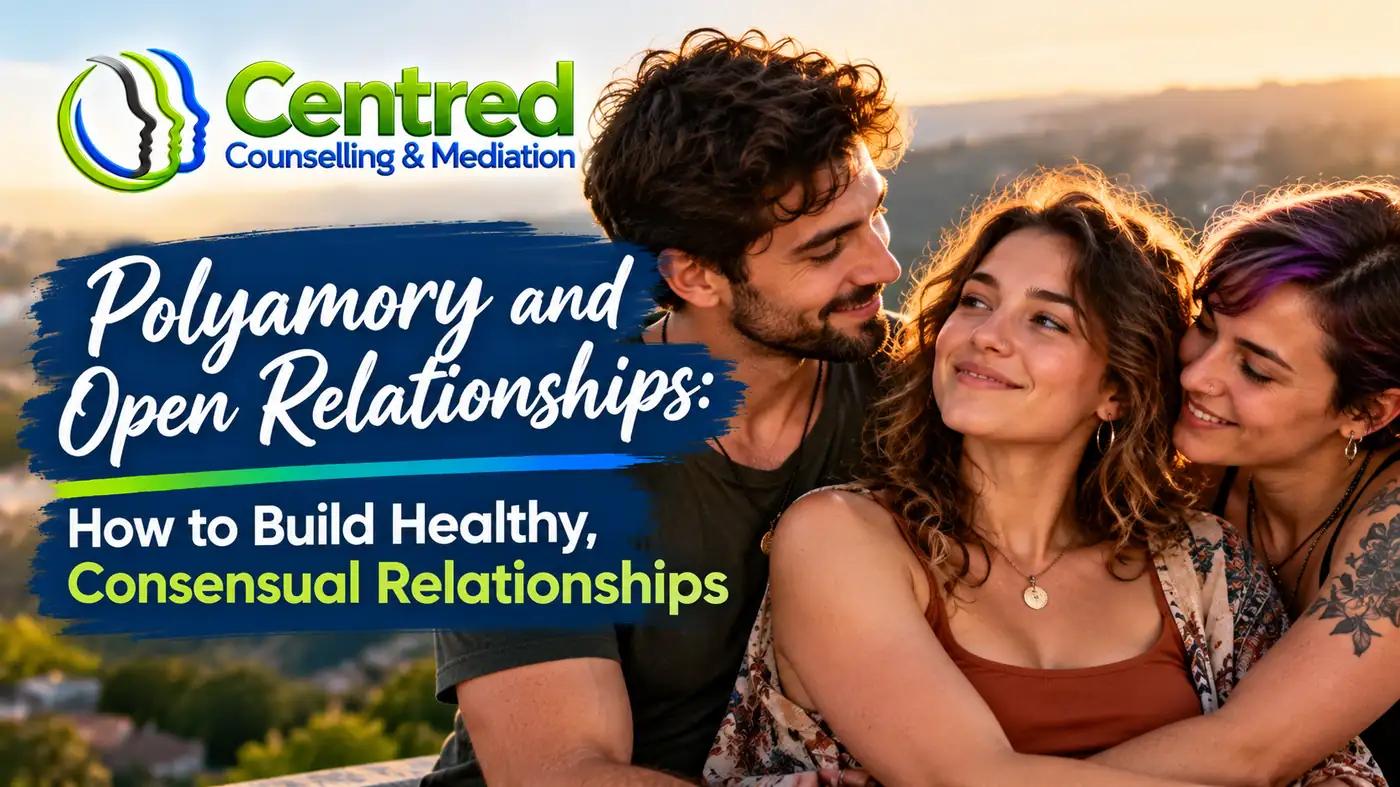
## Polyamory and Open Relationships: How to Build Healthy, Consensual Relationships
Relationships do not all follow the same structure. Some people choose a mutually agreed monogamous relationship, while others build relationships that allow romantic or sexual connections with more than one person. These arrangements are sometimes described as consensual non-monogamy. When they are based on honesty, freely given consent and clear agreements, they are different from secretly breaking an agreement or having an affair.
Polyamory and open relationships can work well for some people, but they are not automatically easier or more difficult than monogamous relationships. They require communication, self-awareness, respect and ongoing attention to everyone’s boundaries. No relationship structure suits everyone, and nobody should feel pressured to accept one to keep a partner.
### What Is the Difference Between Polyamory and an Open Relationship?
Polyamory generally refers to the possibility of having more than one romantic or loving relationship at the same time, with the knowledge and consent of the people involved. An open relationship often refers to a relationship in which partners agree that sexual connections outside the relationship are permitted; the exact meaning varies between couples. Some people use these terms differently, so it is important to discuss what each person means rather than assume everyone shares the same definition.
Consensual non-monogamy is a broader term that can include polyamory, open relationships and other mutually agreed arrangements. These are relationship structures, not sexual orientations, and they are not exclusive to LGBTQ+ people. People of any sexual orientation may be monogamous or consensually non-monogamous.
### Consent Is What Separates an Agreement From Betrayal
The central feature of consensual non-monogamy is informed, freely given and ongoing consent. Everyone affected should understand the arrangement and have a genuine opportunity to agree, ask questions or say no without threats, manipulation or punishment.
If a person agrees only because they fear being abandoned, financially harmed or emotionally punished, the situation may not reflect free choice. Likewise, opening a relationship does not automatically repair an existing breach of trust. If one partner has already been unfaithful, the couple may need to address honesty, accountability and the original agreement before considering any new arrangement.
Consent can also change. People can revisit agreements, ask for clarification or decide that an arrangement no longer works for them. A partner’s previous agreement does not mean they have permanently waived the right to set boundaries.
### Start With Honest Conversations—not Assumptions
Before making changes, partners should talk about what they want, what they are worried about and what the arrangement would mean in everyday life. These conversations are more useful when they happen before anyone acts, rather than after a boundary has been crossed.
- What does each of us mean by an open relationship or polyamory?
- Are we both genuinely interested, or is one person agreeing mainly to avoid losing the relationship?
- What kinds of connections are acceptable, and what would feel uncomfortable or out of bounds?
- What information do we want to share about other partners, and what privacy is appropriate for everyone involved?
- How will we discuss safer sex, testing, contraception where relevant, and changes in risk?
- How will we protect time for our relationship, family responsibilities, work and rest?
- What will we do if one of us changes their mind or an agreement stops working?
### Set Boundaries and Agreements That Are Specific
Vague expectations are a common source of conflict. Instead of assuming that both people know what “being open” means, discuss practical agreements. Some couples agree to disclose new connections before sexual contact; others discuss how much detail they want to know. Some establish limits around time, shared spaces or introductions to family. The details will differ, but the agreement should be clear enough that everyone can understand it.
Boundaries are not a way to control another person’s every move. A boundary identifies what you need, what you are comfortable participating in, and what you will do if an agreement is not respected. Agreements should also take the privacy and dignity of other partners into account, not only the original couple.
### Jealousy Is a Feeling to Understand, Not a Failure
Jealousy can occur in monogamous and non-monogamous relationships. It may point to fear of being replaced, worries about unequal attention, past betrayal, uncertainty about agreements or a need for reassurance. Feeling jealous does not automatically mean a person is unsuited to non-monogamy, but it is also not something that must be ignored or endured.
Try to identify the concern beneath the feeling. Are you worried that shared time is shrinking? Has an agreement been broken? Do you need clearer communication, reassurance or a pause to think? A partner can listen compassionately without being expected to eliminate every uncomfortable feeling. At the same time, reassurance should not be used to dismiss legitimate concerns about dishonesty or unfair treatment.
### Time, Attention and Emotional Responsibility
Multiple relationships require realistic planning. People have limited time, energy and money, and existing responsibilities do not disappear when a new relationship begins. Discuss how dates, weekends, holidays, caregiving, household tasks and financial commitments will be managed. Avoid making promises that cannot realistically be kept.
It is also important to remember that every person involved has feelings and boundaries. New partners should not be treated as disposable or expected to accept arrangements they were never told about. Likewise, an established partner should not be expected to hide distress or accept repeated changes without discussion. Fairness does not always mean identical treatment; it means taking each person’s needs and agreements seriously.
### Safer Sex, Health and Privacy
People who have sexual connections with multiple partners should have honest conversations about sexual health, including testing, barriers, contraception where relevant, and any changes that may affect another person’s informed decisions. The appropriate plan depends on the people and activities involved, so consult a qualified healthcare professional for individual advice.
Privacy matters too. Do not share intimate details, photographs or identifying information about another partner without permission. Be clear about what can be shared with friends, family or online. Consent to a relationship arrangement is not consent to have private information disclosed.
### When One Partner Wants Non-Monogamy and the Other Does Not
A difference in relationship preferences can be painful. One partner may feel curious or strongly drawn to non-monogamy, while the other may want a monogamous commitment. Neither person should be shamed for their preference, but neither should be pressured into an arrangement they do not want.
The conversation needs to explore whether there is a genuinely acceptable option for both people. Sometimes partners agree to remain monogamous; sometimes they choose a consensual change; and sometimes they recognise a fundamental incompatibility. There is no guarantee that a relationship can be preserved without one person compromising an important boundary. Honest incompatibility is preferable to coercion or repeated betrayal.
### Warning Signs That the Arrangement May Not Be Healthy
- One person is pressured, threatened or guilted into agreeing.
- Agreements are repeatedly broken or deliberately kept vague.
- A partner uses “openness” to excuse dishonesty or avoid accountability.
- One person’s needs and boundaries are routinely dismissed.
- There is persistent secrecy about information the partners agreed to disclose.
- A person is isolated from support or punished for raising concerns.
- Sexual health risks are concealed or agreements about safer sex are ignored.
These signs do not mean every non-monogamous relationship is unhealthy. They indicate that consent, trust, communication or safety may need serious attention. If there is coercion, intimidation or abuse, prioritise safety and seek appropriate support rather than treating the issue as an ordinary disagreement.
### Can Counselling Help?
Relationship counselling can help partners clarify what they want, discuss jealousy, rebuild communication, review agreements and decide whether their preferred relationship structures are compatible. Counselling may also support people who are questioning what works for them, or who are trying to recover after an agreement has been broken.
A counsellor should not assume that monogamy is inherently superior or that non-monogamy is the right choice. The goal is to support informed decisions, honest communication, respect and emotional wellbeing. If one partner is being coerced or feels unsafe, the approach should take that power imbalance seriously.
### A Healthy Relationship Is Built on Honesty and Choice
Polyamory and open relationships are not a shortcut to fixing a relationship, and they are not inherently a sign that a relationship is failing. Like monogamous relationships, they rely on trust, communication, accountability and mutual respect. The structure matters less than whether the people involved can make free choices and honour their agreements.
If you and your partner are discussing consensual non-monogamy, you do not need to make a decision quickly. Take time to talk, ask difficult questions and consider the impact on everyone involved. You are entitled to say yes, no or not now.
Centred Counselling & Mediation offers counselling in Sunninghill, Sandton, and online. If you would like support discussing relationship expectations, boundaries, jealousy or compatibility, contact the practice to explore whether counselling may be appropriate for your circumstances.
### Frequently Asked Questions
#### Is polyamory the same as an open relationship?
Not necessarily. Polyamory usually includes the possibility of multiple romantic relationships, while an open relationship often refers to agreed sexual connections outside a primary relationship. People use the terms differently, so clarify what they mean to each partner.
#### Is consensual non-monogamy the same as cheating?
No. Consensual non-monogamy depends on informed agreement and ongoing consent. Cheating generally involves breaking or concealing a relationship agreement.
#### Can an open relationship work if one partner is unsure?
Uncertainty deserves honest discussion, not pressure. If one partner agrees mainly out of fear of losing the relationship, it is important to slow down and consider whether consent is genuinely free.
#### Is jealousy a sign that non-monogamy is wrong for me?
Not automatically. Jealousy can point to fears, unmet needs or broken agreements. It is worth exploring, but you should not be expected to ignore persistent distress or disrespect.
#### Do non-monogamous relationships need rules?
Partners often benefit from clear agreements about consent, safer sex, privacy, time and communication. Agreements should be mutual, specific and open to review.
#### Can counselling help us decide whether to open our relationship?
Counselling can help partners explore motivations, expectations, boundaries and compatibility without pushing them toward monogamy or non-monogamy.
**Tagged with:** [LGBTQ+](https://www.centredcounselling.co.za/centred-counselling-blog/tag/lgbtq)

#### Byron Werbeloff
KEEP READING
## Related Articles
[](https://www.centredcounselling.co.za/centred-counselling-blog/lgbtq-relationships-rejection-family-pressure-and-conflict-centred-counselling)
Oct 22, 2026, 4:45:15 AM Byron Werbeloff
### [LGBTQ+ Relationships: Rejection, Family Pressure and Conflict | Centred Counselling](https://www.centredcounselling.co.za/centred-counselling-blog/lgbtq-relationships-rejection-family-pressure-and-conflict-centred-counselling)
**Polyamory and Open Relationships email moved to Checked off.**
[READ FULL ARTICLE](https://www.centredcounselling.co.za/centred-counselling-blog/lgbtq-relationships-rejection-family-pressure-and-conflict-centred-counselling)
[](https://www.centredcounselling.co.za/centred-counselling-blog/can-a-relationship-survive-infidelity-centred-counselling)
May 7, 2026, 1:53:03 AM Byron Werbeloff
### [Can a Relationship Survive Infidelity? | Centred Counselling](https://www.centredcounselling.co.za/centred-counselling-blog/can-a-relationship-survive-infidelity-centred-counselling)
## **Can a Relationship Survive Infidelity? What To Do After Cheating Happens**
Few experiences in a relationship are as painful and destabilising...
[READ FULL ARTICLE](https://www.centredcounselling.co.za/centred-counselling-blog/can-a-relationship-survive-infidelity-centred-counselling)
[](https://www.centredcounselling.co.za/centred-counselling-blog/porn-addiction-and-relationships-centred-counselling)
Oct 22, 2026, 4:05:29 AM Byron Werbeloff
### [Porn Addiction and Relationships | Centred Counselling](https://www.centredcounselling.co.za/centred-counselling-blog/porn-addiction-and-relationships-centred-counselling)
Previous email moved to **Checked off**.
[READ FULL ARTICLE](https://www.centredcounselling.co.za/centred-counselling-blog/porn-addiction-and-relationships-centred-counselling)
Empowering individuals and couples through evidence-based counselling and mediation. Registered ASCHP professional (WC24/9024).
Quick Links
- [Home](https://www.centredcounselling.co.za)
- [About Me](https://www.centredcounselling.co.za/about-me)
- [Articles](https://www.centredcounselling.co.za/article)
- [Counselling](https://www.centredcounselling.co.za/counselling)
- [Mediation](https://www.centredcounselling.co.za/mediation)
- [Video Resources](https://www.centredcounselling.co.za/mental-health-vlogs-video-resources)
- [Contact](https://www.centredcounselling.co.za/contact-us)
- [Book NOW](https://www.centredcounselling.co.za/booking)
Resources
- [FAQ](https://www.centredcounselling.co.za/counselling#faq)
- [FAQ Mediation](https://www.centredcounselling.co.za/mediation#faq)
- [Downloads](https://www.centredcounselling.co.za/article#resources)
- [Cookie Policy](https://www.centredcounselling.co.za/terms-conditions-policies#cookies)
- [Privacy Policy](https://www.centredcounselling.co.za/terms-conditions-policies#privacy)
- [Terms and Conditions](https://www.centredcounselling.co.za/terms-conditions-policies#terms)
Get in Touch
Call Us [084 485 3541](tel:0844853541)
WhatsApp [Chat with us](https://wa.me/27844853541)
Email Us [info@centredcounselling.co.za](mailto:info@centredcounselling.co.za)
© 2026 Centred Counselling & Mediation. All rights reserved.
[Design by SEO Website Design](https://www.seowebsitedesign.co.za)
[Chat with us](https://wa.me/27844853541)
```json
{
"@context" : "https://schema.org",
"@type" : "BlogPosting",
"author" : {
"@type" : "Person",
"name" : "Byron Werbeloff",
"url" : "https://www.centredcounselling.co.za/centred-counselling-blog/author/byron-werbeloff"
},
"dateModified" : "2026-10-22T08:43:01.662Z",
"datePublished" : "2026-10-22T08:40:41.000Z",
"headline" : "Polyamory and Open Relationships: Building Healthy Relationships | Centred Counselling",
"image" : [ "https://www.centredcounselling.co.za/hubfs/Polyamory_Open_Relationships_Blog_Image_Under_100KB.webp" ],
"mainEntityOfPage" : {
"@id" : "https://www.centredcounselling.co.za/centred-counselling-blog/polyamory-and-open-relationships-building-healthy-relationships-centred-counselling",
"@type" : "WebPage"
},
"publisher" : {
"@type" : "Organization",
"logo" : {
"@type" : "ImageObject",
"url" : "https://www.centredcounselling.co.za/hubfs/logo.jpeg"
},
"name" : "Centred Counselling"
}
}
```
```json
{
"@context": "https://schema.org",
"@type": "LocalBusiness",
"name": "Centred Counselling & Mediation",
"image": "https://www.centredcounselling.co.za/hubfs/logo1.png",
"@id": "https://www.centredcounselling.co.za",
"url": "https://www.centredcounselling.co.za",
"telephone": "0844853541",
"email": "info@centredcounselling.co.za",
"address": {
"@type": "PostalAddress",
"streetAddress": "153A 9th Avenue",
"addressLocality": "Highlands North",
"addressRegion": "Johannesburg",
"postalCode": "2192",
"addressCountry": "ZA"
},
"geo": {
"@type": "GeoCoordinates",
"latitude": -26.1368,
"longitude": 28.0841
},
"openingHoursSpecification": {
"@type": "OpeningHoursSpecification",
"dayOfWeek": [
"Monday",
"Tuesday",
"Wednesday",
"Thursday",
"Friday"
],
"opens": "08:00",
"closes": "18:00"
},
"sameAs": [
"https://www.facebook.com/profile.php?id=61573738539849",
"https://www.instagram.com/centred_counselling/",
"https://www.linkedin.com/in/byron-werbeloff-475bb251/",
"https://www.tiktok.com/@centred.counselli"
],
"founder": {
"@type": "Person",
"name": "Byron Werbeloff",
}
}
```